



Using AI for a literature review means giving a generative AI tool specific tasks, such as suggesting search terms, explaining unfamiliar concepts, or grouping your notes, and then checking what it gives you against the original papers. AI can save you real time, but it can also return a reference that doesn't exist or a summary that claims more than the study found. Neither is obvious at a glance.
In this guide, you'll learn how to:
- Use AI to widen your search vocabulary
- Confirm that a reference from AI is real and correctly described
- Compare an AI summary with what a study actually supports
- Follow a paper's citation trail to find evidence a summary left out
- Turn your notes into themes that reflect the evidence accurately
You'll follow one research question throughout, using real papers checked against their original sources. For a comparison of AI tools, see the best AI tools for literature review. For where AI fits at each stage of a review, see a modern workflow for smarter literature reviews.
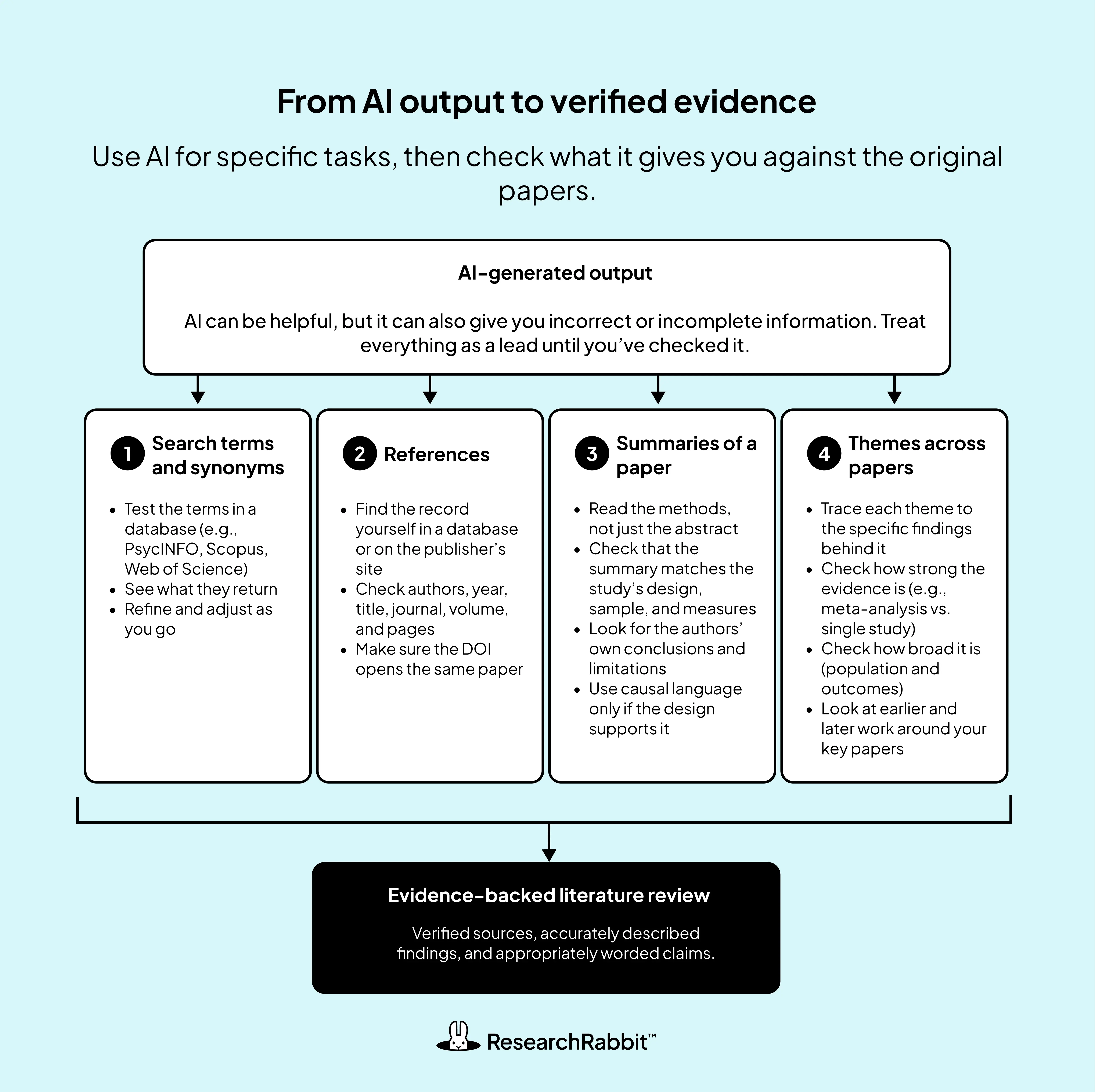
What AI gives you, and how to check each kind of output
AI output in a literature review usually comes in four forms, and each one needs a different check.
The example: social media and academic performance
The question for this guide is How is social media use associated with undergraduate students' academic performance?
The phrase "associated with" matters. Most studies on this topic measure social media use and grades at the same time, which can show that the two go together but not that one causes the other. Using that wording from the start makes it easier to notice when an AI summary turns a link into a cause.
The starting paper is a 2010 study in Computers in Human Behavior by Paul Kirschner and Aryn Karpinski, which found that Facebook users reported lower grades than non-users [1]. An earlier version of these findings circulated in 2009 and drew wide media attention, and later studies tested and complicated the result. That gives you a clear claim to check and a body of later work to compare it with.
Step 1: Use AI to expand your search terms, then test them
AI is good at suggesting vocabulary you might not think of, and this is one of its lower-risk uses because you test every term yourself. A prompt like this works well:
I'm starting a literature review on how social media use is associated with undergraduate students' academic performance. List alternative terms researchers use for "social media use" and for "academic performance," grouped by concept. Don't include any references.
Asking for no references keeps the output to vocabulary, which is what you can check most easily. You might get terms such as "social networking sites," "Facebook use," and "media multitasking," alongside "GPA," "grades," and "academic achievement."
Then run the terms in a database, for example:
("social media" OR "social networking sites" OR Facebook) AND ("academic performance" OR "academic achievement" OR GPA OR grades) AND (undergraduate* OR "college students")
Look at what each term returns and refine as you go. A term that turns up few relevant results at first may work better in a different combination, with a filter, or in another database, so adjust it before setting it aside. As a quick benchmark, a 2018 meta-analysis by Caroline Marker, Timo Gnambs, and Markus Appel searched PsycINFO and ERIC with terms including "Facebook," "social network sites," "GPA," and "grades," so the overlap is a good sign [2]. For building a full search strategy, see how to do a literature review.
Step 2: Check that every AI-suggested reference is real and accurate
Treat every reference from a chatbot as unconfirmed until you've found the record yourself. In a 2023 study in Scientific Reports, William Walters and Esther Isabelle Wilder checked 636 references from short literature reviews written by two versions of ChatGPT. Depending on the version, 18% to 55% of the references were fabricated, and many of the real ones contained errors [3].
Newer models haven't eliminated the problem. A 2025 study in JMIR Mental Health by Jake Linardon and colleagues found that about one in five references from GPT-4o didn't exist, with rates that varied by topic and by how specific the prompt was [4]. Exact rates depend on the model and the task, so treat these as evidence of a pattern rather than a figure for every tool.
Walters and Wilder's findings also show what to look for:
- Fabricated references look plausible. Most of the fabricated articles named real journals.
- Numbers are the weakest part. In real references, wrong years, volumes, and page numbers were the most common errors.
- Don't rely on a chatbot to verify its own references. Earlier studies cited by Walters and Wilder found that ChatGPT often gave wrong answers when asked whether a citation was real.
What a garbled reference looks like
Illustrative example, not real AI output. This reference was constructed for this guide to show the error types those studies describe.
Kirschner, P. A., & Karpinski, A. C. (2012). Facebook use and academic achievement in undergraduate students. Journal of Educational Psychology, 104(3), 512–520.
The authors are real, which is what makes it convincing. Here's how it compares with the verified record:
How to check a reference
- Search the exact title in Google Scholar or your library's database. The illustrative title above returns no match.
- Search the authors with a few key words, such as "Kirschner Karpinski Facebook." This surfaces the real 2010 paper.
- Compare every element with the publisher's page: authors, year, title, journal, volume, and pages. Pay most attention to the numbers.
- Resolve the DOI at doi.org and confirm it opens the same paper.
If none of these turns up a record, treat the reference as fabricated and leave it out. If you find a real paper with different details, cite the verified record, then check the claim attached to it.
Step 3: Check an AI summary against the paper
A real reference can still come with a summary that says more than the study found. To check it, compare the summary with the paper's methods and the authors' own conclusions, not just the abstract.
Illustrative example, not real AI output. This summary was written for this guide to show common problems.
Kirschner and Karpinski (2010) found that using Facebook lowers undergraduate students' GPAs. Because Facebook users study fewer hours, the study shows that social media use damages academic performance.
It reads smoothly and cites a real paper. Here's what the published study actually supports [1]:
The sample breakdown is in the methods section and the limits on causation are in the discussion, so a summary built from the abstract can easily miss both.
Five things to check in any summary
- Design: Is it an experiment, a survey, or a meta-analysis? Only some designs support cause-and-effect language.
- Sample: Who was studied, how many, and where? Does that match your question?
- Measures: How were the key variables measured? Self-reports and records can tell different stories.
- Hedges: Has "was associated with" become "causes," or "may" become "does"?
- Limitations: What do the authors say their study can't show?
Watch for cause-and-effect wording
Words like "lowers," "damages," "improves," and "leads to" all claim a cause. If a study measured two things at the same point in time, expect wording such as "was associated with" instead. In this example, the authors say it directly: their data are correlational, so they can't say Facebook use causes lower grades or less study time. For a fuller approach to reading studies critically, see how to evaluate a research paper.
Step 4: Follow the paper's citation trail to find what the summary left out
One checked paper tells you what one study found. To see how that finding held up, look at the work around it: what it responded to and what later tested it. Citation discovery is a direct way to find that work.
Explore references and citations in ResearchRabbit
In ResearchRabbit, add the paper you've checked as a seed by searching for its title or DOI. Then:
- References shows the papers your seed cites.
- Citations shows the later papers that cite your seed.
- Similar draws on citation and other research connections to your seed, such as shared references and authors, and gives particular weight to papers often cited alongside it. This can surface related work that uses different terminology.
ResearchRabbit finds these papers through citation and authorship connections, and it complements the database searches from Step 1. It doesn't evaluate the papers or check whether an AI summary is accurate. It gives you connected papers to read and judge yourself.
What the surrounding research shows
Reading the work connected to this paper changes the picture considerably.
- An earlier test of the same claim. The 2010 paper's reference list includes a 2009 study by Josh Pasek, eian more, and Eszter Hargittai, written in response to the earlier version of Kirschner and Karpinski's findings [5]. Using three other datasets, including a nationally representative sample of US 14- to 22-year-olds, they found no robust negative relationship between Facebook use and grades. The 2010 paper then re-analyzed its original data and discusses their study.
- A meta-analysis that measured use differently. The Marker meta-analysis from Step 1 pooled 59 samples. Rather than comparing users with non-users, it looked at how students used social networking sites. It found small associations in both directions: slightly lower grades with general use and with multitasking, and slightly higher grades with school-related use. The 2010 study found that Facebook users reported fewer study hours, but the meta-analysis found no association between general use and time spent studying. The authors note that the pooled studies were cross-sectional, so the results can't show cause.
- A meta-analysis from the original authors. A 2017 meta-analysis led by Dong Liu, with Kirschner and Karpinski as co-authors, reported a small negative relationship overall, with results that differed depending on how academic performance was measured [6].
A paper that cites your seed isn't necessarily agreeing with it or using it as evidence. Marker and colleagues cite the 2010 study, but because they excluded comparisons of users and non-users, its result isn't part of their pooled estimates. You'll only know how a paper uses a citation by reading it. For more on working outward from a seed paper, see backward vs. forward citation search and how to make sure your literature review doesn't miss important papers.
Flagging article-level risks with Signals (RR+)
If you use RR+ (ResearchRabbit+), Signals indicators add another layer as you explore. ResearchRabbit partners with Signals to show a badge on each article flagging potential issues such as retractions, suspicious citation patterns, or AI-generated content. Each badge shows one of four statuses: No major risks found, Caution, Alert, or Unable to check. Clicking a badge lists the risks found, and View Report in Signals opens the full breakdown (a free Signals account is needed for that).
A badge is a prompt to look more closely at the article itself. It doesn't check whether an AI summary represents the paper accurately, and No major risks found doesn't mean a study's design supports the claim you want to make. The checks in Step 3 still apply to every paper you rely on.
Step 5: Let AI group your notes, then trace each theme to the evidence
Once you've checked your papers, AI can help you spot patterns across your notes. Give it your own notes on papers you've verified, rather than asking it to recall the literature. For example:
Here are my notes on five papers about social media use and academic performance. Suggest three to five themes that group these findings. For each theme, list which of my notes support it.
Asking the tool to point back to your notes makes the next check faster.
Check each theme against the evidence behind it
For each theme, trace it back to the specific findings that support it, then check that the wording matches what those findings show. Two questions help. How strong is the support: a meta-analysis of many samples, or a single survey at one university? How broad is it: does it cover the population and outcomes the theme claims? Your wording should carry both.
In this example:
- What students do on social media matters. This rests on the Marker meta-analysis, which separated general use, multitasking, and school-related use. Every association it found was small, so the theme should describe a modest difference.
- How performance is measured changes the picture. In the same meta-analysis, studies using self-reported grades showed a small negative association, while studies using school records showed no significant association. Liu and colleagues also reported results that differed by how performance was measured.
- The evidence is mostly correlational. Kirschner and Karpinski say so directly, and the Marker meta-analysis notes that its pooled studies were cross-sectional.
Illustrative example, not real AI output. Suppose the tool also suggests this theme: "Social media use harms academic performance across all age groups." The evidence doesn't support it. Marker and colleagues found a negative association among undergraduates but not among adolescents, and none of these studies can show harm as a cause.
Catching overreach here keeps it out of your writing. The synthesis itself, deciding what the evidence means and how to frame it, is your work.
Keep a record of how you used AI
A short log of your AI use protects you later, when a supervisor asks how you found a source or a journal asks you to disclose your methods. Note the tool, the date, the task, and what you checked. For example: "Used [tool] on [date] to suggest search synonyms; tested and refined the terms in PsycINFO."
Rules on AI use vary between institutions, courses, and journals, so check the policy that applies to your work. For journal publishing, the Committee on Publication Ethics position on AI tools says authors must disclose how they used AI and remain fully responsible for the content [7].
A quick checklist before you rely on AI output
Use this list each time AI gives you something you plan to keep.
References
- I found the record myself in a database or on the publisher's site.
- The authors, year, title, journal, volume, and pages all match.
- The DOI opens the same paper.
Summaries
- I've read the methods, not just the abstract.
- The summary matches the study's design, sample, and measures.
- Cause-and-effect wording appears only where the design supports it.
- The authors' stated limitations are reflected.
Themes and claims
- I can trace each theme to the specific findings behind it.
- The wording reflects how strong and how broad that support is.
- I've looked at earlier and later work around my key papers.
Records
- I've noted which tool I used, for what, and what I checked.
- I've checked the AI policy that applies to my work.
Key takeaway
Treat anything AI gives you as a lead until you've traced it back to a paper. A reference is confirmed when you've found the record. A summary becomes more reliable once you've compared it with the methods and the authors' conclusions, though no single check guarantees it's complete. A theme is well supported when you can point to the findings behind it and your wording matches how strong they are.
In the example, that tracing turned one widely reported claim into a more accurate picture: small associations that depend on what students do online and how grades are measured, with no basis in these studies for claiming cause.
FAQ
Are AI literature review generators reliable?
Treat their output as a draft of leads rather than a finished review. The same checks apply: find the record for each reference yourself, compare each summary with the paper, and trace each theme to the findings behind it. The synthesis that makes a review worth reading still depends on your judgment.
Can I use AI in a systematic review?
Possibly, for some tasks, but systematic reviews require documented, reproducible searches and screening, which is a higher bar than this guide covers. Check your review protocol and any reporting guidance you're following before using AI, and record exactly how you used it. See what is a systematic review for how those requirements differ.
References
[1] Kirschner, P. A., & Karpinski, A. C. (2010). Facebook® and academic performance. Computers in Human Behavior, 26(6), 1237–1245. https://doi.org/10.1016/j.chb.2010.03.024
[2] Marker, C., Gnambs, T., & Appel, M. (2018). Active on Facebook and failing at school? Meta-analytic findings on the relationship between online social networking activities and academic achievement. Educational Psychology Review, 30, 651–677. https://doi.org/10.1007/s10648-017-9430-6
[3] Walters, W. H., & Wilder, E. I. (2023). Fabrication and errors in the bibliographic citations generated by ChatGPT. Scientific Reports, 13, Article 14045. https://doi.org/10.1038/s41598-023-41032-5
[4] Linardon, J., Jarman, H. K., McClure, Z., Anderson, C., Liu, C., & Messer, M. (2025). Influence of topic familiarity and prompt specificity on citation fabrication in mental health research using large language models: Experimental study. JMIR Mental Health, 12, e80371. https://doi.org/10.2196/80371
[5] Pasek, J., more, e., & Hargittai, E. (2009). Facebook and academic performance: Reconciling a media sensation with data. First Monday, 14(5). https://doi.org/10.5210/fm.v14i5.2498
[6] Liu, D., Kirschner, P. A., & Karpinski, A. C. (2017). A meta-analysis of the relationship of academic performance and social network site use among adolescents and young adults. Computers in Human Behavior, 77, 148–157. https://doi.org/10.1016/j.chb.2017.08.039
[7] COPE Council. (2024). COPE position: Authorship and AI tools. Committee on Publication Ethics. https://doi.org/10.24318/cCVRZBms

This is a big test comment on your article.