



We are often taught that a literature review begins and ends with a database search. But in the world of modern research,finding the right literature means balancing three distinct approaches: keyword search, natural language search, and citation-based discovery.
The best reviews don’t stick to a single path. Instead of seeing these as competing tools, think of them as your literature review ecosystem. Each one covers the others' blind spots, which gives you a much clearer, more joyful path through your review. When they work together, you spend less time worrying about what you missed and more time actually thinking about your work.
In practice, you can combine these approaches in a hybrid workflow that moves between discovery, AI-assisted exploration, and structured keyword search. Later in this guide, we walk through what this workflow can look like in practice.
The evolving landscape of literature search
For decades, Boolean keyword search dominated the literature review process. Researchers crafted Boolean queries, refined filters, and worked systematically through database results.
This approach softened a little with many databases (including Google Scholar) accepting keywords without the added step of creating Boolean queries.
Boolean search and keywords still matter. But the vastness of research and the search landscape has expanded.
- AI tools now allow researchers to ask questions in natural language and some tools provide answers synthesized by LLMs.
- Citation-based discovery tools reveal how papers connect across a field, surfacing influential work that keyword matching alone can miss.
The result is not a replacement of one method by another. It is a layered ecosystem. Understanding how each approach works is now part of doing a thorough literature review that is able to cope with the expanding volume of research.
Keyword search: your precision engine
Keyword search (sometimes called lexical search) remains the backbone of searching directly in databases like Google Scholar and many library databases. Extending this to Boolean queries is critical for systematic literature review methodology.
When you know what you are looking for, structured database queries are unmatched in precision and reproducibility.
Keyword search works especially well when you need to:
- Retrieve papers that match clearly defined criteria
- Execute transparent, repeatable search strategies
- Support systematic reviews and meta-analyses
- Narrow results using filters and Boolean logic
This precision is exactly why keyword search remains essential for defensible academic workflows.
However, keyword systems depend heavily on the terms you choose. And that dependency creates predictable blind spots.
[As database providers and academic research improve, the tool landscape is continually changing; for instance, services like OpenAlex are currently running a semantic search option as a beta test, meaning tools that once only offered keyword search may now have new capabilities.]
Where keyword search starts to break down
Keyword search is powerful, but it is not omniscient. Its effectiveness depends on how well your query language matches the language used in the literature.
You might find challenges with:
Terminology mismatch. Different research communities often describe similar concepts using different terms. If your query captures only one vocabulary, relevant work may remain hidden.
Keyword bias. Early in a project, you often do not yet know the full conceptual landscape. Starting with rigid queries can unintentionally narrow the field too soon.
Adjacent literature blindness. Important work sometimes sits just outside your defined keyword boundaries, especially in interdisciplinary areas.
Early-stage uncertainty. When your research question is still evolving, highly structured queries can feel brittle and overly restrictive.
These terminology shifts, interdisciplinary boundaries, and uneven keyword adoption mean that some relevant papers simply do not surface through even well-constructed queries. Many researchers only notice this late in the review process, when a single unexpected citation reveals an entire cluster of work that keyword search alone failed to expose. This is one reason modern literature workflows increasingly pair structured search with network-based discovery.
Keyword search is powerful but it can feel both limiting and overwhelming during the early discovery parts of a literature review. This is where combining AI-powered search and citation exploration in your workflow can help.
Natural language search: your semantic interpreter
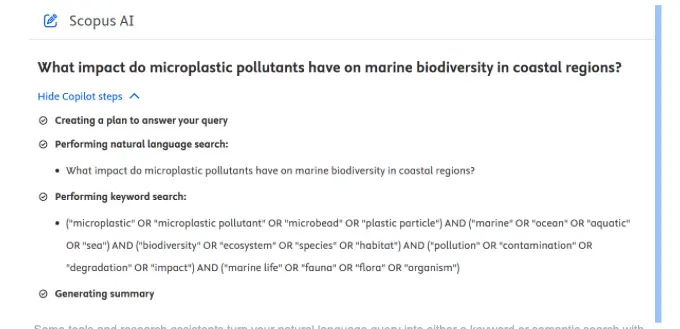
AI search tools introduce a different way to interact with your research topic. Instead of crafting Boolean strings, you can ask questions in natural language and many tools also provide synthesized responses.
This approach is particularly useful when you want to:
- Quickly orient yourself in an unfamiliar topic
- Generate high-level summaries of a field
- Translate vague questions into more concrete directions
- Explore conceptual relationships across papers
AI search tools can reduce friction in early exploration and help surface themes that may not be obvious through keyword matching alone.
At the same time, they introduce new considerations. Recent advances in LLMs have made literature exploration feel more conversational, but they have also introduced a new kind of uncertainty. Not all search boxes behave the same, even when they look identical. In many AI-driven systems, it is not always clear whether results are being retrieved through keyword matching or semantic approaches. This opacity can make it harder to predict coverage and reproducibility, especially for high-stakes academic work.
AI-tools can often work across many databases but it is worth checking which ones are included to understand the coverage for your search. LLM tools typically work best as an exploratory layer rather than a standalone evidence-gathering method. Used thoughtfully, they can accelerate understanding. Used alone, they can obscure important gaps.
Citation discovery: your network view
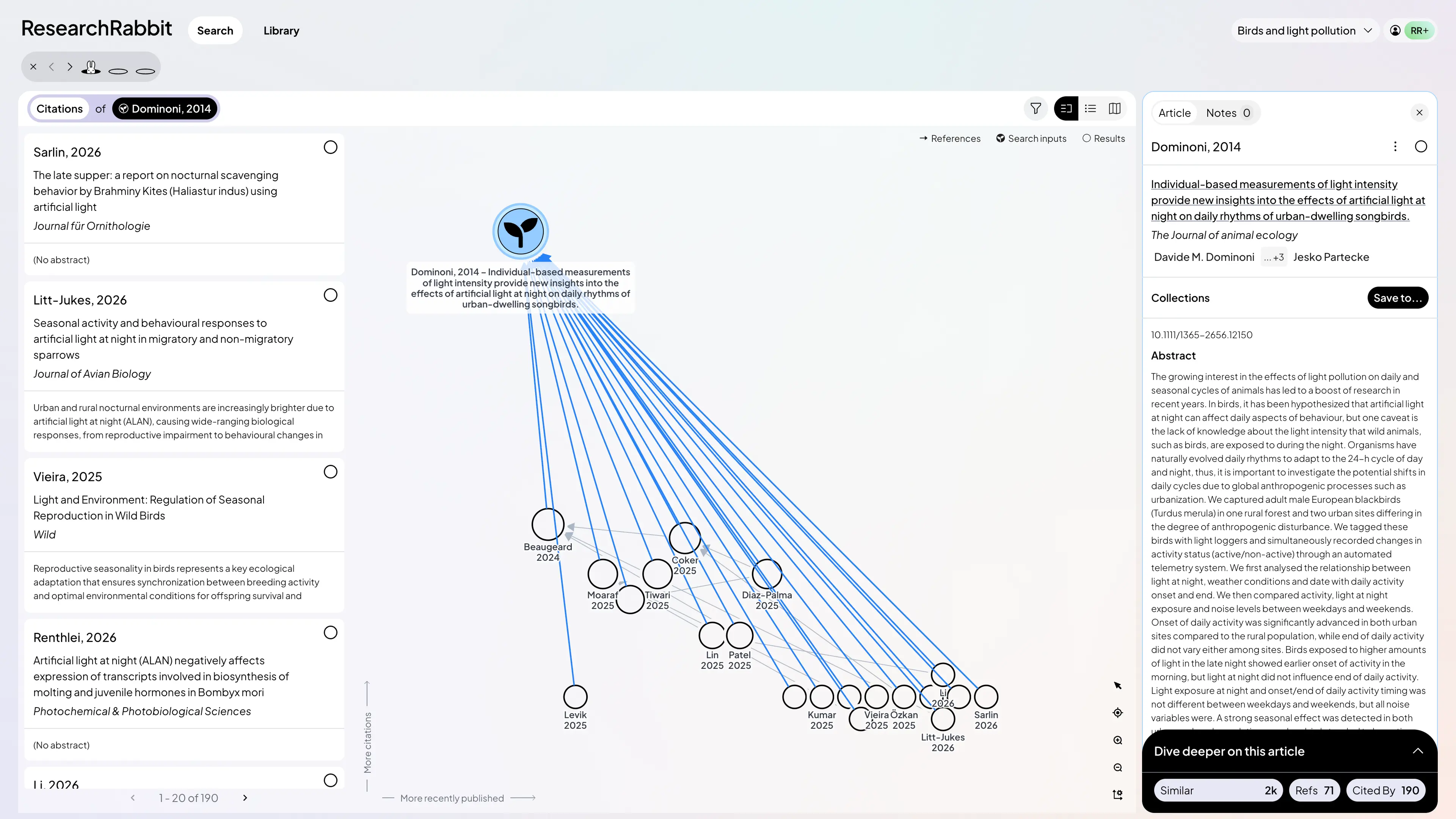
Citation-based discovery takes a fundamentally different approach. Instead of matching words, it follows relationships between papers.
Starting from one relevant seed paper, you can move outward through its references and forward citations, revealing how ideas propagate across a field. This network view often surfaces influential work that keyword searches miss, particularly when terminology varies across subfields or when important work sits just beyond predefined query boundaries.
Citation discovery is especially strong for:
- Mapping the intellectual structure of a field
- Identifying foundational and highly influential papers
- Surfacing adjacent or emerging research clusters
- Following the evolution of ideas over time
- Expanding beyond initial keyword assumptions
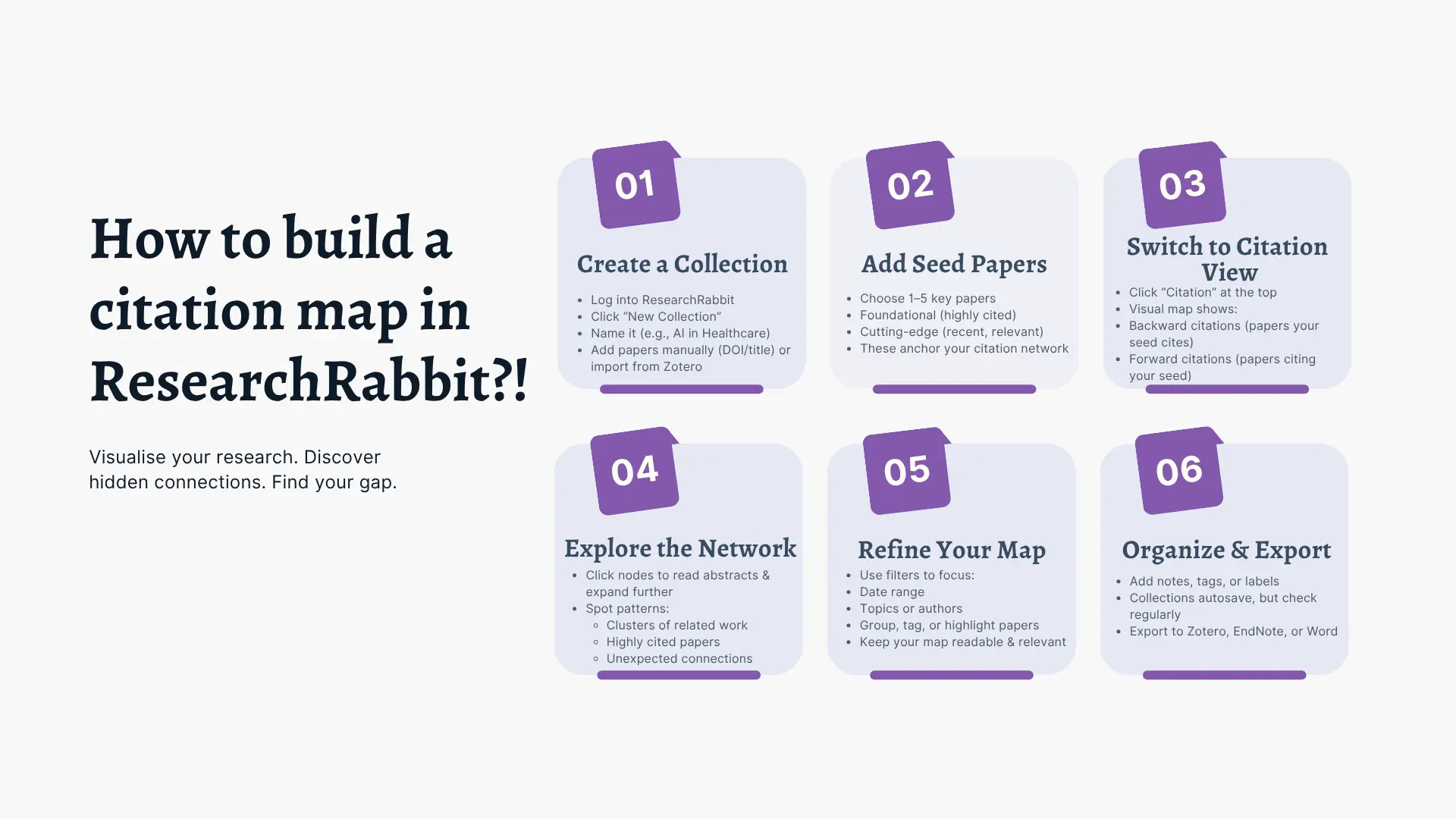
Tools like ResearchRabbit let you search on dozens, or even hundreds of seed papers, and to make this easy you can import your reference library. These seed papers help ResearchRabbit to find highly relevant articles through their citation connections. But connectedness goes beyond forward and backward citations also considering articles that might share a citation or have shared authors. You can also choose to infer a connection based on semantic similarity of titles and abstracts. These articles are mapped making it easier to explore citation networks visually and helping you see connections that would otherwise require extensive manual tracing.
Citation discovery does not replace keyword search. It complements it by adding structural awareness to the literature review process.
Why modern literature reviews need all three
Each approach solves a different part of the literature review problem.
- Keyword search gives you precision and reproducibility when you need to systematically gather evidence.
- AI-tools help you get oriented quickly and make sense of unfamiliar territory.
- Citation discovery reveals how papers actually connect across a field.
Relying on just one of these views almost always leaves blind spots and can make the vastness of modern day literature overwhelming to review. Used together, they give you a more complete and resilient picture of the literature. In practice, many experienced researchers move between these modes as their understanding of the field deepens.
The modern hybrid workflow
A practical workflow often looks like this:
1. Start with discovery.
Begin broadly. Use citation networks or exploratory tools to understand the landscape and identify key papers and terminology.
2. Use AI-tools to clarify concepts.
Ask natural language questions to surface themes, alternative phrasings, and conceptual relationships that can refine your search strategy.
3. Move to structured keyword search.
With better terminology in hand, run keyword searches or systematic database queries using Boolean logic and controlled vocabulary.
4. Visualize your topic.
Add a set of relevant papers as seed papers and explore how they connect across the citation network. Visualizing these connections can surface highly relevant papers and research clusters that may be missed by traditional search tools.
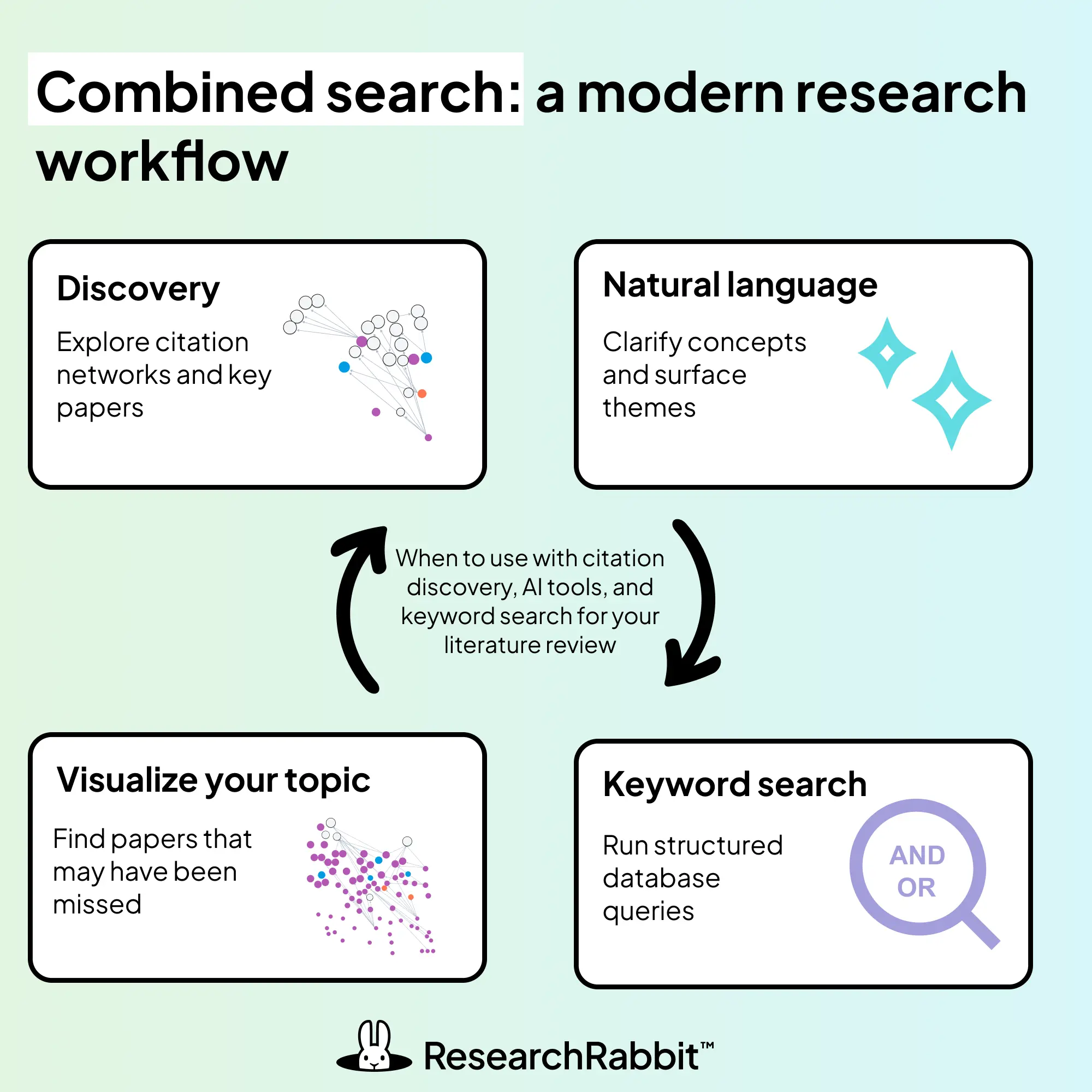
This iterative loop helps you reduce early bias while maintaining the rigor required for formal reviews.
For a step-by-step view of how these phases fit together, see our guide to modern literature review workflows.
Implications for research quality
The way you search directly affects the quality of your literature review.
Workflows that combine precision retrieval with exploratory discovery tend to produce:
- More comprehensive coverage
- Reduced terminology bias
- Better identification of seminal work
- Stronger conceptual synthesis
- More defensible review methodologies
- …are a lot more joyful to complete
As the research landscape continues to grow, these hybrid approaches are becoming less optional and more expected.
Key takeaway
Keyword search gives your review rigor. AI tools accelerate orientation. Citation discovery reveals the structure of the field.
Used together, they transform literature review from a process of accumulation into a process of understanding.
👉 If you're ready to explore how papers connect across your field, start with one seed paper in ResearchRabbit, or import your existing library to map your research landscape.
FAQ
What is the difference between search and discovery in literature reviews?
Search focuses on retrieving papers that match specific keywords or filters, while discovery focuses on exploring how research connects across a field. Most modern literature reviews use both approaches together.
Can AI tools replace traditional literature search?
AI tools can accelerate early exploration and summarization, but they typically work best alongside structured database search and citation tracking, especially for rigorous academic reviews.
Why is citation discovery important in research?
Citation discovery helps you see how ideas flow through a field. It reveals foundational papers, emerging conversations, and connections that keyword searches often miss, especially when different research communities use different terms for the same concept. It's like having a map of the field, not just a list of addresses.
%20(800%20x%201036%20px).webp)



This is a big test comment on your article.