




A systematic review is a research study that collects, evaluates, and synthesizes all available evidence on a specific question using a pre-planned, transparent, and reproducible method.
Unlike a traditional literature review, where you search for relevant papers and summarize what you find, a systematic review follows a strict protocol designed to reduce bias at each stage of the process. The goal is to give decision-makers, researchers, clinicians, policymakers, the most complete and reliable picture of what the evidence shows.
In this guide, you'll learn what makes a systematic review different from other review types, when to use one, and what the process actually involves.
Systematic review vs literature review: what's the difference?
This is the question most researchers ask first, and the answer matters, because choosing the wrong review type can mean months of wasted work.
The short version: a traditional literature review is what most students and researchers write for dissertations and papers. A systematic review is a research project in its own right, with its own methodology, registration, and reporting requirements.
Systematic review vs meta-analysis: are they the same thing?
No, though they're often confused, and often go together.
A systematic review is the process of identifying, selecting, and synthesizing all relevant evidence on a question. A meta-analysis is a statistical technique that pools the numerical results from multiple studies to produce a combined estimate.
A systematic review can include a meta-analysis, but only when the included studies are similar enough in design, population, and outcome that pooling their data makes statistical sense. Many systematic reviews don't include a meta-analysis because the studies are too different to combine meaningfully.
Think of it this way: the systematic review is the house; the meta-analysis is one room inside it that not every house has.
Systematic review vs scoping review: which do you need?
A scoping review is the right choice when you're exploring a new or emerging topic and want to understand the landscape before committing to a specific research question. A systematic review is the right choice when you have a specific, answerable question and need the most rigorous possible answer.
What makes a systematic review different: 6 key characteristics
1. A pre-registered protocol Before searching, systematic reviewers write and often publicly register a detailed protocol specifying the research question, search strategy, inclusion and exclusion criteria, and analysis plan. This transparency prevents researchers from changing their approach based on what they find.
2. A comprehensive search The search must be designed to find all relevant studies, not just the ones that are easy to find or support a particular conclusion. This means searching multiple databases, using precise search terms and Boolean operators, and often including grey literature (reports, conference proceedings, dissertations).
3. Explicit inclusion and exclusion criteria Studies are screened against pre-defined criteria. A study is included or excluded based on whether it meets those criteria, not based on whether the reviewer likes its findings.
4. Independent screening by at least two reviewers To minimize bias, at least two researchers independently screen studies and extract data. The Cochrane Handbook recommends "use at least two people working independently to determine whether each study meets the eligibility criteria," and PRISMA 2020 requires authors to report how many reviewers screened records. Disagreements are resolved by discussion or a third reviewer. This is one of the reasons systematic reviews require a team.
5. Quality assessment Every included study is assessed for risk of bias. A study might be relevant but methodologically flawed. The quality assessment helps readers understand how much weight to give each study's findings.
6. PRISMA reporting Systematic reviews in health sciences and many other fields report their methods using the PRISMA (Preferred Reporting Items for Systematic Reviews and Meta-Analyses) guidelines, a checklist that ensures every step of the process is documented and transparent. Many journals now require PRISMA compliance for systematic review submissions.
The 7 steps of a systematic review
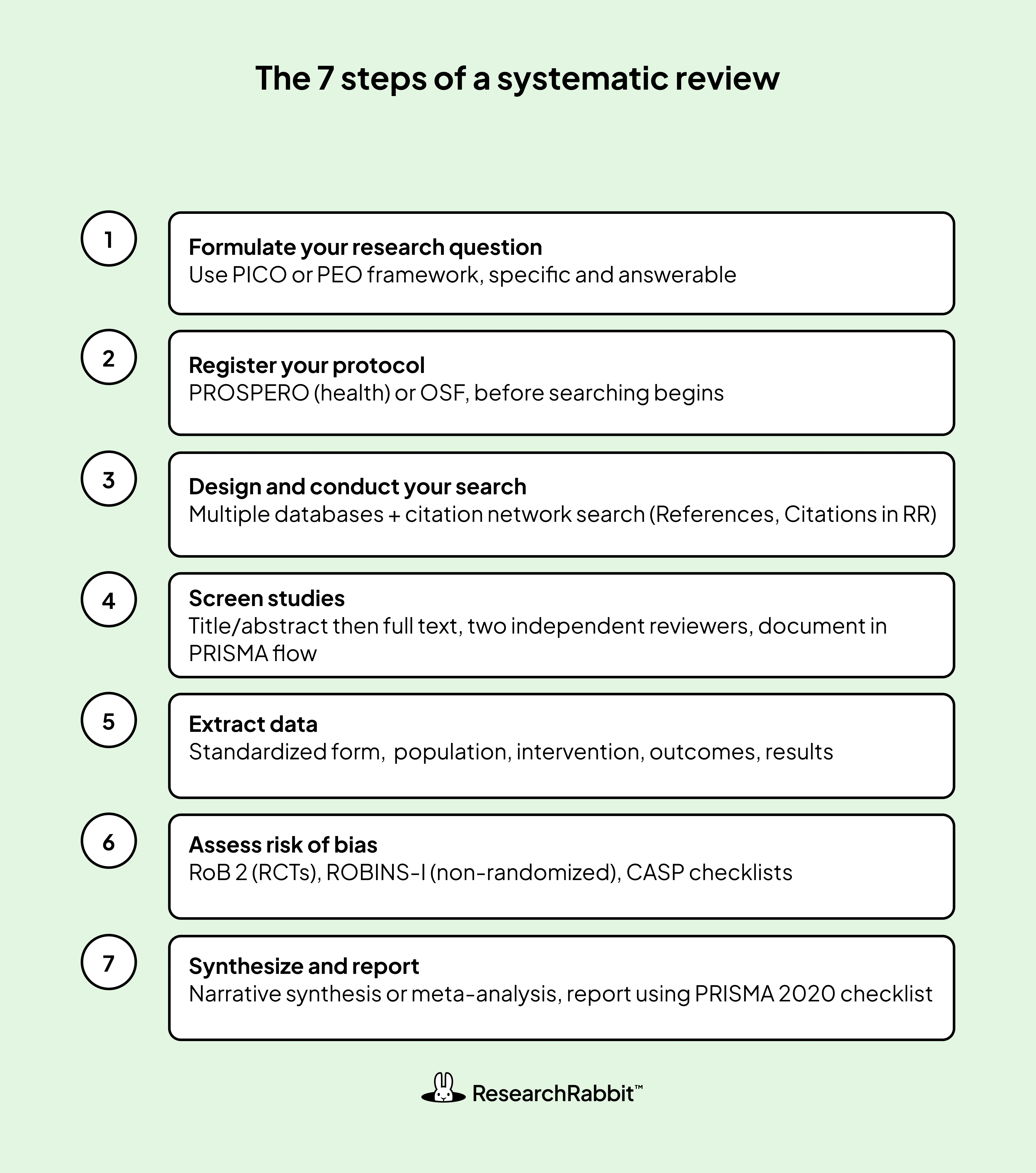
Step 1: Formulate your research question
Systematic review questions are typically structured using frameworks like PICO (Population, Intervention, Comparison, Outcome) for clinical questions, or PEO (Population, Exposure, Outcome) for observational research. The question must be specific and answerable.
Step 2: Register your protocol
Register your protocol in PROSPERO (for health-related reviews) or OSF before you begin searching. Registration creates a public record of your intended methods, which makes it harder to change them based on what you find.
Step 3: Design and conduct your search
Work with a librarian if you can, systematic review searches are complex, and a librarian's expertise significantly improves search quality. Search multiple databases relevant to your field, Cochrane recommends a comprehensive, pre-specified search strategy across multiple databases to minimize the risk of missing relevant studies. Document every search term, database, and date.
Citation network search is an important complement to database searching here. Starting from papers you've already identified as relevant and selecting References and Citations in ResearchRabbit surfaces papers that share vocabulary or citation connections with your included studies, papers that database searches often miss, particularly older foundational work and cross-disciplinary studies. This approach, sometimes called citation chasing or snowballing, is recognized in systematic review methodology guidelines including the Cochrane Handbook.
Start your citation network search in ResearchRabbit →
Step 4: Screen studies
Screen first by title and abstract, then by full text. Use your pre-defined inclusion and exclusion criteria at each stage. At least two reviewers should screen independently, and disagreements should be resolved systematically. Document every decision in a PRISMA flow diagram.
Step 5: Extract data
Use a standardized extraction form to collect consistent information from each included study, population characteristics, intervention details, outcome measures, results, and risk of bias indicators. Two reviewers extracting independently reduces errors.
Step 6: Assess risk of bias
Use an established tool appropriate to your study types. Cochrane's RoB 2 tool is standard for randomized controlled trials; ROBINS-I for non-randomized studies; CASP checklists for a range of study types.
Step 7: Synthesize and report
Summarize the findings across studies. If the studies are sufficiently homogeneous, conduct a meta-analysis. If not, use narrative synthesis. Report your methods and findings using the PRISMA 2020 checklist.
Is a systematic review right for you?

A systematic review is the right choice when:
- You have a specific, narrow research question
- A substantial body of primary research already exists on your topic
- You need the most rigorous and defensible answer possible
- You have access to a team of at least two reviewers
- You have at least several months available, systematic reviews typically take a year or more to complete
A systematic review is probably not the right choice when:
- You're writing a dissertation literature review chapter, a traditional narrative review is appropriate here
- Your topic is too new to have a substantial body of evidence
- You're exploring a broad question rather than answering a specific one
- You're working alone with a tight deadline
Where does citation network search fit in?
Keyword-based database searches can miss relevant papers that use different terminology, particularly older foundational work and cross-disciplinary studies that address your question with different vocabulary.
Citation chasing, following the references of included studies backward and the citations forward, is recognized in systematic review methodology as a way to address these gaps. The Cochrane Handbook for Systematic Reviews recommends it as a complement to database searching.
In ResearchRabbit, you can do this systematically. Add your included studies as seeds, then select References to map what each study was built on and Citations to find what has cited them since publication. Papers that appear repeatedly across multiple included studies are strong candidates for inclusion, and are exactly the papers most likely to be missed by keyword-based database searches alone.
Document this search step in your PRISMA flow diagram alongside your database searches.
FAQ
What is a systematic review in simple terms?
A systematic review is a study of studies. It uses a strict, pre-planned method to find, assess, and combine all the research evidence on a specific question, giving you a more reliable answer than any single study could.
What best describes a systematic review?
A systematic review is a type of research that applies rigorous, transparent, and reproducible methods to identify and synthesize all available evidence on a specific research question, designed to minimize bias at every step of the process.
What is the difference between a review and a systematic review?
A traditional literature review summarizes existing research based on the researcher's judgment. A systematic review follows a pre-planned protocol, searches comprehensively, applies explicit criteria to include or exclude studies, and assesses the quality of each included study. The process is designed to be reproducible, another researcher following the same protocol should reach the same results.
What are the 7 steps of a systematic review?
Formulate your research question, register your protocol, design and conduct your search, screen studies against your inclusion criteria, extract data from included studies, assess risk of bias, and synthesize and report your findings using PRISMA guidelines.
How long does a systematic review take?
Systematic reviews typically take at least a year from protocol registration to publication, and often longer. The search and screening phases alone can take several months, particularly for broad questions with large numbers of results.
Do I need a team to conduct a systematic review?
Yes, in most cases. The Cochrane Handbook recommends "use at least two people working independently to determine whether each study meets the eligibility criteria," and PRISMA 2020 requires authors to report how many reviewers screened records. Many journals also require dual screening as a condition of publication. If you're working alone, a scoping review or narrative review may be more appropriate.
What is PRISMA?
PRISMA (Preferred Reporting Items for Systematic Reviews and Meta-Analyses) is a reporting guideline that specifies what information should be included when reporting a systematic review. The PRISMA 2020 checklist covers 27 items across introduction, methods, results, and discussion. Originally developed for health sciences systematic reviews, it has since been adopted across many disciplines. Many journals now require PRISMA compliance for systematic review submissions.
What is the difference between a systematic review and a scoping review?
A systematic review answers a specific, narrow question as rigorously as possible, including quality assessment of included studies. A scoping review maps the breadth of literature on a broader topic without requiring quality assessment. Scoping reviews are faster and can be done by one person; they're useful for exploring a new area before committing to a specific research question.
%20(800%20x%201036%20px).webp)





This is a big test comment on your article.