



To evaluate a research paper, check five things: the relevance of the topic to your question, the authority and credibility of the authors and journal, the accuracy and transparency of the methods, the currency of the findings for your field, and the purpose or potential bias behind the study. Within two to five minutes of scanning, most papers will tell you clearly whether they deserve your full attention.
Here's how to do that in practice.
The 5 criteria for evaluating a research paper
These five criteria, sometimes taught as the CRAAP test or similar frameworks, give you a consistent way to assess any paper before committing time to reading it fully.
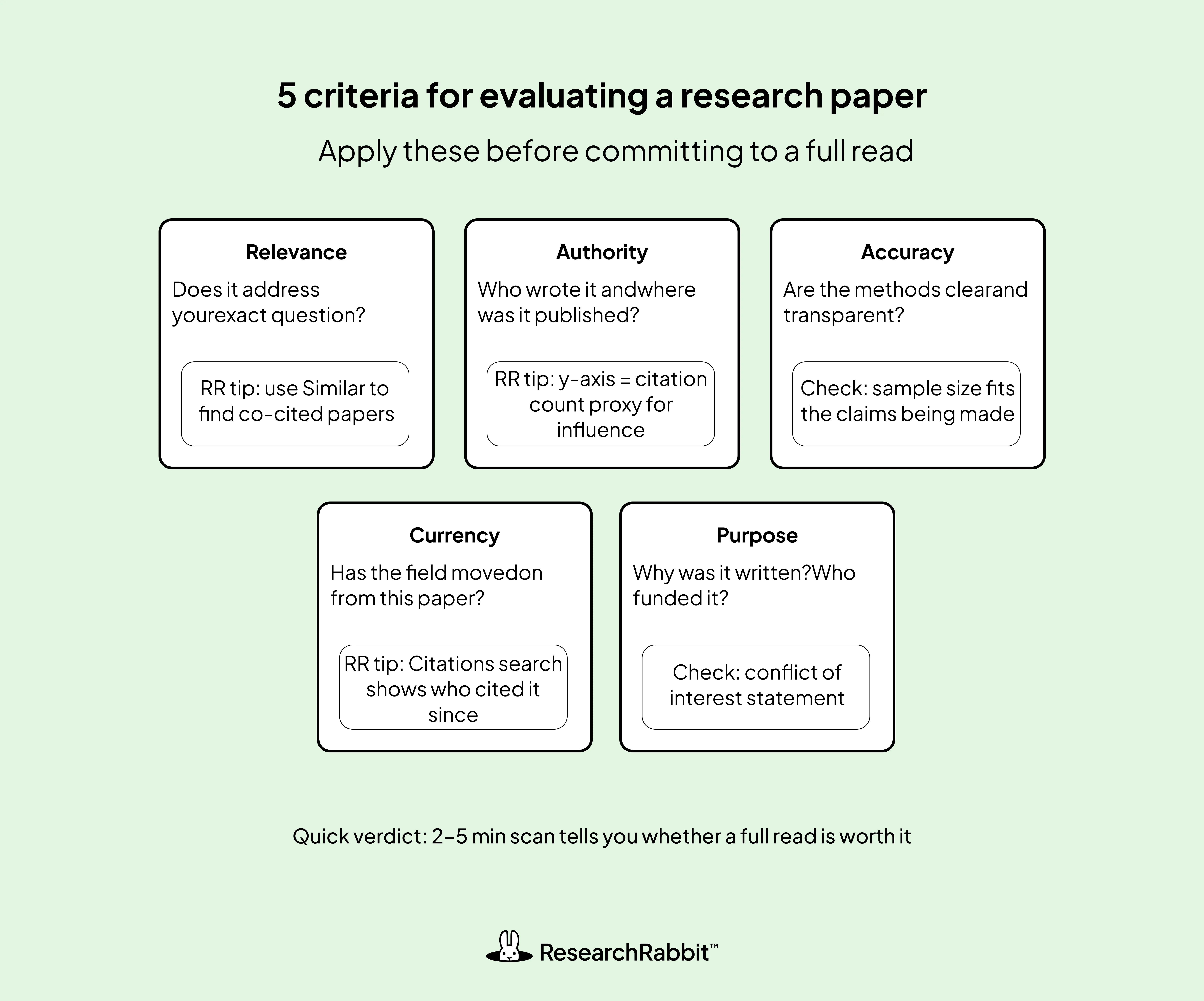
Relevance. Does this paper actually address your research question, or does it just share vocabulary with it? A study on "social media and adolescent wellbeing" is relevant to a teen mental health review. A study on "social media marketing for small businesses" isn't, even though both mention social media. Relevance is always specific to what you're working on, there's no universal answer.
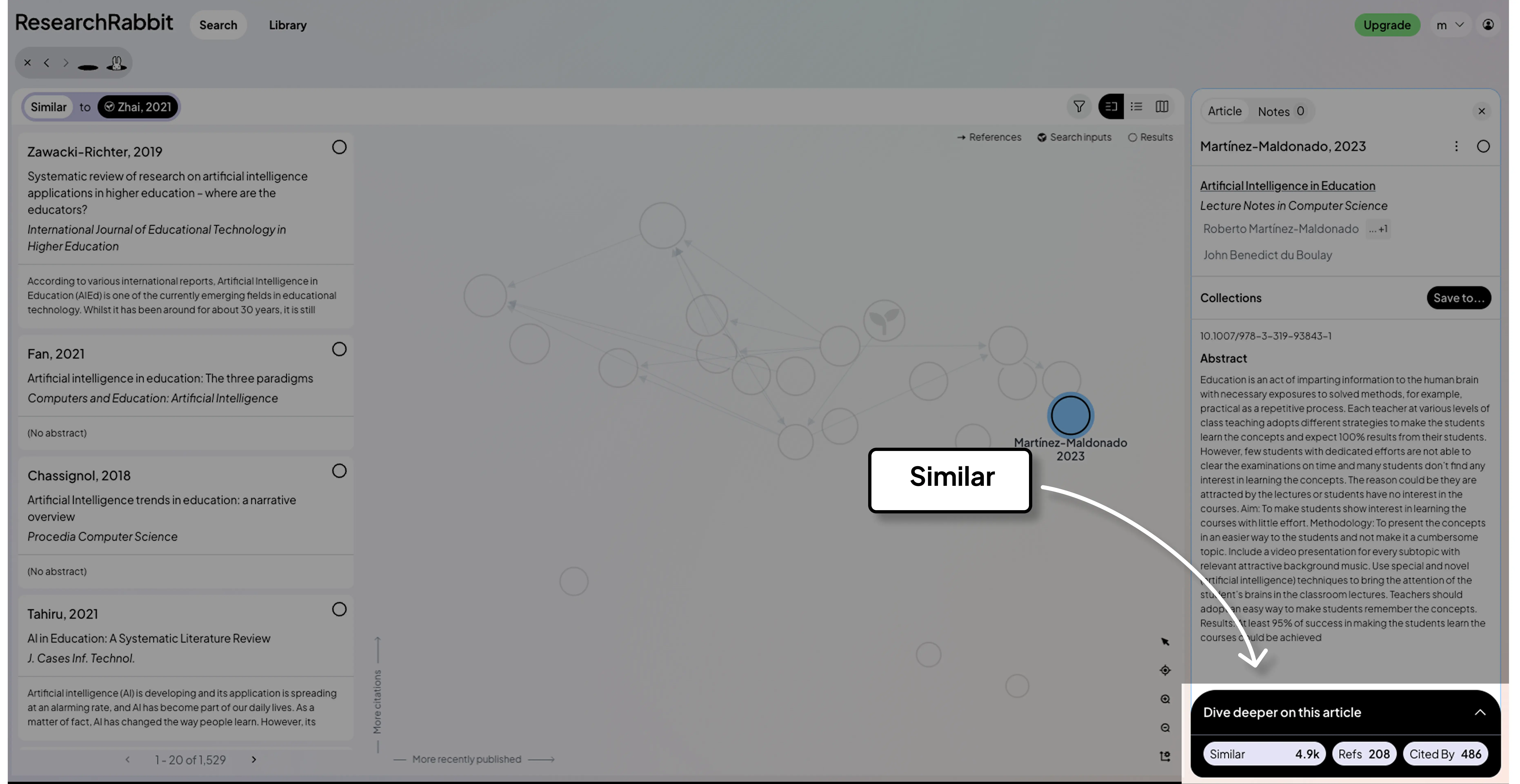
If you've already identified one or two relevant papers, use ResearchRabbit's Similar search to find papers that are co-cited alongside them. Papers that appear repeatedly in that network have already been filtered by the field for relevance, they're worth a closer look.
Authority. Who wrote it, and where was it published? Authors with a track record in the field, institutional affiliations, and publications in peer-reviewed journals carry more authority than anonymous or unverifiable sources. A quick Scimago check tells you where a journal sits relative to others in its field.Our guide on how to check journal rankings quickly walks through exactly how to do that.
ResearchRabbit's citation map gives you a fast visual read on authority too; papers positioned high on the y-axis have accumulated significant citations, which is a useful proxy for influence in the field.
Accuracy. Are the methods described clearly enough that you could understand how the study was conducted? Does the sample size make sense for the claims being made? Are limitations acknowledged honestly? Papers that are transparent about what they can and can't tell you are generally more trustworthy, not less.
Currency. Is the paper recent enough for your field? In fast-moving areas like machine learning or genomics, a 2018 paper might already describe a landscape that has changed significantly. In stable theoretical fields, older work can remain as relevant as anything published recently. The question isn't just the date, it's whether the field has moved on from what the paper argues.
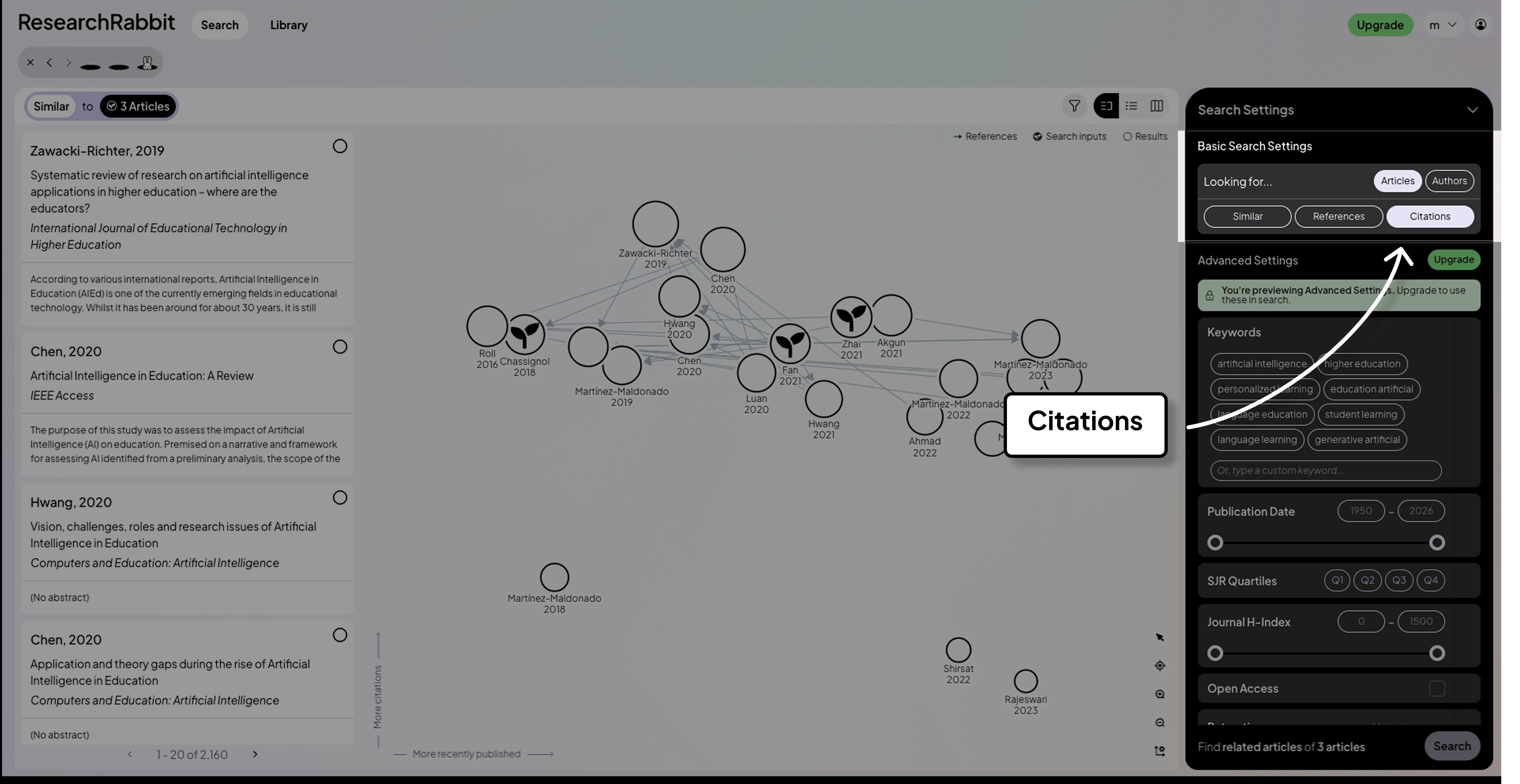
In ResearchRabbit, selecting Citations for any paper answers this directly. It shows you every paper that has cited it since publication, letting you see at a glance whether the field has built on it, challenged it, or moved on entirely. It's one of the fastest ways to check whether a paper's ideas are still current.
Purpose. Why was this paper written, and who funded it? Most research is conducted in good faith, but understanding the context helps you interpret the findings. A study funded by a drug company may reach different conclusions than one funded by an independent body, even on the same topic. Always check for a conflict of interest statement (or its absence).
The pre-reading sequence: how to apply these criteria quickly
Here's how these five criteria map onto a practical scanning sequence you can use for any paper.
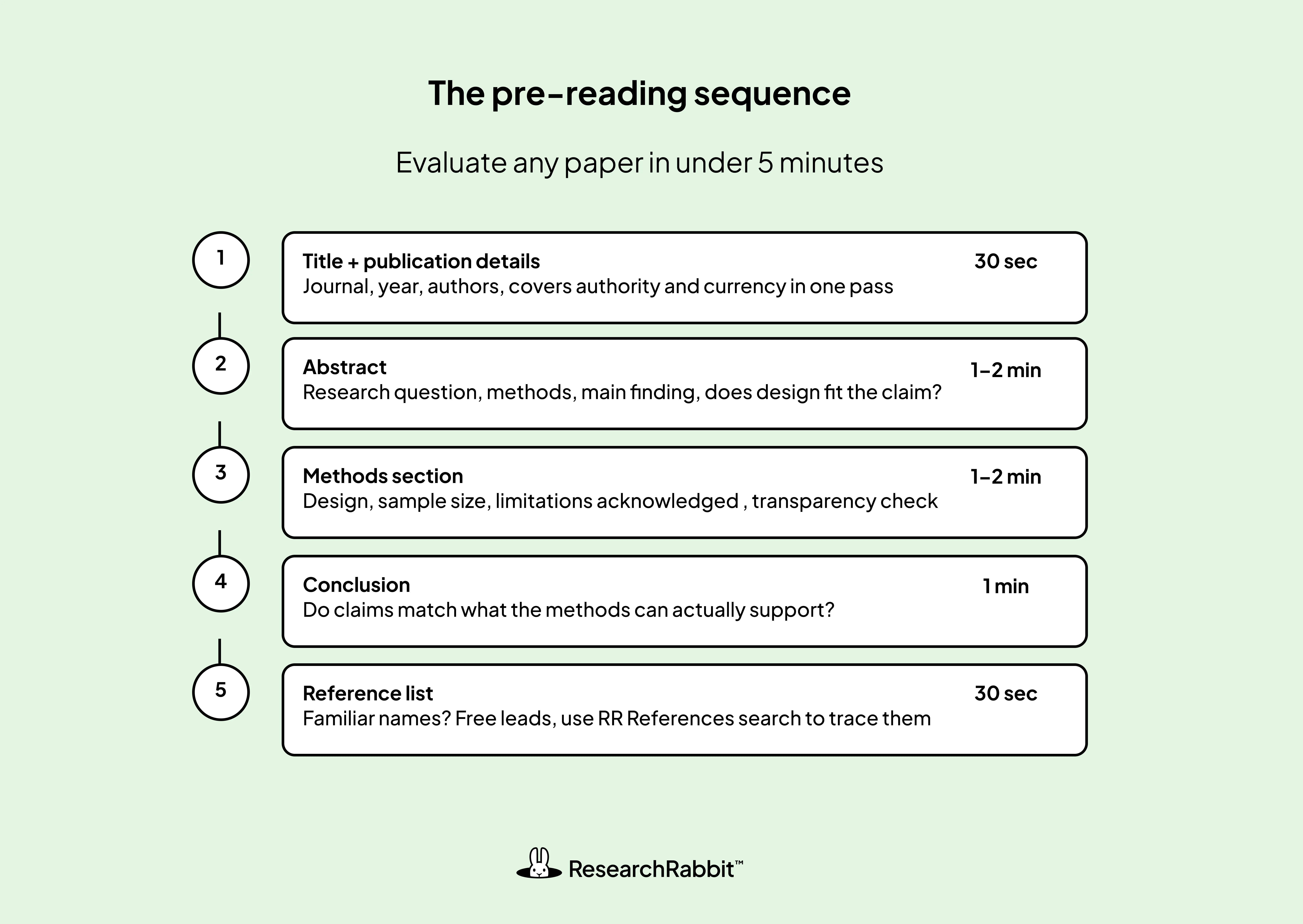
Step 1: Title and publication details (30 seconds)
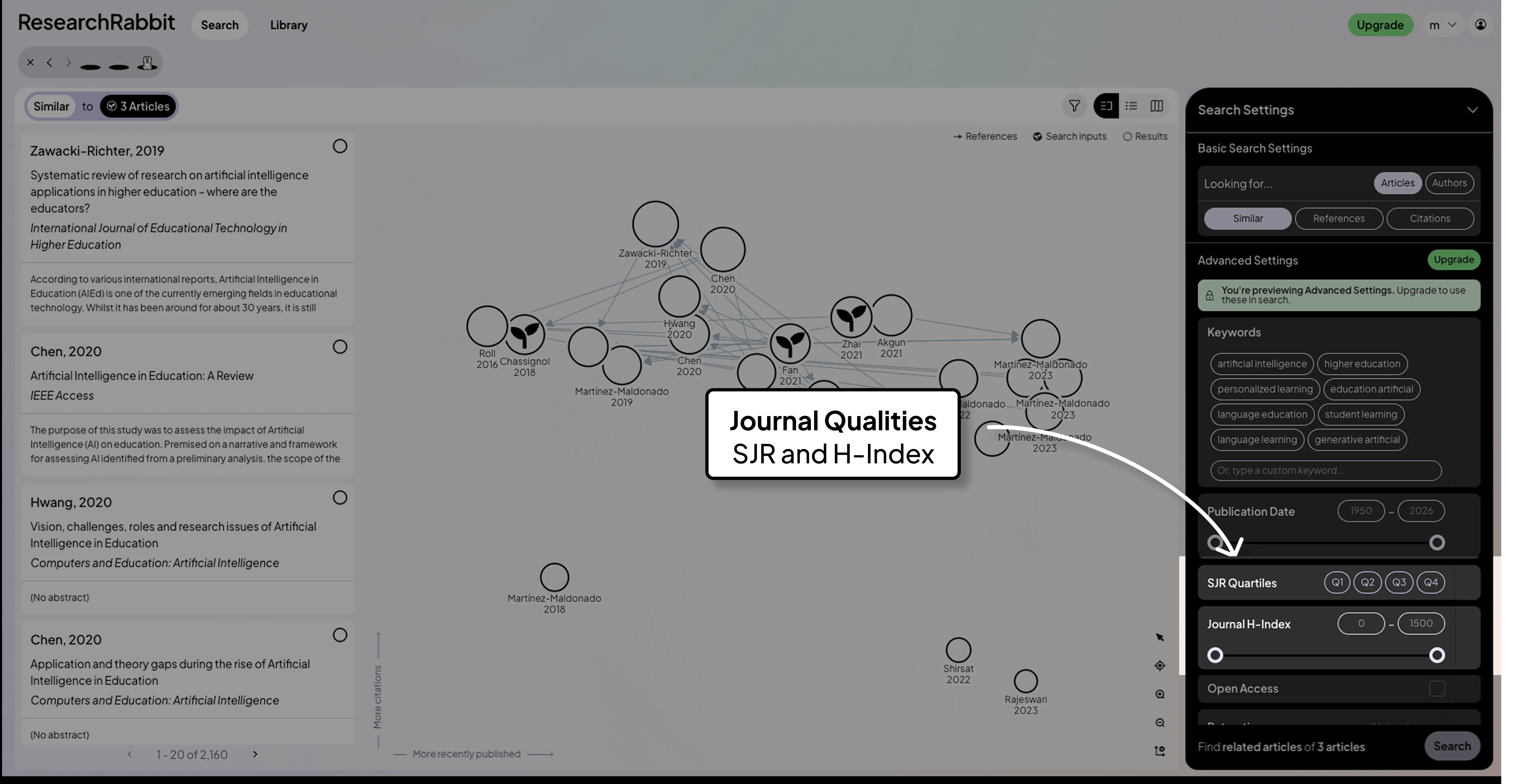
The title answers the relevance question immediately. Check the journal name and publication year at the same time, this covers authority and currency in a single pass. If the journal is unfamiliar, a quick Scimago search takes under a minute and tells you its quartile ranking in your subject area. ResearchRabbit's Advanced Search filters let you set journal quality thresholds (SJR quartile or H-index) directly, so you can limit your results to papers from journals that meet your standards before you even start reading.
Step 2: Abstract (1 to 2 minutes)
Read the abstract looking for the research question, the methods, and the main finding. This is where accuracy starts to come into view, does the study design seem appropriate for what's being claimed? And does the conclusion fit the study, or has it expanded well beyond what the data can actually support?
If the abstract makes you want to know more, keep going. If it's clearly off-target or the methods don't fit what you need, this is a natural stopping point.
Step 3: Methods section (1 to 2 minutes)
You're not reading the full methods, just scanning for three things. Is the study design appropriate for the claims? Does the sample make sense for the scope of those claims? And are limitations acknowledged? Papers that discuss their own limitations clearly are giving you useful information, not admitting failure.
Step 4: Conclusion (1 minute)
Skim the conclusion and ask whether it matches what the abstract and methods described. Papers sometimes arrive at their discussion section and quietly expand their claims beyond what the study can actually support. One country becomes "globally", one specific population becomes "young people". When that gap is large, it affects how much weight you can give the findings.
Step 5: Reference list (30 seconds)
A quick scan for familiar names and papers. A reference list that includes sources you already know are central to your field is a positive sign. It also gives you free leads, papers cited by multiple sources you already trust are worth pulling directly.
What this looks like in practice: a worked example
Say you're reviewing the literature on mindfulness interventions for university student mental health. You come across this paper on Google Scholar:
Ritvo P, Ahmad F, El Morr C, Pirbaglou M, Moineddin R. "A Mindfulness-Based Intervention for Student Depression, Anxiety, and Stress: Randomized Controlled Trial." JMIR Mental Health. 2021 Jan 11;8(1):e23491. doi: 10.2196/23491.
Here's how a quick evaluation runs:
Relevance. Title is directly on topic: mindfulness intervention, student population, depression/anxiety/stress outcomes. This is exactly the territory you're reviewing. Keep going.
Authority. JMIR Mental Health is a peer-reviewed open-access journal indexed in PubMed and Scopus. The authors are affiliated with York University and the University of Toronto, both credible research institutions with established health science faculties. No red flags here.
Accuracy. The abstract describes a randomised controlled trial with a waitlist control group, validated outcome measures (PSS, PHQ-9), and an 8-week intervention window. That's a solid design for this kind of question. One thing worth noting: the study ran during a university-wide labour strike, which the authors acknowledge affected results; between-group differences were only significant for perceived stress, not depression or anxiety. That's honest reporting of a messy situation, not a flaw they're hiding.
Currency. Published 2021. Mindfulness intervention research is active but not changing as rapidly as, say, AI or genomics. The findings are likely still applicable, though you'd want to check whether more recent meta-analyses have updated the picture.
Purpose. The paper is open access and published via a university-affiliated research team. No pharmaceutical or industry funding declared. The MVC program it evaluates is a web-based intervention, which adds a practical implementation angle that might be useful depending on your review's scope.
Decision. Worth a full read. The RCT design is appropriate, the authors are transparent about the strike-related limitations, and the findings are relevant even if they're more modest than expected. You'll cite it with a note about the contextual constraint, which actually makes it a more interesting source, not a weaker one.
That whole process took about five minutes. The paper is freely available via PMC if you want to follow along.
When you need to go deeper: how to critically evaluate a research paper
Quick pre-reading tells you whether a paper is worth your time. Critical evaluation, the deeper reading you do for papers your argument actually depends on, asks more demanding questions.
Does the study design match the research question? A randomised controlled trial, a systematic review, a qualitative interview study, and a cross-sectional survey are each well-suited to different kinds of questions. Using the wrong design doesn't make a paper useless, but it does limit what it can tell you. A cross-sectional study can show association but not causation. A small qualitative study can illuminate lived experience but not estimate population-level prevalence.
Are the statistical methods appropriate? You don't need to be a statistician to ask basic questions: does the analysis match the data type? Are effect sizes reported alongside p-values? Is statistical significance being confused with practical significance? A result can be statistically significant and still represent a difference too small to matter in practice.
How were participants selected, and could that selection introduce bias? Convenience samples (e.g., undergraduate psychology students who received course credit for participating) are common in research and not inherently problematic, but they do limit the range of people the findings apply to. Knowing how participants were selected helps you understand the boundaries of the conclusions.
Has this paper been cited critically or supportively? A paper with many citations isn't automatically reliable, it could be cited primarily because people are challenging its findings. In ResearchRabbit, selecting “Citations” for a given paper lets you scan the studies that have cited it and skim their abstracts, giving you a faster read on whether the field has built on it or pushed back against it. The “Other Related Authors” search can also help here, it surfaces the researchers who appear most frequently in the neighbourhood of a paper, helping you identify the key voices in a debate and whether your source is aligned with or opposed to the scholarly consensus.
Are the conclusions proportionate? Strong claims require strong evidence. A single study, even a well-designed one, rarely settles a contested question. Papers that acknowledge uncertainty, call for replication, and frame their contribution accurately are more reliable than papers that present their findings as definitive.
Red flags worth knowing about
A few patterns are worth slowing down for, regardless of where you are in the evaluation process.
Claims that seem much larger than the methods. A pilot study of 30 participants making population-level claims, or a study from one specific context presented as universally applicable, deserves a closer look at what the data can actually support.
Results that look unusually clean. Real research tends to have noise, unexpected patterns, null findings, results that need explaining. Perfectly consistent findings across all measures, especially on contentious topics, are worth reading carefully.
A conflict of interest statement that's missing. More journals require this now than used to. Its absence doesn't prove anything, but on topics where funding sources can influence outcomes, it's worth knowing.
Methods that are hard to find or understand. Transparency is a marker of trustworthiness in research. If scanning the methods section leaves you genuinely unclear about what was done, that's worth noting before you rely on the conclusions.
Sorting what you've found
After pre-reading a batch of papers, you'll naturally have three groups.
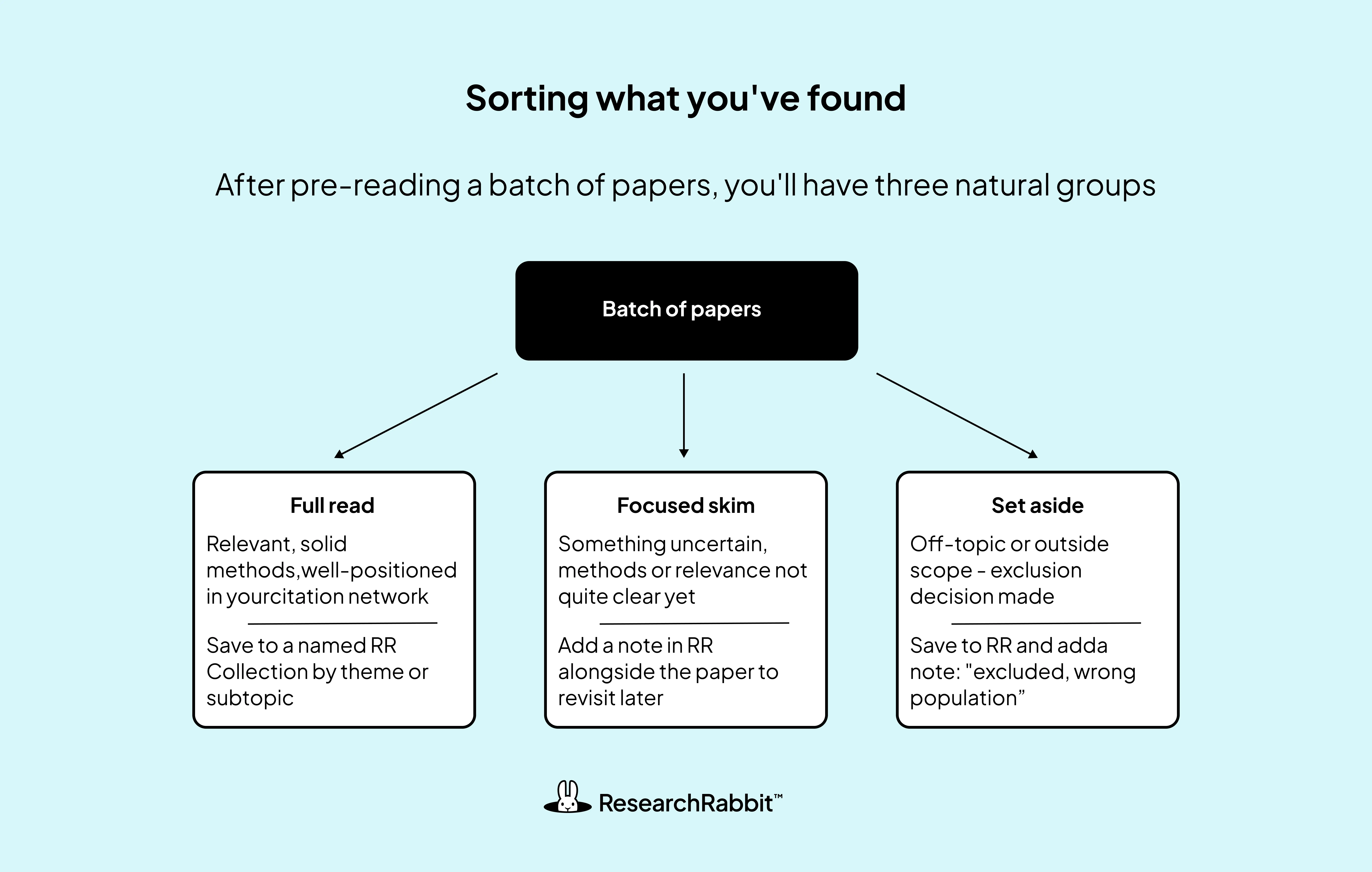
Meta description: After pre-reading, sort papers into full read, focused skim, or set aside, and use RR Collections and notes to document your inclusion and exclusion decisions.
- Papers that are clearly relevant, methodologically solid, and well-positioned in your citation network deserve a full read and likely a critical evaluation. These are the sources your argument will depend on. Save them directly to a ResearchRabbit Collection, named by theme or subtopic, so your reading list stays structured as it grows.
- Papers where something was uncertain, methods that needed a closer look, or relevance that wasn't quite clear, are worth a focused skim. Read the introduction and discussion properly, check the methods more carefully, and note the key finding. ResearchRabbit's built-in notes let you record your assessment right alongside the paper, so you don't lose your thinking when you come back to it later.
- Papers that turned out to be off-topic or outside your scope can be set aside. A brief note about why helps, especially for systematic reviews where that documentation is part of your methodology.
Papers that are clearly relevant and well-positioned in your citation network deserve a full read. If you're not sure how to assess citation network position, our guide to how to find high-quality research papers covers this in detail.
It gets faster with practice
Quick evaluation feels like an extra step early on. It quickly becomes the opposite, a way of moving efficiently through a large pile of papers without losing track of where you are.
As your knowledge of a field grows, the process speeds up naturally. You start recognising journals, author names, and methodological patterns, and those recognitions make your judgments faster without making them less reliable. The sequence stays the same; it just runs more smoothly.
ResearchRabbit is designed to support exactly this kind of iterative, growing familiarity with a field. The more papers you save and search from, the more precisely the citation network surfaces what's most relevant, so your evaluation process and your search process reinforce each other over time.
Start your literature review in ResearchRabbit →
%20(800%20x%201036%20px).webp)
This is a big test comment on your article.