



Research has a way of expanding in the best possible sense. You begin with a question that sparks your curiosity, and suddenly you’re discovering decades of studies, lively debates, and ideas that connect in unexpected ways. It can feel like a lot, but it’s also a sign that you’ve stepped into a valuable intellectual conversation.
This stage can feel stretching, not because you’re doing something wrong, but because you’re learning to navigate the real complexity of your field and see how its pieces connect.
In this article, you will break down what a literature review is, why it matters, why it is so difficult, and how you can move from reviewing literature to identifying a clear and defensible research gap.
What is a literature review?
It’s the process of stepping back, seeing the shape of the field, and deciding where your own work fits. Whether you’re preparing for your first major project or refining an advanced study, the strength of your literature review shapes the confidence, direction, and originality of everything that follows.
A strong literature review helps you answer questions like:
- What has already been studied?
- Which theories or methods dominate the field?
- Where do scholars agree or disagree?
- What remains unknown or underexplored?
You can think of a literature review as building a “family tree” of knowledge around your topic. You identify foundational works, major debates, key theories, methodologies, and gaps that shape the field.
Instead of summarizing papers one by one, you synthesize findings, compare perspectives, identify patterns, and surface gaps in current knowledge.
Why literature reviews matter
Literature reviews are not a formality or a box to check. They are the foundation of scholarly progress and a core skill you must develop as a researcher or critical thinker.
1. Build a foundation for original work
A literature review allows you to identify the research gap. You cannot claim novelty unless you clearly understand what already exists. By reviewing prior work, you expose unanswered questions, contradictions, and underexplored areas that justify your own study.
You also avoid duplicating work that has already been done. A strong review ensures your research builds on existing knowledge rather than unknowingly repeating it.
By examining how others approached similar problems, you sharpen your methodology. You learn which methods worked, which failed, and where limitations appeared. At the same time, you ground your work in established theories and frameworks that give your analysis conceptual clarity.
2. Contribute to collective knowledge
Your approach to a literature will be different based on your field, what contribution you want your research to have, and your approach to creation of knowledge.
In fields like humanities and social science a well-executed literature review maps the intellectual landscape of a field. You turn scattered studies into a coherent narrative that shows how ideas evolved, where debates exist, and which directions dominate current thinking.By comparing conflicting results, you clarify where disagreements come from and where consensus truly exists. In many cases, synthesizing existing research allows you to generate new hypotheses or theoretical insights that individual papers could not reveal on their own.
In applied fields like medicine and education literature reviews focused on quantitative measurement directly inform policy and practice. Systematic reviews, in particular, represent the highest level of evidence and guide real-world decision-making.
Adapted from 2026 article Literature Review Types in Academic Research which proposes a new taxonomy of four literature review types defined by epistemological stance.
3. Develop essential skills
Writing a literature review forces you to think critically rather than read passively. You evaluate sources, assess credibility, compare arguments, and judge evidence.
You also learn synthesis rather than summary. Instead of repeating what each paper says, you connect ideas across sources and build a narrative. This skill applies far beyond academia.
By the end of the process, you gain deep mastery of a narrow topic. You understand its history, its key contributors, and its unresolved questions. At the same time, you strengthen your research and information literacy by navigating databases, evaluating sources, and managing large volumes of material efficiently.
4. Guide your reader
For your reader, a literature review serves as orientation, credibility proof, and roadmap. It brings them up to speed quickly, demonstrates your expertise, and explains why your research question matters. A weak or incomplete review immediately undermines trust in everything that follows.
Why literature reviews are difficult
Literature reviews can feel challenging because modern research is vast and constantly evolving. That challenge isn’t a flaw, it’s a reflection of how alive and active your field really is. You are not dealing with a finite body of work, but with a constantly expanding and fragmented ecosystem of knowledge.
- Information overload from thousands of relevant papers published across journals, conferences, and preprint servers
- Fragmentation across disciplines, keywords, and publication venues that rarely use consistent language
- Constantly evolving literature that can shift the state of the field in a matter of months
- High cognitive load when tracking arguments, methods, assumptions, and findings across dozens or hundreds of papers
The challenge is not just reading. It is maintaining context. Without a clear system, connections between papers disappear, key insights fade, and important questions resurface repeatedly.
Most people struggle not because they cannot read papers, but because they cannot organize, connect, and revisit literature effectively over time.
Common literature review chaos (and how to turn it into clarity)
Here’s the good news: most literature review “mistakes” are actually signs of growth. They show you’re stretching into more complex ways of thinking and learning how synthesis works.
Instead of treating these as traps to avoid, think of them as upgrade points. Small shifts that move your review from competent to compelling. Let’s walk through a few of the most common ones and how to turn each into something stronger
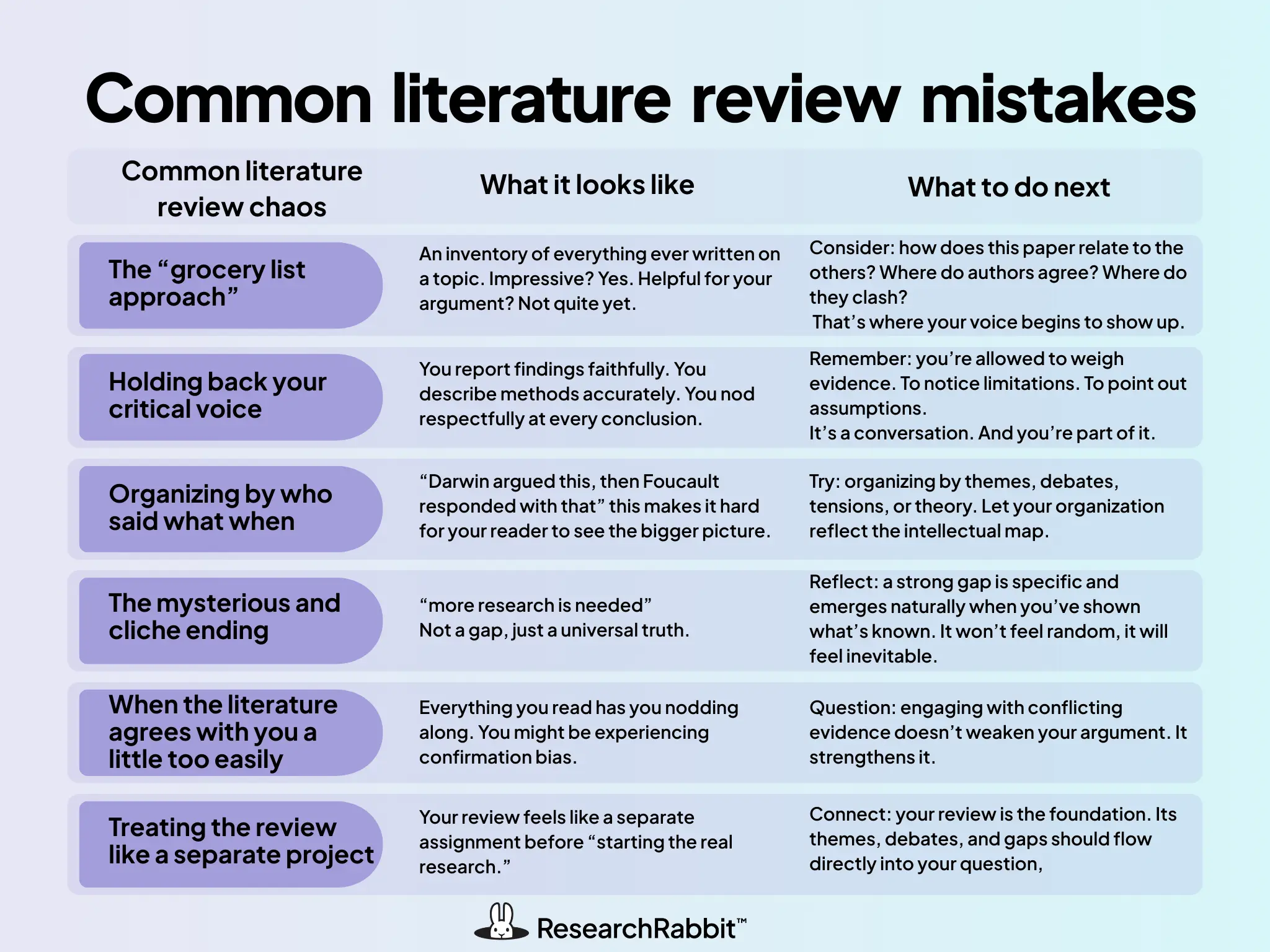
- The “grocery list” approach
You read a paper. You summarize it. You move to the next one. Repeat generously.
Before long, your review starts to resemble a very polite, beautifully organized inventory of everything ever written on the topic. Impressive? Yes. Helpful for your argument? Not quite yet.
Now, instead of asking “What did this paper say?”, ask “How does this paper relate to the others?” Where do authors agree? Where do they clash? What patterns are emerging? That’s where your voice begins to show up.
- Holding back your critical voice
You report findings faithfully. You describe methods accurately. You nod respectfully at every conclusion.
But research isn’t about polite nodding. It’s about thoughtful judgment.
You’re allowed to weigh evidence. To notice limitations. To point out assumptions. A literature review isn’t a fan club — it’s a conversation. And you’re part of it.
- Organizing by who said what when
If your structure follows a timeline of authors, “Darwin argued this, then Foucault responded with that””, your reader has to work very hard to see the bigger picture..
Instead, you can try organizing around themes, debates, tensions, or theories. Let your structure tell a story about ideas, not just about people. When your organization reflects the intellectual landscape, your reader can see the map.
- The mysterious “more research is needed” ending
Yes. More research is almost always needed. But that’s not a gap, that’s a universal truth.
A strong gap is specific. It emerges naturally when you’ve shown what’s known, what’s contested, and what’s still unclear. After you’ve done that work, your research question evolves naturally. It won’t feel random, it will feel inevitable.
- When the literature agrees with you a little too easily
When every paper you read has you nodding along, it can feel reassuring. But if nothing challenges you, it’s worth pausing. You may be gravitating toward evidence that confirms what you already suspect.
Engaging with conflicting evidence doesn’t weaken your argument. It strengthens it. It shows you understand the full complexity of the field and that your contribution holds up in the real conversation, not just the comfortable parts.
- Treating the review like a separate project
Sometimes the literature review feels like a separate assignment you complete before “starting the real research.”
But your review is the foundation. Its themes, debates, and gaps should flow directly into your question, your methods, and your discussion. When everything connects, your project feels coherent instead of assembled.
Search vs. discovery in literature reviews
A literature review does not begin and end with database searches. To do this well, you need to combine systematic search and exploratory discovery.
Search helps you retrieve known information using precise queries and filters. Discovery helps you encounter relevant work you did not know how to search for.In practice, many researchers begin with exploration to understand the language, debates, and structure of a field before committing to specific keywords. Once that context is established, you can move into structured searches using more refined terminology.
You should start with discovery. This allows you to understand the language, debates, and structure of the field before you lock yourself into a set of keywords. Once you have that context, you can move into structured searches using refined terminology.
From that point onward, search and discovery should inform each other in a continuous cycle. You follow citation chains backward and forward, refine your keywords, organize what you find, and adjust your understanding as you go. This process is not linear, it becomes an ongoing loop of searching, exploring, organizing, and refining your research over time.
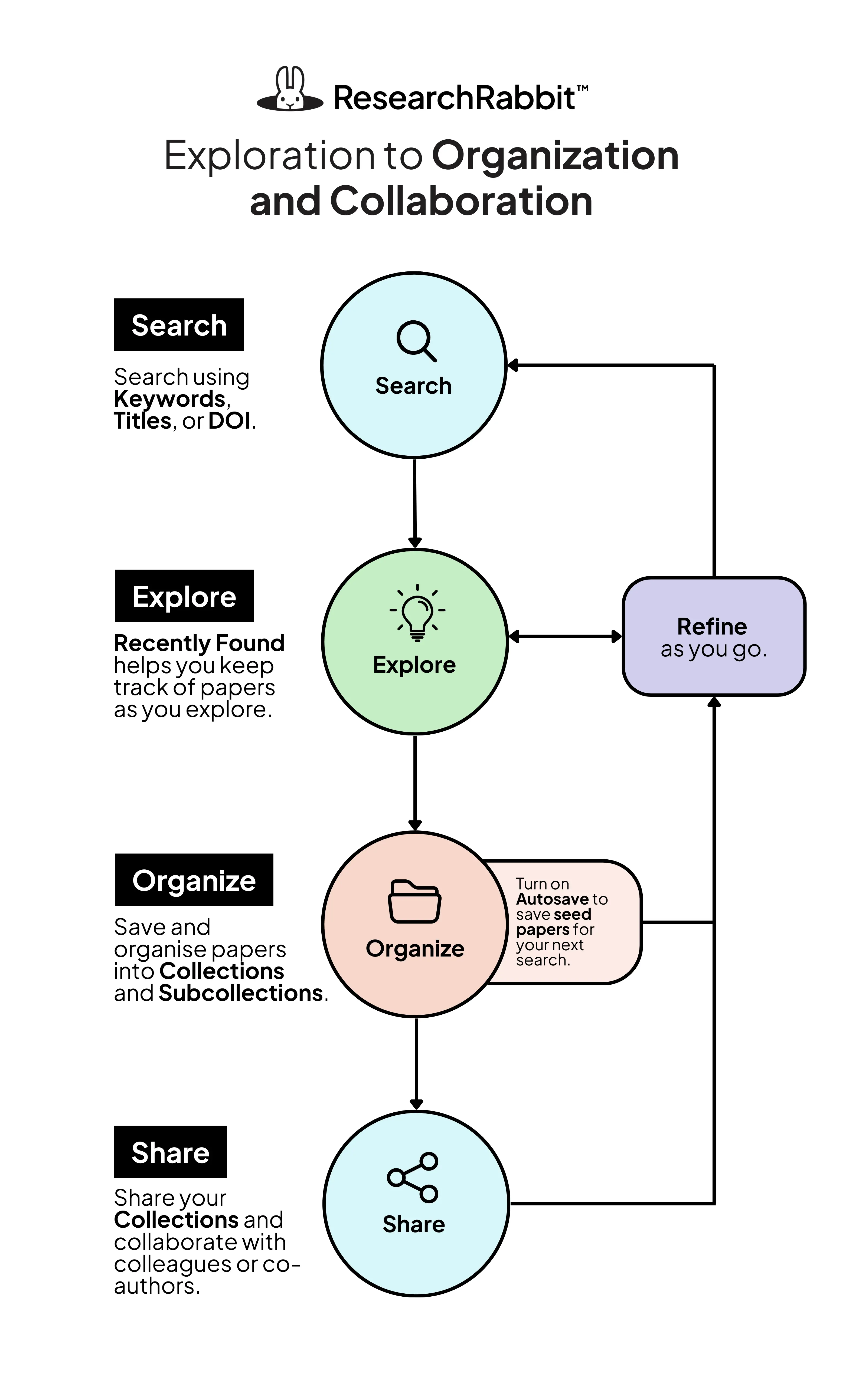
The workflow below illustrates how initial exploration leads into a continuous cycle where search and discovery reinforce each other while you stay organized and collaborative throughout the process.
Search gives your review rigor. Discovery gives it depth. You need both.
For a deeper explanation of why keyword search alone misses important research and how discovery complements it, see Search vs discovery in literature reviews.
How researchers manage literature reviews today
Today, you rarely manage a literature review through reading and note-taking alone. You rely on a combination of search tools, discovery platforms, reference managers, and visual mapping systems to handle scale and complexity.
Instead of working linearly, you follow multi-phase workflows that include exploratory discovery, systematic searching, structured organization, and ongoing updates. Traditional tools such as Google Scholar, Web of Science, or Scopus help you run structured searches, while reference managers like Zotero or Mendeley support organization and citation management. Discovery platforms such as ResearchRabbit, Litmaps, and Connected Papers extend this process by helping you uncover related work, citation networks, and emerging clusters that keyword search alone may miss.
For a deeper look at tools, workflows, and best practices, see this detailed overview of A modern workflow for smarter literature reviews.
From literature review to research gap
The goal of a literature review is not the review itself. The goal is the research gap.
A research gap becomes clear when you can articulate:
- What is already known
- What remains unknown
- Why that missing piece matters
Strong literature reviews expose limitations, contradictions, and unanswered questions. When you do this well, the gap does not need to be declared explicitly. It emerges naturally from your analysis as the logical conclusion of your synthesis.
If you want a deeper understanding of what a research gap is, how to identify it effectively, and real examples you can learn from, see ResearchRabbit’s guide to research gaps.
Final thought
A literature review is not just a requirement to complete. It’s your way of joining the conversation with clarity and confidence. When you balance search, discovery, and thoughtful organization, the process becomes less about surviving information overload and more about seeing patterns, balancing searching and exploring, and finding ways to organize that work for you.
If you want to move faster from reading papers to identifying meaningful research gaps, how you explore and connect literature matters just as much as how much you read.
And that’s where research starts to feel joyful again.
%20(800%20x%201036%20px).webp)


This is a big test comment on your article.