


You've probably searched Google Scholar, Scopus, or PubMed, found a handful of relevant papers, and assumed you had a good picture of the literature.
The problem is that keyword search can only find papers that use the words you're searching for. Some of the most influential papers in your field may use different terminology, belong to a neighbouring discipline, or simply be too old to rank highly in search results.
Citation networks solve that problem by navigating through connections between papers instead of relying on keywords alone. This guide explains how citation networks work, when to use them, and how they can help you discover papers traditional search often misses.
What is a citation network?
A citation network is a map of how research papers connect to each other through citations.
Every time a paper cites another, it creates a link. Over time, thousands of these links form a web that shows you something keyword search never can: not just what papers exist, but how they relate to each other, which ones are foundational, which ones are building on what, and where the field is heading.
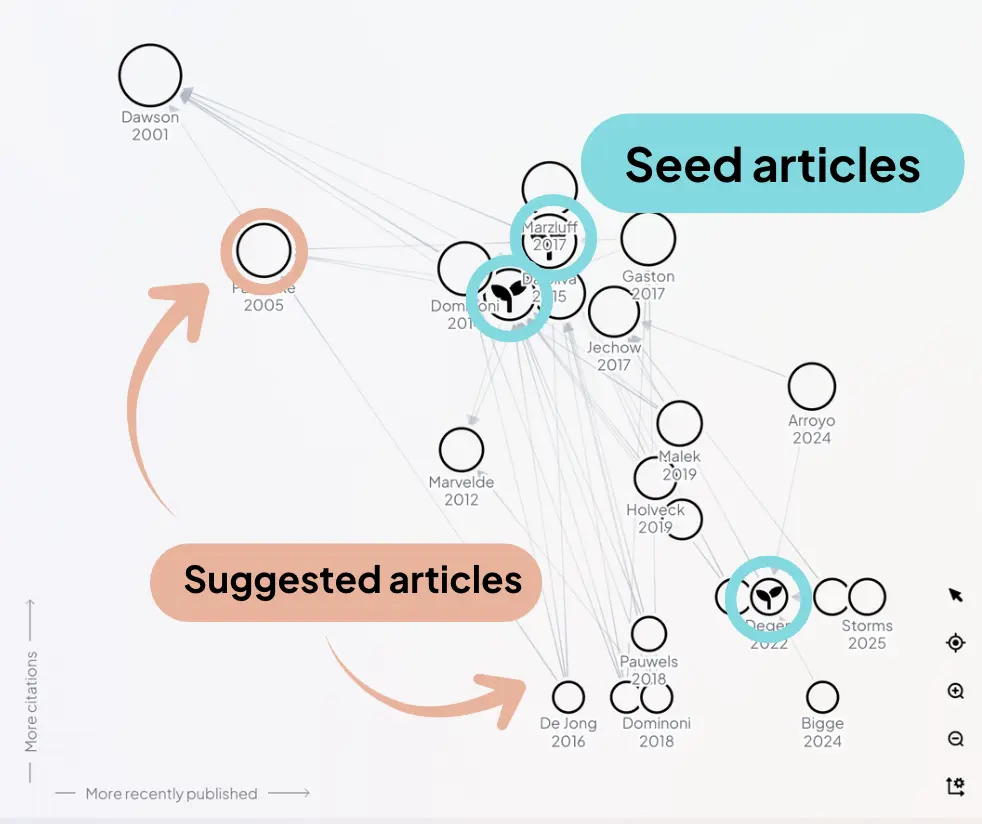
In a citation network, each paper is a node. Each citation is a line connecting two nodes. Papers with many connections sit at the center of the network. Papers with few connections sit at the edges. The structure itself tells a story about how a field has developed.
ResearchRabbit visualizes this as an interactive map. Papers you add become your seeds. The network grows outward from them, showing you the papers your field actually builds on, not just the ones that happen to share your keywords.
Why keyword search alone isn't enough
Keyword search has one fundamental limitation: it can only find papers that use your exact words.
This creates three blind spots that affect every researcher working from search alone.
- Terminology blind spots.
Research fields develop their own vocabulary, and that vocabulary changes over time. The concept you're studying might be called something completely different in papers from ten years ago, or in adjacent disciplines approaching the same problem from a different angle. If you search for "machine learning in healthcare," you'll miss the foundational papers from the 1990s that called the same thing "clinical decision support systems."
- Connection blind spots.
Keyword search shows you papers in isolation. It can't show you that two papers you've already found both cite a third paper you haven't found yet, a paper that might be the most important one in your entire review.
- Recency blind spots.
Search algorithms optimize for relevance and recency. The most-cited foundational papers in your field, the ones everyone builds on, often don't surface at the top of search results precisely because they're old. They're foundational, not recent.
Citation networks solve all three of these problems because they navigate by connection, not by keyword.
Forward vs backward citations: the two directions of a citation network
Every paper in a citation network connects to others in two directions. Understanding the difference is fundamental to using citation networks effectively. For a deeper look at when to use each direction and how to combine them, see our guide to backward vs forward citation search.
Backward citations (references)
When you look at a paper's references, you're looking backward in time, at the papers your chosen paper builds on. These are the intellectual foundations of the work.
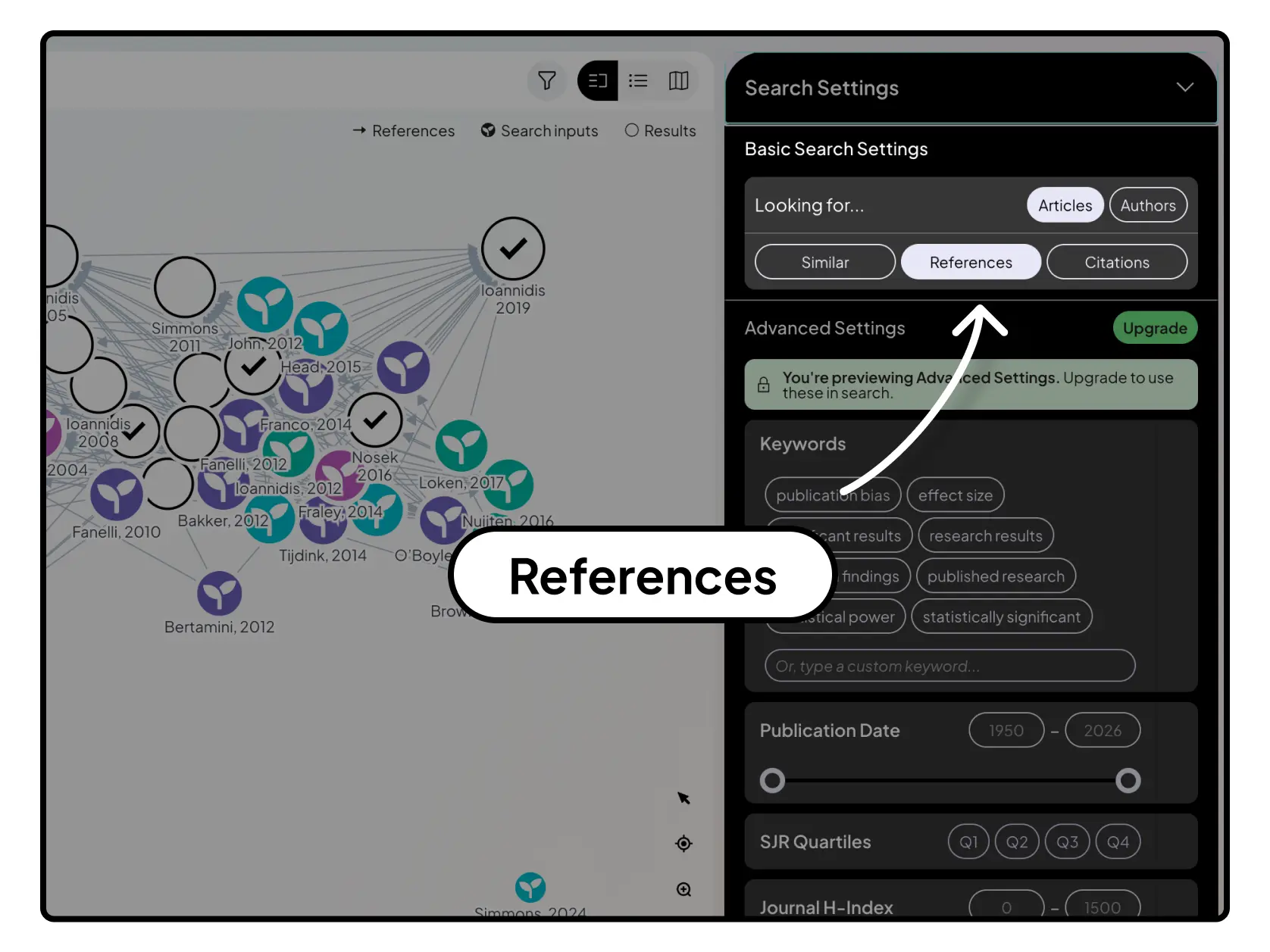
In ResearchRabbit, selecting References for any paper maps everything that paper cites. This is how you find the foundational work in a field: start from a recent paper you know is relevant, then follow its references back to see what it was built on.
Use backward citations when you want to:
- Understand the intellectual history of a topic
- Find the foundational papers that everyone in a field references
- Trace how a concept developed over time
- Make sure your literature review includes the work your field considers foundational
Forward citations
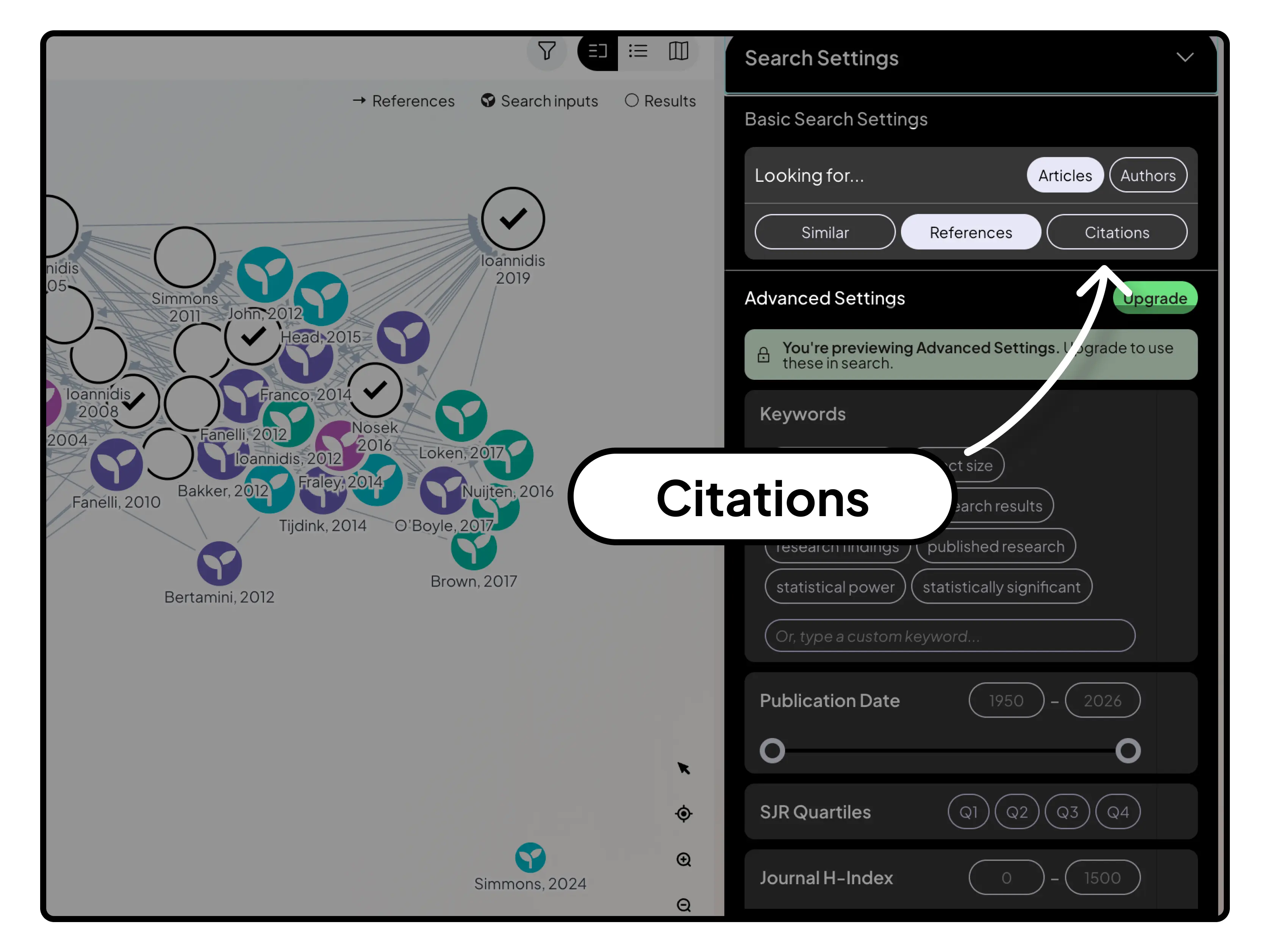
When you look at who has cited a paper since it was published, you're looking forward in time, at the research that has built on it, challenged it, or extended it.
In ResearchRabbit, selecting Citations for any paper surfaces every paper that has cited it, with scannable abstracts so you can assess the character of those citations quickly.
Use forward citations when you want to:
- Check whether a paper's ideas are still current or have been superseded
- Find the most recent work building on a foundational study
- See whether a paper has been challenged or refuted since publication
- Identify emerging research directions in your field
Using both directions together
The most powerful literature searches combine both. Start from one or two seed papers you know are relevant. Follow their references backward to find foundations. Follow their citations forward to find recent developments. Then add the papers you discover to your seed set and repeat.
Each iteration surfaces papers that pure keyword search would never find.
How co-citation analysis works
Beyond forward and backward search, citation networks reveal a third type of connection: co-citation.
Two papers are co-cited when a third paper cites both of them. If many papers cite both Paper A and Paper B together, it suggests that A and B address related ideas, even if they use completely different terminology, were published decades apart, or come from different disciplines.
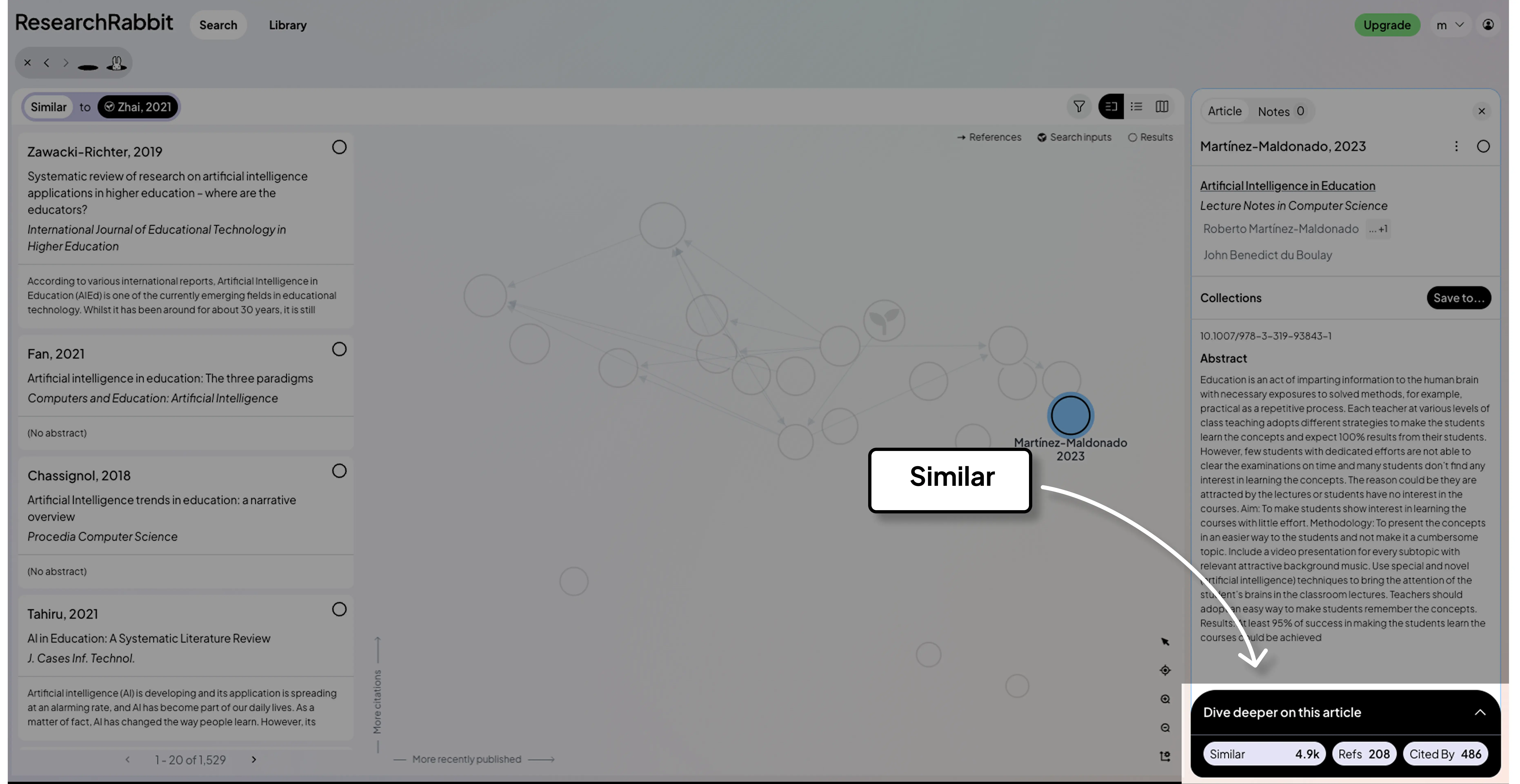
This is how ResearchRabbit's Similar search works. When you add seed papers, it identifies papers that are frequently co-cited alongside your seeds. These papers are intellectually related to your starting point, not just terminologically similar.
Co-citation analysis is particularly powerful for:
- Finding papers from adjacent fields that address your question from a different angle
- Discovering connections between bodies of literature that don't share vocabulary
- Identifying the papers that the field implicitly treats as related, even if they're never explicitly connected
How to use a citation network in practice: starting from seed papers
The practical workflow for citation network-based research has four stages.
Stage 1: Choose your seeds carefully
Your seed papers shape everything that follows. Start with one to three papers you're confident are relevant and well-positioned in your field, not necessarily the most famous papers, but papers you've read and trust.
If you're new to a topic, a recent review article or meta-analysis is often a good seed. It's already synthesized the field, which means its reference list is a curated entry point into the literature.
In ResearchRabbit, add your seeds to a collection. The citation map will populate immediately around them.
Stage 2: Read the map before you read the papers
Before opening any individual paper, spend time with the network visualization itself. In ResearchRabbit's citation map, papers are positioned by publication date on the x-axis and citation count on the y-axis. This gives you an immediate read on the structure of the field:
- Papers in the upper left are older and highly cited, likely foundational work
- Papers in the upper right are recent and highly cited, likely the current influential work
- Papers in the lower right are recent with few citations, emerging work worth watching
- Papers clustered together are likely addressing related questions
This structural view tells you things no list of search results ever could.
Stage 3: Explore in both directions
From your seeds, explore outward using both directions:
Select References to map the foundations your seeds were built on. Look for papers that appear repeatedly across multiple seeds, these are the papers your field considers foundational, whether or not they appeared in your keyword search.
Select Citations to find what has been built on your seeds since they were published. This surfaces the most recent relevant work and lets you check whether your seeds' ideas have been extended, challenged, or superseded.
Select Similar to find papers that are co-cited alongside your seeds, papers that the field treats as intellectually related, even if they don't share your exact terminology.
Stage 4: Add, iterate, and organize
As you find relevant papers, add them to your ResearchRabbit collection. Each paper you add becomes a new seed, expanding the network and surfacing further connections. This iterative process is so important that we've written a separate guide on how to build your search iteratively, including how to know when to stop.
Save papers to named collections by theme or subtopic. Use ResearchRabbit's built-in notes to record your assessment of each paper as you go, whether it's core, peripheral, or worth a deeper read, so your thinking doesn't get lost as your reading list grows.
The process is iterative by design. Each hop through the network brings you closer to a genuinely comprehensive view of your literature.
Common pitfalls and how to avoid them
Starting with too many seeds Adding twenty papers as seeds at once produces a network so large it's hard to navigate. Start with one to three papers, explore the network, then add more seeds as you identify relevant papers. Build iteratively.
Only searching in one direction Researchers new to citation networks often only look at references (backward). Forward citations are equally important, they show you what's been built on foundational work and whether the field has moved on from what a paper argued.
Stopping too early The first hop from your seeds is just the beginning. The papers that keyword search consistently misses often live two or three hops out from your starting point. Keep iterating.For a full breakdown of what you're likely missing and how to find it, see how to make sure your literature review doesn't miss important papers.
Treating citation count as a quality signal A paper appearing prominently in a citation network isn't necessarily good, it might be there because it's controversial, because it introduced a widely-used tool, or because it made a claim that others have spent years refuting. Always read before you cite.
Using citation networks instead of databases, not alongside them Citation networks are a discovery tool, not a replacement for structured database search. Use them to find papers you'd otherwise miss, then verify coverage with a systematic keyword search. The combination is stronger than either alone.
Citation networks vs keyword search: when to use each
The most thorough literature reviews use both. Start with keyword search to establish your initial reading list. Then use citation networks to find what keyword search missed.
Getting started in ResearchRabbit
If you have one paper you're confident is relevant to your research question, you have everything you need to start.
Add it to ResearchRabbit as a seed. Look at the citation map that builds around it. Select References to see what it was built on. Select Citations to see what has been built on it since. Select Similar to find what the field treats as intellectually related.
Then add the papers you find and repeat.
The papers that matter most to your research are already out there. Keyword search just can't see them.
Start your literature search in ResearchRabbit →
FAQ
- What is a citation network?
A citation network is a map of research papers connected through citations. Each paper is a node, and each citation creates a link between papers. Citation networks help researchers understand how ideas develop, identify foundational studies, and discover related work that keyword searches may miss.
- What is the difference between a citation network and keyword search?
Keyword search finds papers that contain specific words or phrases. Citation networks find papers based on their relationships to other papers. While keyword search is useful for discovering papers on a topic, citation networks can reveal foundational studies, related research, and influential papers that use different terminology.
- What is citation chasing?
Citation chasing is the process of following references and citations between papers to discover additional relevant research. Researchers typically use backward citation chasing to find foundational work and forward citation chasing to find newer studies that build on earlier research.
- How many seed papers should I start with?
It's usually best to start with one to three highly relevant papers. Starting with too many papers can create a large and difficult-to-navigate citation network. As you discover more relevant papers, you can add them to your collection and expand your search iteratively.
- Can citation networks replace keyword search?
No. Citation networks and keyword search work best together. Keyword search helps you identify initial papers and explore unfamiliar topics, while citation networks help you uncover influential papers, related research, and connections that keyword searches may not reveal.
- How do citation networks help with literature reviews?
Citation networks help researchers identify foundational studies, discover important papers that use different terminology, track the development of ideas over time, and reduce the risk of missing influential research when conducting a literature review.
- What are forward and backward citations?
Backward citations are the references that a paper cites. Forward citations are papers that have cited that paper since publication. Using both directions helps researchers understand the history of a topic and identify the latest developments in a field.
- How does ResearchRabbit use citation networks?
ResearchRabbit visualizes citation networks as interactive maps. Researchers can start with seed papers, explore references, citations, and similar papers, and build collections that grow as new connections are discovered.
- Can citation networks find papers that keyword search misses?
Yes. Citation networks follow relationships between papers rather than relying on matching keywords. This makes them particularly useful for finding foundational studies, interdisciplinary research, and papers that use different terminology from your search terms.
%20(800%20x%201036%20px).webp)



This is a big test comment on your article.