


Systematic reviews require rigorous coverage, but keyword-based searches alone often leave gaps. Visual literature discovery and citation mapping provide a structured way to identify hidden connections, reduce publication bias, and ensure a more comprehensive evidence synthesis without compromising methodological rigor.
Systematic reviews are designed to be thorough. When you’re working on a systematic review, the goal is to build a clear and well-supported view of the literature.
You’re not just collecting papers, you’re bringing together the key ideas, studies, and perspectives in a structured way.
As your review develops, you want to feel confident that you’re seeing the field from different angles and that your coverage reflects how the research is actually shaped.
Structured methods and defined criteria help guide this process. At the same time, understanding how papers connect to each other can add another layer of insight.
This is where visual literature discovery can support your workflow, not by replacing systematic methods, but by helping you explore the literature in a more connected and intuitive way.
What systematic reviews require
A systematic review is built on three core elements: comprehensive coverage, transparent methodology, and reproducibility.
In practice, this means defining a clear search strategy, selecting appropriate databases, applying inclusion and exclusion criteria, and documenting each step along the way.
These structured approaches provide a strong foundation for building a reliable review.
At the same time, the quality of the outcome also depends on how effectively relevant literature is identified and brought into the process.
The more complete and representative your set of papers is, the more confident you can be in the overall picture your review presents.
The challenge: coverage and hidden bias
Most systematic reviews begin with keyword-based search, which provides a strong and structured starting point.
Keyword search works especially well when terminology is consistent, the field is clearly defined, and the research area is familiar.
At the same time, academic research often spans multiple disciplines, perspectives, and ways of describing similar ideas. As a result, relevant work can appear across different contexts and vocabularies.
For example, a topic like “human-AI collaboration” might also appear in the literature as “human-in-the-loop systems,” “augmented decision-making,” or “interactive machine learning.” Each of these terms can lead to slightly different sets of papers, even though they are closely related.
By looking beyond individual queries and considering how studies relate to each other, researchers can build a more complete and well-rounded view of the literature.
This broader perspective supports stronger coverage, helping you build a more complete and connected understanding of the literature.
You can also explore how citation mapping improves research coverage in more detail.
Moving beyond search: understanding research as a network
Every paper exists within a network of relationships.
- it builds on earlier work through references
- it influences later work through citations
- it connects to other papers that explore similar ideas
Systematic reviews often engage with this network indirectly through search results. Visual literature discovery makes these relationships easier to see and explore.
Instead of only retrieving papers through queries, you begin to navigate how the literature is structured.
For example, starting from one paper, you might explore the studies it builds on to understand its foundations, follow newer work that cites it to see how ideas have developed, and discover related research that approaches the topic from a different angle.
As you move through these connections, your view of the literature becomes more connected and easier to interpret.
👉 Rather than working with isolated results, you are navigating the structure of the field itself.
You can move:
- backward → to understand foundations
- forward → to track developments
- sideways → to uncover related work
This shift from search to exploration adds depth and clarity to your review process, and reflects a broader change in how researchers approach literature discovery.
If you’re interested in how these two approaches work together, you can read more about search vs discovery in literature reviews.
The role of visual discovery tools
Visual discovery tools make citation networks visible and easier to explore.
Instead of working with isolated results, you can start to see how papers relate to each other across the literature. Patterns that are difficult to notice in lists become clearer when they are visualised.
For example, you might notice groups of papers forming around a specific topic, identify highly connected studies that play a central role in the field, or see how different subtopics relate to one another.
As you explore, these connections provide additional context, helping you understand not just individual papers, but how they fit within the broader research landscape.
This is especially valuable in systematic reviews, where:
structure matters as much as content
By seeing how papers connect, you gain a more complete and connected view of the literature, which is often difficult to build from lists alone.
Supporting coverage without losing methodological rigor
When introducing new tools into a systematic review workflow, it’s important to ensure that the structure and rigor of the process remain intact.
In practice, visual discovery complements systematic methods rather than replacing them.
It can support your workflow by helping you expand your initial set of papers, bring in additional relevant studies, and provide a clearer sense of how well different areas of the literature are represented. It can also inform screening decisions by giving you more context around each paper.
Importantly, this does not change your inclusion criteria or the standards you apply during evaluation.
Instead, it strengthens the process by improving the quality and completeness of the set of papers you are working with.
Reducing blind spots in systematic reviews
Blind spots in systematic reviews often relate to visibility rather than methodology.
If a paper is not surfaced during the discovery process, it simply does not become part of the review. Expanding how you explore the literature can help bring more of these relevant studies into view.
Visual exploration helps address this by:
- surfacing papers connected through citation relationships
- revealing subtopics that may not appear in search results
- highlighting influential work across different clusters
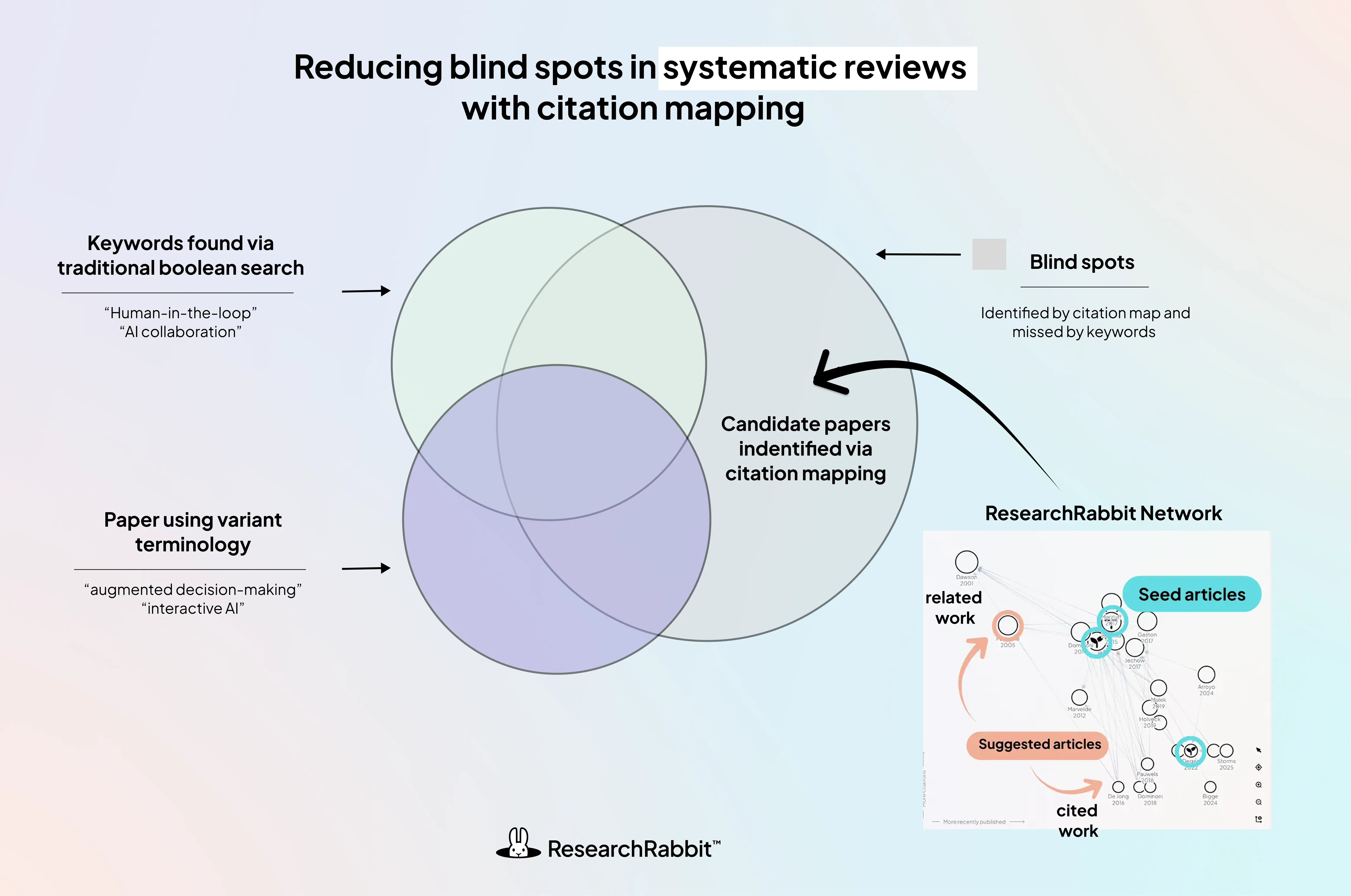
Instead of relying solely on how papers are described, you are also considering how they are used and connected within the research community.
👉 This leads to a more balanced and representative view of the literature.
A more intuitive way to understand the literature
A common starting point in any review is a single relevant paper.
From there, traditional workflows often involve extracting keywords, running multiple queries, and screening results step by step.
With visual discovery, that same paper becomes an entry point into a broader network of research.
You can explore the work it builds on to understand its foundations, follow newer papers that cite it to see how ideas have developed, and identify related studies through shared citation patterns.
As you continue, patterns begin to emerge:
- clusters of research around specific themes
- key authors contributing to particular areas
- connections between topics that initially seemed unrelated
What begins as a single paper gradually becomes:
👉 a network → a cluster → a structured view of the field
This approach does not replace systematic review methodology. It enhances your understanding of the research landscape you are working within.
If you're new to this approach, you can follow a step-by-step guide to using ResearchRabbit to get started.
Limitations and best practices
Systematic reviews rely on structured and reproducible search strategies, including Boolean queries across databases. These approaches provide the foundation for transparency and methodological rigor.
Citation-based and visual exploration can complement this foundation by expanding coverage, revealing connections between studies, and helping identify relevant work that may not appear through keyword search alone.
Visual discovery is not a substitute for structured database search, but it can play a valuable role in expanding and validating coverage.
When used thoughtfully, visual discovery strengthens the review process without changing its underlying principles
Best practices for integrating
To ensure visual discovery strengthens your research without compromising methodological rigor, it is essential to follow a structured integration strategy.
- Use it as a complement, not a replacement
Visual exploration should be used as a complement to structured search, not a replacement. It works most effectively when combined with database queries and clearly defined protocols. - Stay aligned with your inclusion criteria
It is important to stay aligned with your inclusion criteria. Exploration can help expand your pool of candidate papers, but the scope of your review should remain consistent. - Document your process
Documenting your process is equally important. If citation-based exploration is part of your workflow, including it in your methodology helps maintain transparency. - Avoid over-expansion
As with any discovery approach, critical evaluation remains essential. Not every connected paper will be relevant, and careful screening continues to play a key role.
Used in this way, visual discovery supports systematic reviews by improving coverage while preserving rigor.
Why this matters
At its core, a systematic review is about building a clear and complete understanding of a research question.
This involves seeing the literature broadly, understanding how different studies relate to each other, and evaluating them carefully.
Visual literature discovery supports each of these steps. It helps you move from collecting individual papers to understanding how they fit within a larger research landscape.
In systematic reviews, this shift leads to a more connected and well-supported view of the field, strengthening the quality of your conclusions.
Final thoughts
Systematic review methods provide the structure and rigor needed to build a reliable review.
Visual discovery adds another layer by helping you understand how the literature connects and evolves.
When combined, they support a more complete, connected, and well-informed view of the research landscape.
Ready to map your research? Try ResearchRabbit for free and discover the connections you’ve been missing.
%20(800%20x%201036%20px).webp)



This is a big test comment on your article.