



Research today moves faster than ever. Every week, thousands of new papers are published across disciplines, making it harder for you to keep up, stay organized, and focus on what truly matters. Between managing references, finding related work, and identifying research gaps, your productivity can quickly get lost in the noise.
That’s where AI comes in. It reshapes how you work, from automating tasks to supporting writing, planning, and analysis, giving you powerful ways to boost productivity and reduce manual workload.
Yet even with these advances, one challenge always remains: you still need to discover the right literature and understand how it all connects.
This is where ResearchRabbit fits in — a visual, intelligent, and collaborative platform that helps you discover, organize, and understand research far more effectively.
How AI improves research productivity
AI has become one of the most powerful ways you can accelerate your research, improve quality, and reduce the friction in every stage of your workflow.
A recent study in Discover Sustainability (Springer, 2025) shows that AI helps you produce research that is faster, higher-quality, more scalable, and more efficient.
Below are the specific ways AI boosts your productivity, with clear examples so you can see exactly how each part works in practice.
Automating tasks
You don’t need to spend hours on tedious, manual tasks anymore. AI can take over the time-consuming parts of your workflow, like cleaning messy datasets, transcribing interviews, extracting keywords from PDFs, or running repetitive calculations. When you let AI handle these mechanical steps, you free yourself to focus on the actual thinking: interpreting results, building arguments, and shaping your contribution. This shift alone can save you days in every project.
Assisting with writing
Writing is one of the most cognitively demanding parts of research, and AI can help you move through it much faster. You can use AI tools to outline your manuscripts, restructure unclear sections, improve coherence, and fix grammar without losing your voice. You can even check citation consistency automatically. Instead of staring at a blank page, you start with a strong foundation, and you refine from there. This keeps your writing process smoother and more efficient.
Streamlining research planning
Planning your research shouldn’t slow you down. With generative AI, you can quickly refine your research questions, compare possible methodologies, and map out clear project timelines. When you’re unsure how to frame a study or structure a chapter, AI can offer multiple options within seconds. You still make the final decision, but you get past the “where do I start?” stage much faster. This helps you begin every project with clarity and momentum.
Tools like ResearchRabbit also help during this stage by giving you a clearer sense of how different areas of literature connect, which makes planning decisions more grounded.
Facilitating literature reviews
One of the biggest gains comes during the literature review.
AI systems can summarise large groups of papers, extract recurring themes, cluster articles, and highlight influential or highly cited studies.
This helps you understand the shape of a field much earlier, so you know which papers deserve deeper reading.
When you need to explore how these papers relate, for example through citation pathways, author networks, or topic clusters, ResearchRabbit gives you those relationships visually, making the discovery phase easier to navigate.
Improving data analysis
AI tools can analyse complex datasets far faster than manual methods. Whether you're dealing with survey data, text data, behavioral logs, or qualitative transcripts, AI can surface patterns, correlations, and anomalies that would take you much longer to detect on your own. You can use AI for quick exploratory analyses, model testing, or identifying relationships worth investigating further. This helps you build stronger, more evidence-based conclusions in less time.
Challenges and limitations of using AI in research
Even though AI can boost your productivity, you can’t treat it like a magic solution. The value you get from AI depends entirely on how intentionally you use it, and how carefully you check what it produces. There is several limitations you need to keep in mind as you integrate AI into your workflow:
- Algorithmic bias can distort your findings
AI models are trained on imperfect data. If the underlying dataset is biased, the patterns it highlights, or the examples it generates, can skew your research. You need to catch these biases early so they don’t shape your review or analysis incorrectly.
- Data privacy and confidentiality matter
If you're working with sensitive or proprietary data, you need to make sure the tools you use are secure. Uploading raw datasets, or transcripts with personal identifiers, can create privacy risks if the platform isn’t designed to handle confidential information.
- You need new skills to use AI effectively
Prompting, interpreting AI outputs, validating results, and understanding model limitations are now core research skills. If you don’t develop them, AI can slow you down rather than help you.
- Impact varies depending on your task
AI doesn’t enhance every part of research equally. Some tasks, like summarising text or cleaning data, see huge gains. Others may become more complicated or require more manual checking. You need to choose where AI actually adds value instead of trying to force it into every step.
Keys to successful implementation
If you want AI to actually improve your productivity, you need to treat it as a collaborator, not a replacement. The most effective workflows come from combining AI’s speed with your own expertise and judgment. Here are the practices you need to follow to get real value out of AI:
- Use effective prompting
You need to be clear about what you want.
Set the context, define the task, and specify the constraints. Vague prompts lead to vague outputs. When you guide the AI with precise instructions, you get sharper, more accurate results that actually help your research.
- Integrate AI strategically, not blindly
AI can generate ideas, identify patterns, or summarise content, but you decide what’s relevant, valid, and meaningful. Use AI to speed up the mechanical parts, then apply your own critical thinking to refine, evaluate, and interpret. That balance is what leads to stronger conclusions.
- Build your skills so you don’t fall behind
To use AI effectively, you need to improve your prompting, verification, and interpretation skills. These are now essential parts of modern research. If you invest time in learning how to work with AI tools, you make your entire workflow more efficient and reduce the risk of errors.
- Encourage support and structure around AI use
If you’re working in a team, lab, or institution, you need shared guidelines and basic training so everyone works consistently. When leadership supports AI adoption, and people know how to use tools correctly, you avoid resistance, confusion, and inconsistent results.
While AI helps you read, write, analyse, and plan faster, you still need a clear way to discover the right literature in the first place. That’s where tools like ResearchRabbit become useful, by helping you understand how papers connect before you begin analysing them.
What is ResearchRabbit?
ResearchRabbit is a literature discovery and mapping tool that helps you explore how papers, authors, and ideas connect. Instead of scrolling through long lists, you can see visual relationships and understand how a field develops over time.
Powered by sources like Semantic Scholar, Crossref, and OpenAlex, it gives you an updated, structured view of the research landscape, which pairs naturally with AI tools that help you read, summarise, or analyse the papers you find.
How ResearchRabbit Boosts Research Productivity
AI can help you analyse and write faster, but you still need a powerful way to discover the right papers and understand how they connect. That’s where ResearchRabbit elevates your workflow. It gives you a clearer, faster, and more intuitive way to explore your field so you can move from scattered reading to focused discovery.
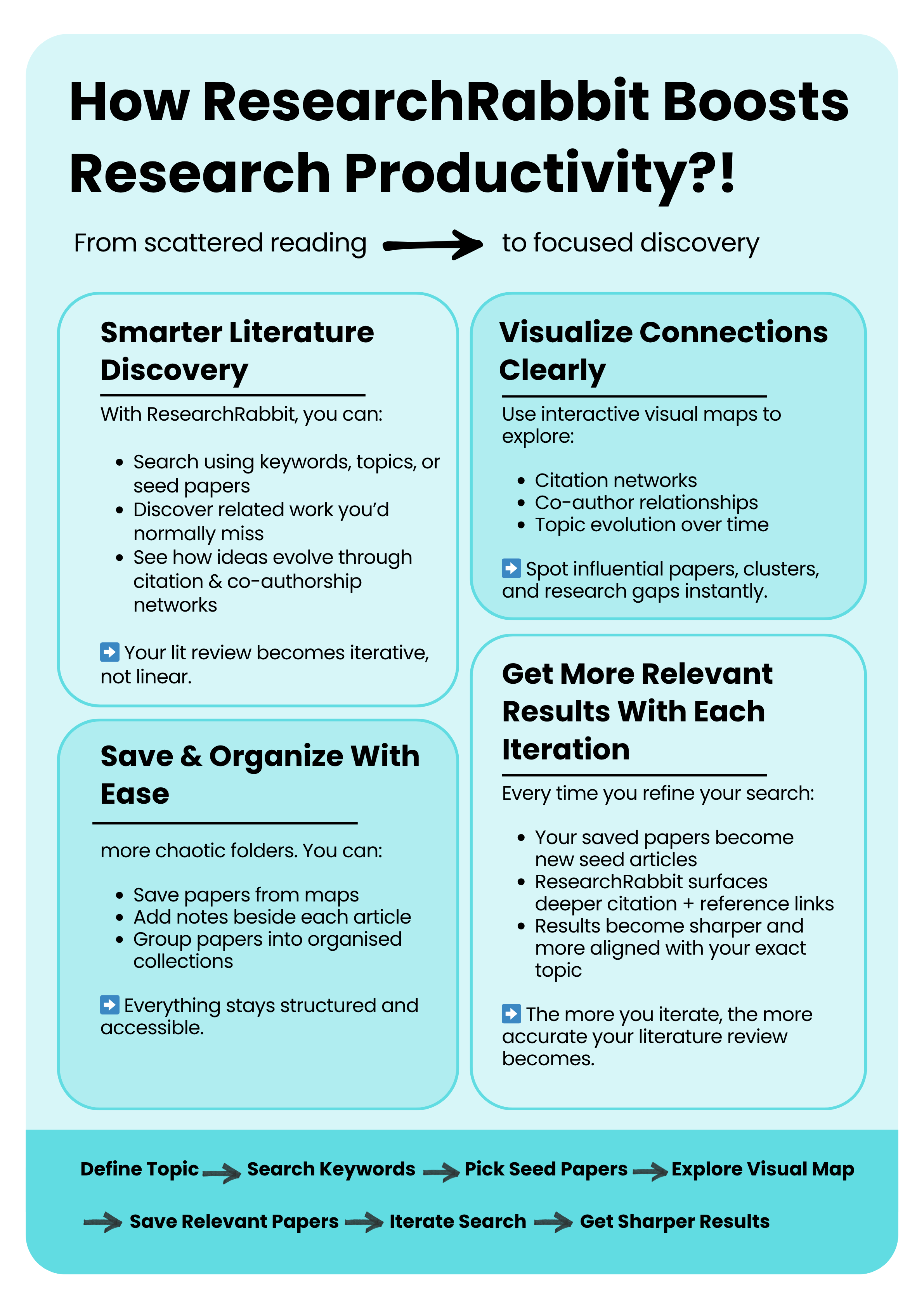
1️⃣ Smarter Literature Discovery
Many AI tools support research in general, but you need something that strengthens your literature exploration directly, and that’s where ResearchRabbit helps you.
You can:
- Search using keywords, topics, or seed papers
- Discover related work you would normally miss in traditional databases
- Visualize how ideas evolve through citation and co-authorship networks
This lets you turn your literature review from a repetitive, linear search into an iterative discovery workflow that grows with you.
2️⃣ Visualize Connections and See the Bigger Picture
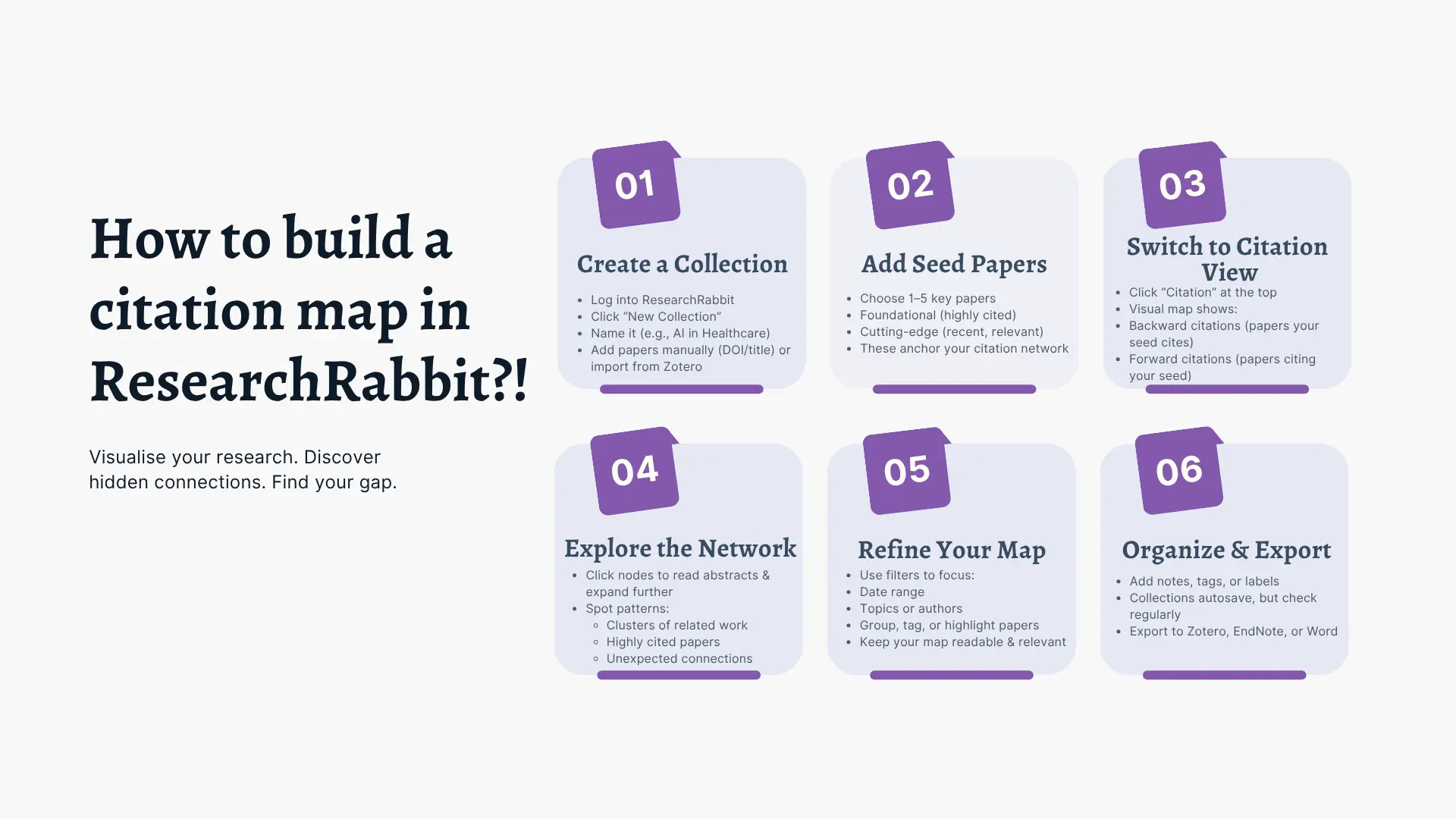
Instead of scrolling through endless static lists, you can use ResearchRabbit’s interactive visual maps to understand how the research landscape fits together.
You can explore:
- Citation networks between papers
- Co-author relationships and collaboration patterns
- The evolution of key topics across time
This helps you trace the story of a field and quickly spot the influential studies, emerging clusters, and gaps you need to pay attention to.
3️⃣ Save and Organize with Ease
Stop managing scattered folders, random PDFs, and chaotic bookmarks.
You can use ResearchRabbit to:
- Save papers directly from visual maps
- Add notes and keep your thoughts beside each paper
- Group related research into clean, searchable collections
Everything stays organized and accessible across your devices, so you always know exactly where things are.
4️⃣ Get More Relevant Results With Each Iteration
Each time you iterate your search in ResearchRabbit, your results become sharper and more aligned with your exact topic. As you save papers and add them to your collection, you give ResearchRabbit new “seed” articles to work from, and the system uses these seeds to surface papers with deeper citation, reference, and topical links. Instead of repeating broad or generic results, every new round tightens the focus and highlights studies that match the direction you’re actually heading. The more you explore, save, and refine, the better your recommendations become. This iterative approach gives you a cleaner, more targeted literature review, without wasting time on irrelevant papers.
Getting Started with ResearchRabbit
- Visit researchrabbit.ai
- Create a free account
- Search, save, visualize, and build your first collection
Whether you’re preparing a literature review, exploring a new topic, or leading a research team, ResearchRabbit helps you work smarter, not harder.
Conclusion
The best research happens when your tools remove friction instead of adding to it. AI helps you read, write, analyse, and plan more efficiently, while ResearchRabbit gives you a faster and clearer way to discover the right literature and understand how it all connects.
Together, they streamline your workflow from the very first search to the final draft, helping you stay organised, work more intentionally, and uncover insights that truly matter.
If you want to build a more efficient, confident, and connected research process, combining AI with ResearchRabbit is one of the smartest ways to start.
%20(800%20x%201036%20px).webp)



This is a big test comment on your article.