


Identifying a research gap is one of the most important and challenging steps in the research process. Whether you are an undergraduate student, a PhD candidate, or an experienced researcher, your work needs to contribute something new. That element of newness is what defines a research gap.
In this article, you will learn what a research gap is, understand the main types of gaps, walk through a clear research gap example, and see how you can identify gaps in the research today.
What is a research gap?
A research gap is something important that existing studies have not fully addressed yet. It may be an unanswered question, an area that has not been explored in enough depth, or a perspective that is largely missing from the literature. Put simply, a research gap is the space between what you already know from existing research and what still needs to be understood.
In practical terms, a research gap exists when key questions remain unanswered, when certain populations, methods, or variables have been overlooked, or when existing findings are outdated, inconsistent, or incomplete. Identifying a gap of research matters because it explains why your study is necessary and how it adds new value to the field instead of repeating what is already known.
Key aspects of a research gap
Not every gap you notice will make a strong foundation for a research project. To move your work forward, you need to focus on gaps that have a few essential characteristics.
Your research gap needs to be relevant, meaning it addresses an issue that genuinely matters to the field rather than a minor or purely academic detail. It also needs to be evidence-based, emerging from a careful review of existing literature rather than assumptions. You must be able to research the gap realistically using the data, methods, and time available to you. Finally, the gap should offer something original, such as a new perspective, context, or approach, rather than repeating well-established findings.
When these elements are in place, your research gap clearly connects what is already known to meaningful questions that still need to be explored.
Types of research gaps
When you start looking for a research gap, this is often where things become confusing. Different sources use different terms, and the lists do not always match. In practice, however, most gaps in the research fall into a small number of core categories. The labels may vary, but the underlying logic stays the same.
Below are the most common types of research gaps, explained in a way that reflects how you will actually encounter and use them.
1. Knowledge or evidence gaps
A knowledge gap exists when there is still limited understanding of a topic or when important questions have not been answered. You may also see this described as an evidence gap, especially when claims exist but are not supported by strong empirical data.
This type of gap forces you to ask a simple question: what do you still not know?
Example:
There is limited evidence on how you can identify research gaps using AI-based discovery tools.
2. Theoretical or conceptual gaps
A theoretical gap appears when existing theories or conceptual frameworks fail to fully explain a phenomenon. In some cases, the problem is not missing data but unclear or incomplete explanations of how key concepts relate to one another. These are often described as conceptual gaps, and the two terms are commonly used interchangeably.
This type of gap requires you to ask how a phenomenon should be explained.
Example:
Current theories of information retrieval do not adequately explain exploratory research discovery.
3. Methodological or empirical gaps
A methodological gap highlights limitations in how previous studies have been carried out. You may notice narrow study designs, small sample sizes, or heavy reliance on a single method. Closely related to this is the empirical gap, which points to a lack of robust or validating data.
Here, you need to ask how the topic has been studied so far and what is missing from those approaches.
Example:
Prior studies rely on small qualitative samples, with little large-scale empirical validation.
4. Population or context gaps
A population gap appears when research focuses on a limited group, location, or context while other relevant populations remain underexplored. You will encounter these gaps frequently in interdisciplinary and global research.
This gap pushes you to ask who or where has been studied and who has been left out.
Example:
Most research focuses on senior academics, with limited attention to early-stage researchers.
5. Practical or application gaps
A practical gap, sometimes referred to as a practical-knowledge conflict gap, exists when research findings do not translate well into real-world practice. In these cases, knowledge may exist, but it is not being applied effectively.
This type of gap requires you to understand why existing knowledge is not being used in practice.
Example:
Although best practices for literature review exist, little research examines how they are applied in real research workflows.
Even though different sources use different labels, you can understand most gaps in the research through these core types. The specific terminology matters less than the reasoning behind the gap.
When you ask questions like how to find a gap in research, where gaps in the research exist, or what makes a meaningful gap of research, you are usually identifying one or more of these categories, even if you describe them using different words.
Research gap example
Imagine you are exploring how AI tools are used in academic research. As you review the literature, you may notice that many studies focus on AI for literature search, that most of this research is concentrated in STEM fields, and that very little attention is paid to how early-stage researchers use AI for idea discovery. Taken together, these patterns point to a clear research gap.
You could frame this gap as follows: while existing studies examine AI-assisted literature search in STEM disciplines, there is limited research on how early-stage researchers in the social sciences use AI tools to identify research gaps. This gap works because it is specific, grounded in existing literature, and realistic for you to investigate within a research project.
Common mistakes when identifying gaps
You may struggle to identify a clear research gap if you fall into a few common traps. One frequent mistake is confusing a general topic of interest with an actual research gap. Another is claiming that no studies exist without thoroughly reviewing the literature. You may also define gaps that are too broad to be useful or so narrow that they add little real value. Treating the limitations of a single paper as a full research gap is another common error.
Learning how to find a gap in research requires careful reading, comparison, and synthesis, not just skimming abstracts or conclusions.
Why finding research gaps is difficult
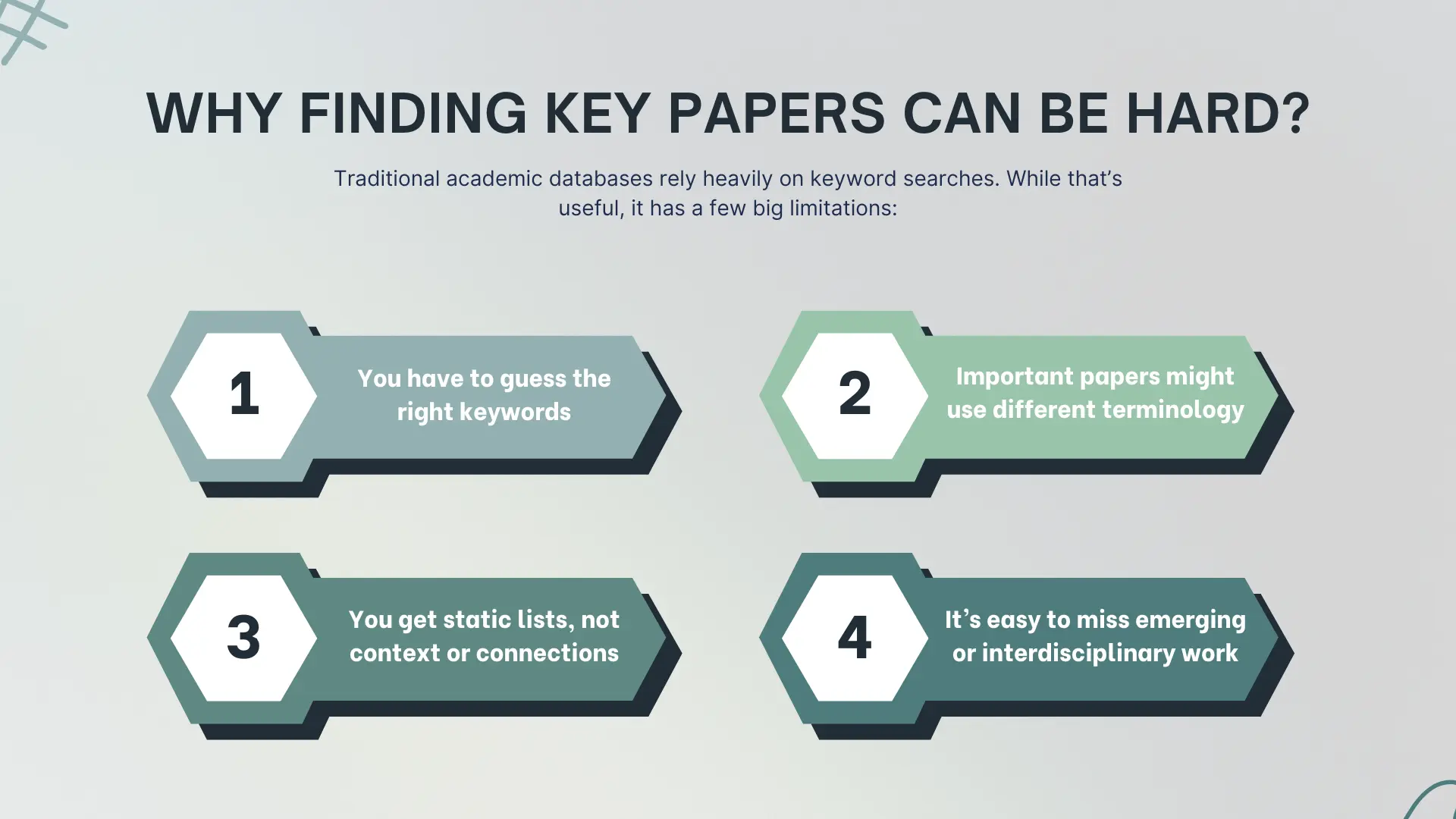
Identifying meaningful research gaps is difficult because modern research landscapes are crowded and constantly changing. Thousands of papers are published every week, often using different terminology to describe similar ideas. Research gaps are rarely stated explicitly, which means you usually need to infer them rather than find them directly. Relevant studies may also be spread across multiple disciplines, making it harder for you to connect them.
If you are early in your research journey, the lack of a clear mental map of the field can make it especially difficult to see where gaps in the research truly exist. As a result, identifying a strong research gap often takes significant time and mental effort.
How you identify research gaps today
Traditionally, you would identify research gaps through manual literature reviews, extensive note-taking, and repeated reading. While these approaches still matter, you can now strengthen them with digital tools that help you work more efficiently and at greater scale.
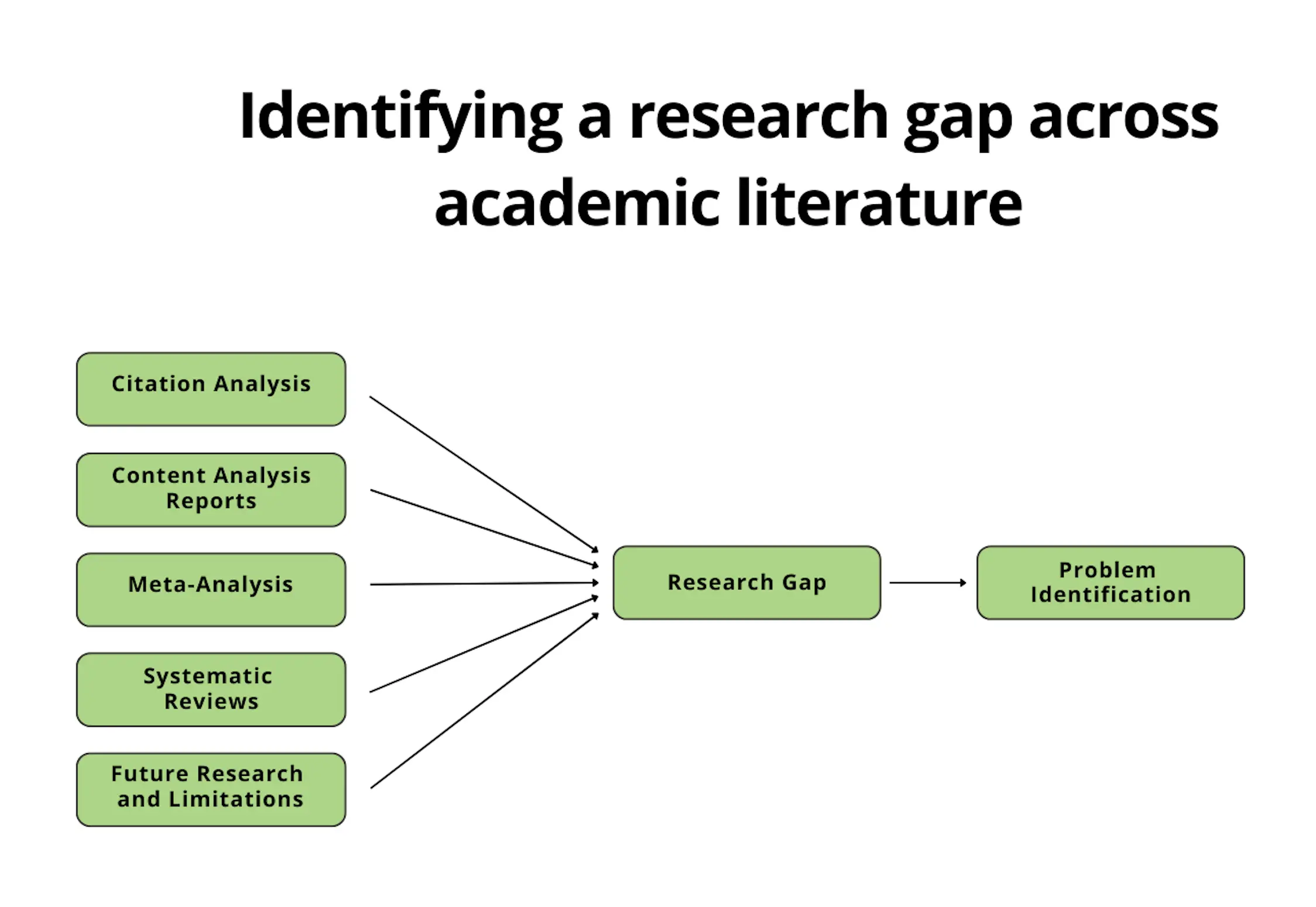
Today, you can map citation networks to see how ideas connect, track emerging themes across clusters of papers, and compare heavily studied areas with those that remain underexplored. You can also use AI-assisted tools to surface patterns, contradictions, and blind spots in the literature.
If you’re unsure where to start when thinking about how to find a gap in research, check out our guide on How to find a research gap using ResearchRabbit for a step-by-step approach that helps you move beyond simple keyword search and toward conceptual discovery. These approaches make it easier to define a clear and defensible research gap.
Final thoughts
A research gap is not simply something missing from the literature. It is an opportunity for you to move knowledge forward in a meaningful way. By understanding different types of gaps, avoiding common mistakes, and using modern discovery methods, you can position your work more confidently within the academic landscape. Finding the right gap of research takes time and effort, but it forms the foundation of impactful and original scholarship.
%20(800%20x%201036%20px).webp)




This is a big test comment on your article.