



Finding research papers is the easy part. Most databases will return thousands of results for almost any query. The harder part, the part that actually shapes your literature review, is figuring out which of those papers are worth building on.
This is a skill researchers develop over time, often through trial and error. But there are frameworks that can help you get there faster. In this guide, we walk through the signals that actually matter when evaluating paper quality, the common mistakes that trip up even careful researchers, and how tools like ResearchRabbit can make the whole process more systematic and less stressful.
What makes a research paper high-quality? (Beyond the basics)
Most researchers start with the obvious markers: published in a journal, has a methods section, been cited a few times. These aren't wrong. But they're not enough on their own.
Quality in academic research is contextual. A paper can have modest citations and still be landmark work, simply because the field is small. A paper with thousands of citations might be influential mainly because it introduced a methodology that others later criticised. And a paper from 2004 can be more current in its ideas than something published this month.
This is why quality evaluation can't be reduced to a single number or badge. It involves reading signals together, not in isolation.
Here are the ones that matter most.
Methodological rigor is the foundation. Can you understand exactly how the study was conducted? Are the limitations acknowledged honestly rather than buried in the discussion? Do the conclusions actually follow from the data? A paper that overstates what its findings can tell you is a problem regardless of where it was published.
Theoretical grounding tells you whether the paper is in genuine conversation with the field or treating its findings as if they exist in a vacuum. Papers that engage seriously with existing literature tend to be more reliable, and easier to connect to your other sources.
Transparency is increasingly important. Open data, pre-registration, and clear descriptions of analytic choices are signs of a paper that has nothing to hide. When a paper is vague about its methods, or when results look suspiciously clean, that's worth noting.
Peer review matters, but it's often over-weighted by students. Peer review is a filter, not a guarantee. It fails sometimes. Replication crises happen. What matters more is how the broader research community has engaged with the work, whether it's been challenged, built on, or replicated by others.
Relevance to your specific question is the one signal no external metric can assess for you. A methodologically perfect paper that doesn't speak to your research question is less useful than a more modest paper that directly addresses your gap. You'll need to make this call continuously throughout your review, not just once at the beginning.
Citation count and impact: useful, but not the whole picture
Citation counts are the first thing most researchers look at, and for good reason. A paper that's been cited frequently usually means other researchers found it useful or important enough to engage with.
But citation counts come with some important limitations.
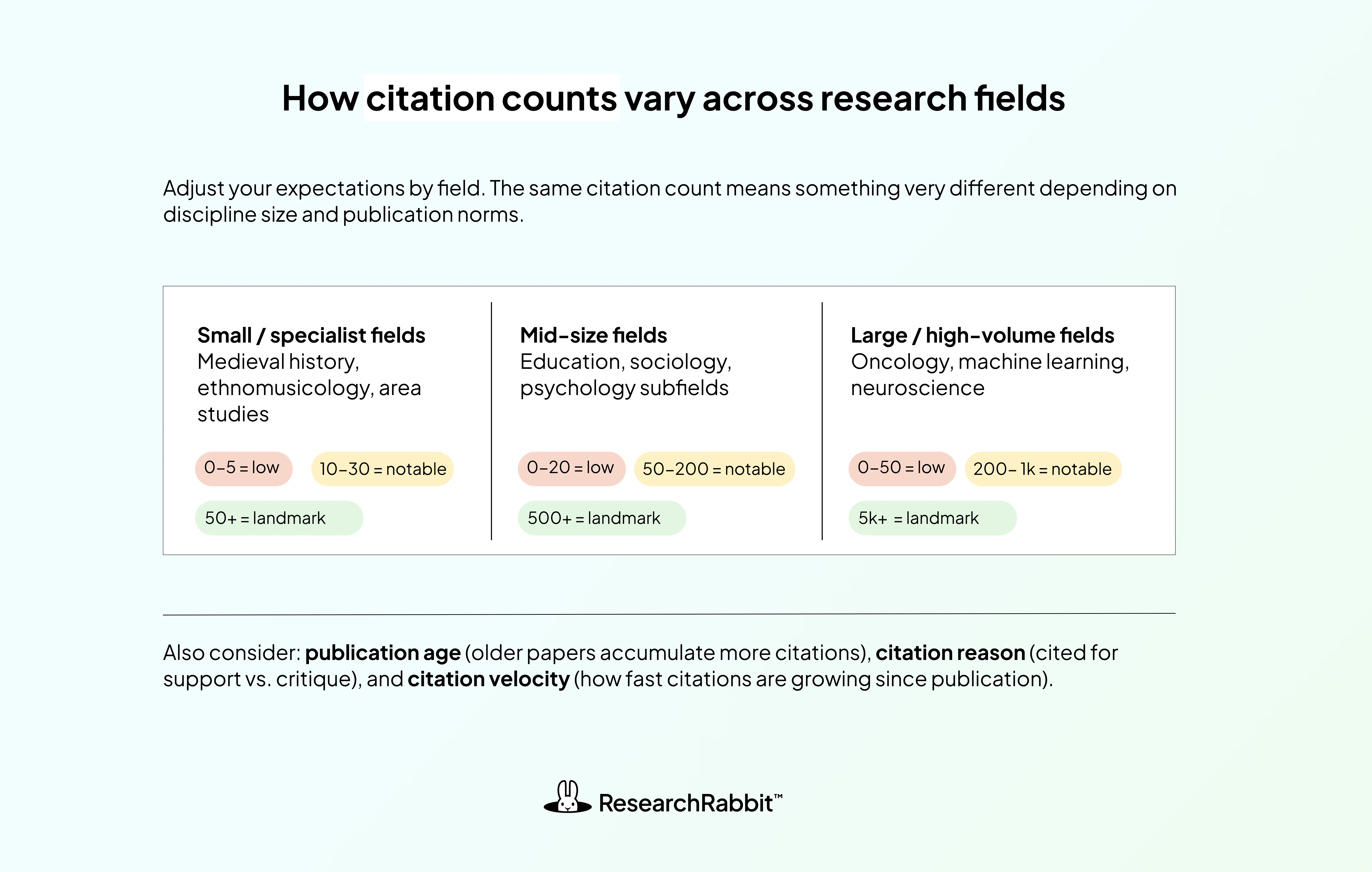
Field size is the biggest one. Citation norms vary a lot between disciplines. In a large field like machine learning or oncology, a paper with 500 citations might be moderately well-known. In a specialist area of medieval studies or ethnomusicology, 50 citations might represent extraordinary reach. Comparing counts across fields, or even across subfields, doesn't tell you much without that context.
Publication age creates a related issue. A paper published in 2022 has had a few years to accumulate citations. One published in 1995 has had more than thirty. Raw counts systematically benefit older work. This is why citation rate, how quickly a paper is being cited since it was published, can sometimes be a better signal than the raw total.
Citation reason is almost never captured in the number itself. Papers can be cited because they introduced an influential methodology, because their findings became a foundation others built on, or because they made a claim that others have spent years trying to refute. A paper cited a thousand times for the wrong reasons is a different thing entirely from a paper cited two hundred times because it changed how a field thinks.
None of this means you should ignore citation counts. They're still useful as a first-pass signal. But treat them as a starting hypothesis, not a conclusion. And when a highly cited paper appears in your search results, it's worth asking why it's been cited, not just noticing that it has.
For a detailed breakdown of what citation counts mean by field and career stage, see our guide to what is a good citation count for a research paper.
Recency vs. lasting influence: how to find the right balance
There's a quiet tension in most literature reviews between two understandable goals: wanting to include the most recent work (to reflect the current state of knowledge) and recognising that some older papers remain essential no matter when they were written.
Both of these goals are right. The skill is knowing where each applies.
Recency matters most in fast-moving fields. In machine learning, genomics, or climate science, a paper from 2018 might describe a landscape that has since changed significantly. In these areas, your review should be anchored in recent publications, with older work cited mainly for background or contrast.
Lasting influence matters for foundational work. Every field has papers that defined the terms of debate, introduced the core frameworks, or produced findings strong enough that researchers still build on them decades later. These papers matter regardless of when they were published. Leaving them out because they're old leaves your literature review without its intellectual foundation.
A practical question to ask: has the field meaningfully moved beyond what this paper argued? For strong theoretical and methodological contributions, the answer is often no. For empirical findings in fast-moving areas, it's often yes.
Seminal papers sit in their own category. These are papers so consistently cited and so foundational to a field that excluding them can create a real gap in your literature review.
One of the easiest ways to identify them is through citation networks. If the same paper keeps appearing across many of your sources, it’s usually a sign that it plays an important role in the field.
Tools like ResearchRabbit make this easier by surfacing papers that sit at the centre of the citation network, especially papers connected to multiple seed papers.
Journal rankings, impact factors, and where they fall short
Journal metrics are everywhere in academia, and it's worth understanding what they actually measure, and where they stop being useful.
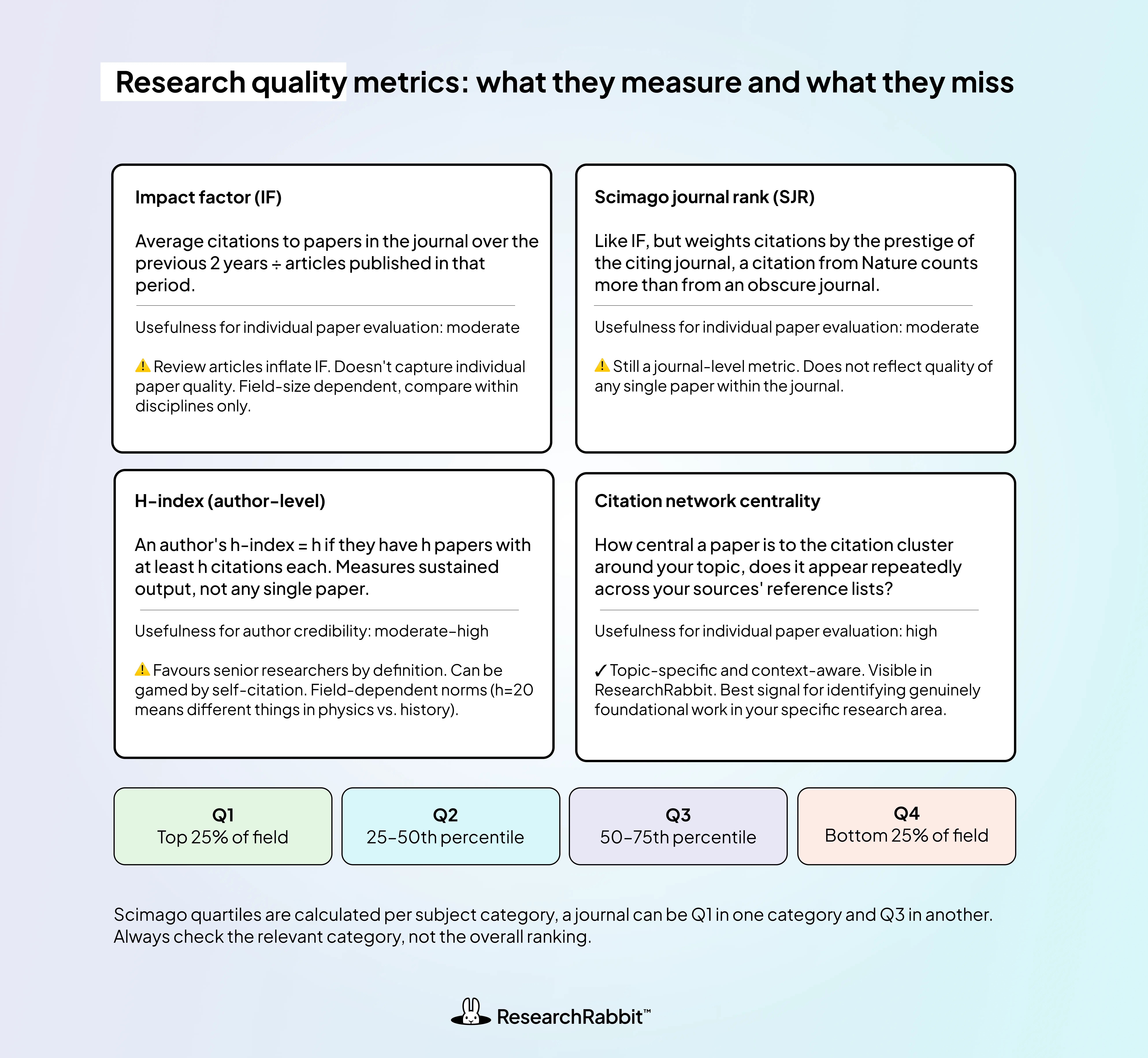
The impact factor of a journal is the average number of citations received by papers published in it over the previous two years. A high impact factor means papers in that journal tend to get cited a lot. It says nothing directly about the quality of any individual paper within it. A paper in Nature can be wrong. A paper in a modest specialist journal can be exactly what you need.
Scimago quartile rankings (Q1–Q4) rank journals based on how influential they are within their field. They can give you a general sense of how respected a journal is compared to others in the same subject area. But like impact factors, they also have limitations. They measure the reputation of the journal, not necessarily the quality of every individual paper published in it. There are also a few other things worth keeping in mind. Review articles often increase a journal’s impact factor because they tend to receive more citations than original research papers. Citation patterns also vary a lot between fields, so journals in lower-citation disciplines can appear weaker simply because researchers in those areas cite less frequently overall. And sometimes, journal prestige reflects history and academic gatekeeping as much as research quality itself.
Preprints are increasingly important in fields like physics, economics, and biology. Important work often appears on arXiv, SSRN, or bioRxiv months or years before formal publication. Evaluating preprints requires a bit more individual judgment, checking the methods carefully, looking at the authors' track record, and seeing whether the preprint has been discussed or critiqued elsewhere.
The sensible approach to journal rankings is to use them as one signal among several. A paper in a high-ranking journal has passed a filtering process, and that’s worth something. But it shouldn’t replace your own evaluation of the paper itself.
Our guide to how to check journal rankings quickly walks through exactly how to do this.
How researchers actually assess quality today
Experienced researchers rarely evaluate papers in isolation. They read them in context, looking not just at what a paper claims, but also at how it fits into the broader research landscape around it.
This kind of contextual reading has traditionally required years of field-specific knowledge. Citation networks make it more accessible earlier.
This matters for quality assessment in a few concrete ways.
It's easier to spot retractions and contested findings when you can see how a paper has been cited over time. If a highly cited paper is being challenged by many of the papers that reference it, that pattern shows up in the network before you've committed to using it as a foundation.
It's also easier to trace how research methods evolved over time. Understanding which papers introduced the methods that others built on, and whether those methods have held up, becomes much clearer when you can follow citation chains rather than reading each paper separately.
And calibrating recency is simpler. You can see which recent papers are accumulating citations quickly (likely important) versus which are new but still uncited (too early to assess). This helps you prioritise where to spend your reading time.
The combination of traditional evaluation, critical reading, checking journal quality, noting citation count, with citation network exploration gives you a richer picture of quality than either approach alone.
A quick checklist for evaluating research papers
When you're working through a large stack of potential sources, having a consistent framework helps you make faster, more reliable decisions about what to include, read closely, or set aside.
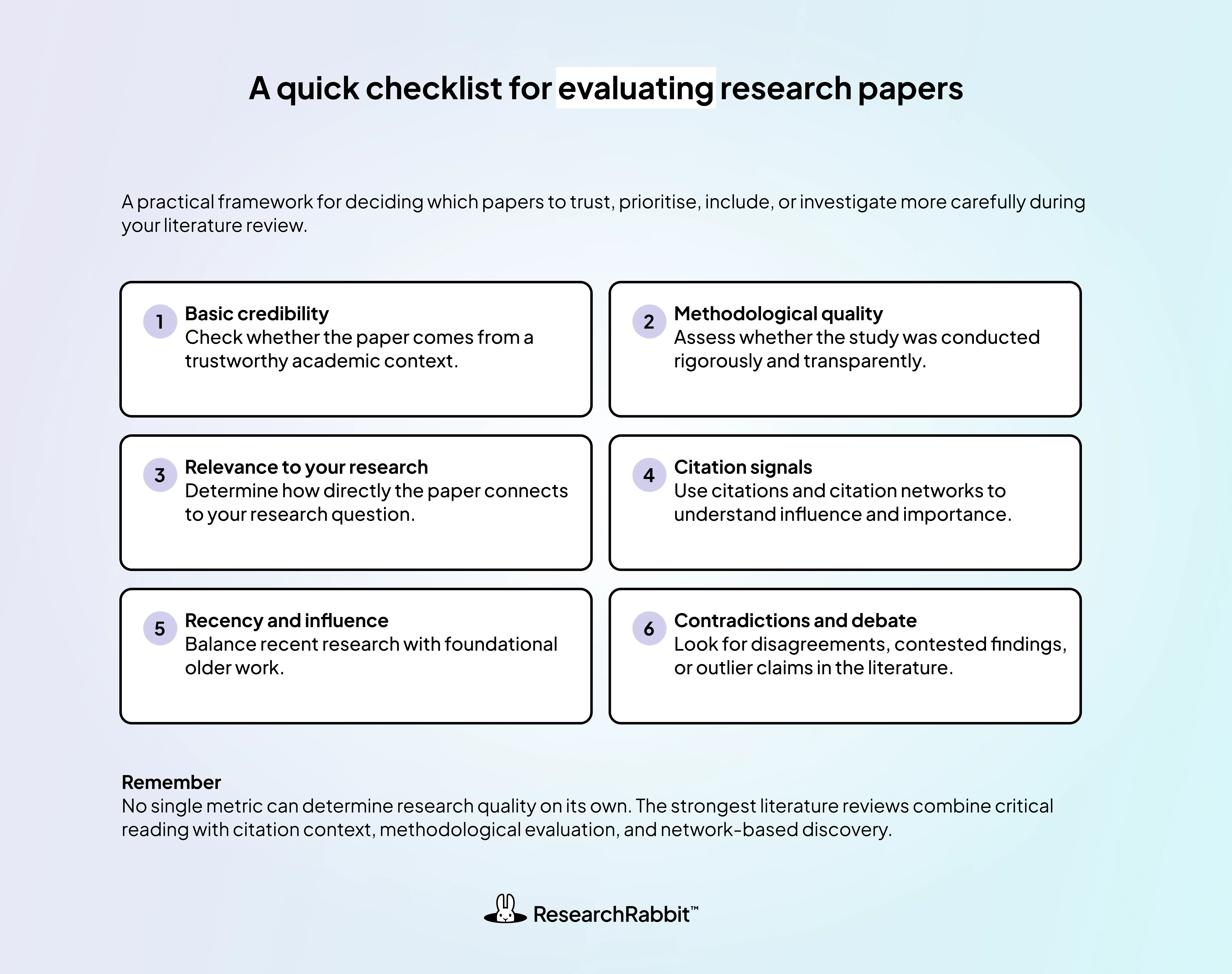
1. Basic credibility check
Is it peer-reviewed, or a credible preprint? Do the authors have a track record in this area? Is the journal reputable within this field? Is there a conflict-of-interest statement?
2. Methodological scan
Does the methods section give enough detail to understand what was actually done? Does the sample size seem appropriate for the claims being made? Are limitations acknowledged honestly? Do the conclusions follow from the data, or does the paper overreach?
3. Situational relevance
Does this paper directly address your research question, or is it only loosely related? Is the context, population, or setting transferable to yours? Is it the type of evidence, theoretical, empirical, or a review, that your literature review currently needs more of?
4. Citation signal
How many citations does it have, adjusted for your field's norms and the paper's publication age? Is it cited by papers you already know are important? Does it keep appearing in your ResearchRabbit network, suggesting it's central to your topic's citation cluster?
5. Recency fit
Is it recent enough for a fast-moving field, or a foundational piece that remains relevant regardless of age? Has the field moved substantially beyond what this paper argued?
6. Contradiction check
Does this paper conflict with others you're planning to include? If so, is that tension documented and debated in the broader literature, or is this an outlier finding that deserves extra scrutiny before you build on it?
For a deeper look at how to evaluate any paper in under five minutes, see how to evaluate a research paper quickly.
Common mistakes when evaluating papers
Even careful researchers fall into predictable patterns. Knowing what they are makes them easier to catch in your own work.
Treating citation count as a quality stamp. This is the most common mistake. High citation counts often reflect influence, and influence can be related to quality, but the two are not the same thing. A paper can be widely cited because it introduced a useful tool, because it made a provocative claim that generated debate, or simply because it was first on a topic and got picked up as background context for decades. Always ask what the paper is being cited for, not just how often.
Stopping at journal prestige. Finding a paper in a high-impact journal is usually a good sign, and it's a reasonable positive signal. But it becomes a mistake when it replaces rather than supplements your own critical reading. Some of the most-discussed retractions of recent years appeared in top journals.
Applying your field's norms to other fields. What counts as strong causal evidence in economics (a well-designed natural experiment) is considered weak in medicine (where randomisation is expected). What counts as a reasonable sample size in one discipline can seem too small in another. When you're working across fields, take time to understand each field's methodological standards before applying your own.
Dismissing older papers by default. In fields with stable theoretical consensus and well-established methods, foundational papers from decades ago are often the most reliable work available; they've been tested, challenged, and either validated or revised over time. Excluding them because they're old creates a gap in your review's intellectual foundation.
Relying entirely on keyword search. The papers that appear first in keyword search results are the ones most optimised for the terms you searched for. They're not necessarily the most important papers in a field. Building a review exclusively from keyword results risks missing foundational work that uses different terminology, important papers in adjacent disciplines, and emerging research that hasn't yet accumulated the citations that push it to the top of search pages. This is where citation-based discovery adds something keyword search genuinely can't, it surfaces papers by intellectual relationship rather than word match.
Including papers without reading them critically. The pressure of a large literature review can push researchers toward skimming abstracts and accepting authors' framings of their own findings. This produces reviews that look comprehensive but misrepresent the actual state of knowledge. When time is short, it's better to include fewer papers you understand well than more papers you've only skimmed.
Not tracking where papers came from. Note how you found each source, whether through a keyword search, a citation chain, a supervisor's recommendation, or a ResearchRabbit connection. If all your sources came from a single narrow search, that's a signal your review might have systematic gaps you haven't noticed yet.
Putting it together: a practical workflow
The workflow most experienced researchers use combines targeted database searching with citation-based exploration, and the two approaches work better together than either does alone.
Start with a few database searches to build an initial understanding of the topic and identify a few clearly relevant papers. These become your seed set. Add them to ResearchRabbit and explore the citation landscape around them. Which papers do your seeds share as common references? Those are likely foundational. Which recent papers cite your seeds? Those might represent emerging responses to the work you're already reading.
As your collection grows, apply the checklist above to each paper you're considering. Is it methodologically sound? Does it address your specific question? Does it appear across multiple branches of your network, suggesting it plays an important role rather than a minor one?
The goal isn't to include every paper that touches your topic. It's to build a representative, high-quality set of sources that accurately reflects the intellectual landscape of your research question, including the foundational work that shaped the conversation, the empirical studies that tested the core claims, and the recent contributions that show where the field is heading.
Quality evaluation isn't a one-time filter you apply at the start of a literature review. It's an ongoing judgment that gets sharper as your understanding of the field deepens.
FAQ
How do you know if a research paper is high quality?
High-quality research papers are usually methodologically sound, relevant to the research question, transparent about limitations, and well connected to the broader literature. Citation count and journal prestige can help, but they should never be used alone.
Is citation count a good indicator of paper quality?
Citation count can indicate influence, but not necessarily quality. Some papers are highly cited because they introduced widely used methods or controversial claims. Citation counts also vary significantly across research fields.
How many citations is considered good for a research paper?
There is no universal number. A strong citation count depends on the field, the paper’s age, and the size of the research community. In some disciplines, 50 citations may be exceptional; in others, it may be average.
Are older research papers still useful in literature reviews?
Yes. Foundational or seminal papers often remain essential even decades after publication. Older papers can provide the theoretical background and core frameworks that newer studies build on.
What is the difference between impact factor and Scimago ranking?
Impact factor measures the average number of citations received by papers in a journal over a specific period. Scimago rankings (SJR) also consider the prestige of the journals providing those citations. Both are journal-level metrics, not direct measures of individual paper quality.
What are seminal papers?
Seminal papers are foundational studies that strongly influenced the direction of a research field. They are usually cited consistently across many later papers and often appear repeatedly in citation networks.
How can citation networks help with literature reviews?
Citation networks help researchers identify foundational papers, trace methodological development, discover related work outside keyword searches, and spot influential or contested studies more efficiently.
Is peer review enough to trust a research paper?
No. Peer review is an important quality filter, but it is not a guarantee that a paper is correct or reliable. Researchers should still evaluate the methodology, evidence, transparency, and broader scholarly response to the work.
How do researchers find important papers they might otherwise miss?
Researchers often combine keyword-based database searches with citation-based discovery methods. Exploring citation networks can reveal foundational and highly connected papers that may not appear in standard search results.
What is the best way to evaluate papers for a literature review?
The best approach combines critical reading, methodological evaluation, citation context, journal quality signals, and citation network exploration. No single metric can reliably determine paper quality on its own.
%20(800%20x%201036%20px).webp)


This is a big test comment on your article.