


When you’re building a literature review, your goal isn’t just to collect papers, it’s to develop a clear and structured understanding of your research field.
As you explore, one of the most valuable things you can gain is a sense of coverage: the confidence that you’ve seen the key ideas, important studies, and the different directions your topic has taken.
This doesn’t usually happen all at once. It builds gradually, as your understanding becomes more connected.
Citation mapping supports this process by helping you move beyond isolated results and toward a more complete view of the literature, one that reflects how research is actually structured.
In this guide, you’ll learn how citation mapping can improve your literature review by helping you find relevant papers, expand coverage, and build a more complete understanding of your topic.
What coverage means in research
When you think about coverage, it’s easy to focus on volume, how many papers you’ve read or saved.
But in practice, research coverage is about perspective, not just quantity.
As your coverage improves, you begin to see your topic from multiple angles. You can recognise:
- the foundational work that shaped the field
- the newer studies that reflect current thinking
- different approaches taken by different researchers
- and how these ideas relate to each other
This is what allows you to move from reading papers individually to understanding how they fit together as a whole.
Over time, this makes your literature review more structured, more coherent, and easier to build on.
How citation mapping expands your scope
Every paper you work with is part of a larger network.
It connects to earlier research through its references, and to newer research through citations. It also sits alongside other papers that explore similar ideas.
Citation-based exploration helps you follow these connections in a natural way.
Instead of relying only on what you can think to search for, you expand your scope by following how research connects across the literature.

For example, you can:
- Move Backward (Trace the Roots): Travel down the reference list to find the foundational theories and "giant's shoulders" on which the paper stands. This helps you understand the historical context and the original problems the field tried to solve.
- Move Forward (Track the Evolution): See who has cited the paper since it was published. This reveals how the initial idea has evolved, where it has been contested, and what its most modern, cutting-edge applications are today.
- Move Sideways (Discover the Ecosystem): This is where the magic happens. You find papers that may not cite each other directly but share a deep intellectual connection, perhaps they use the same core datasets or build on the same niche theories.
Why it matters: It breaks the "Keyword Prison." You’ll discover influential work from adjacent fields or researchers who use different terminology for the same concepts, effectively eliminating the biggest blind spots in your review.
As you navigate these directions, your exploration shifts from a random collection of PDFs to a structured map. You aren’t just adding papers to a list; you are witnessing the conversation of science as it unfolds.
Reducing blind spots in literature reviews
One of the challenges in research is the blind spot, areas of the literature that you never encounter because they don’t match your initial assumptions or keywords.
These blind spots can come from:
- different terminology used in adjacent fields
- niche subtopics that don’t appear in top search results
- or papers that are influential within a cluster but not globally
Citation mapping helps reduce this risk.
Because it surfaces papers based on how they are connected, not just how they are described, it can reveal:
- clusters of work you didn’t know existed
- authors who consistently contribute to a niche area
- and relationships between papers that aren’t obvious from search alone
👉 In practice, this leads to a more balanced and less biased view of the literature. Citation mapping works best as a complement to keyword search, not a complete replacement, together they give you both precision and breadth.
Practical examples
Imagine you start with a single paper that feels relevant to your research.
At first, it’s just one study. But it quickly becomes a starting point.
You look at the papers it cites to understand where the idea came from, using citation networks to see how that work connects to others. Then you explore newer papers that cite it, seeing how that idea has evolved over time.
As you continue, you begin to notice other papers that are frequently mentioned alongside it. These often turn out to be closely related, sometimes even more relevant than what you initially found.
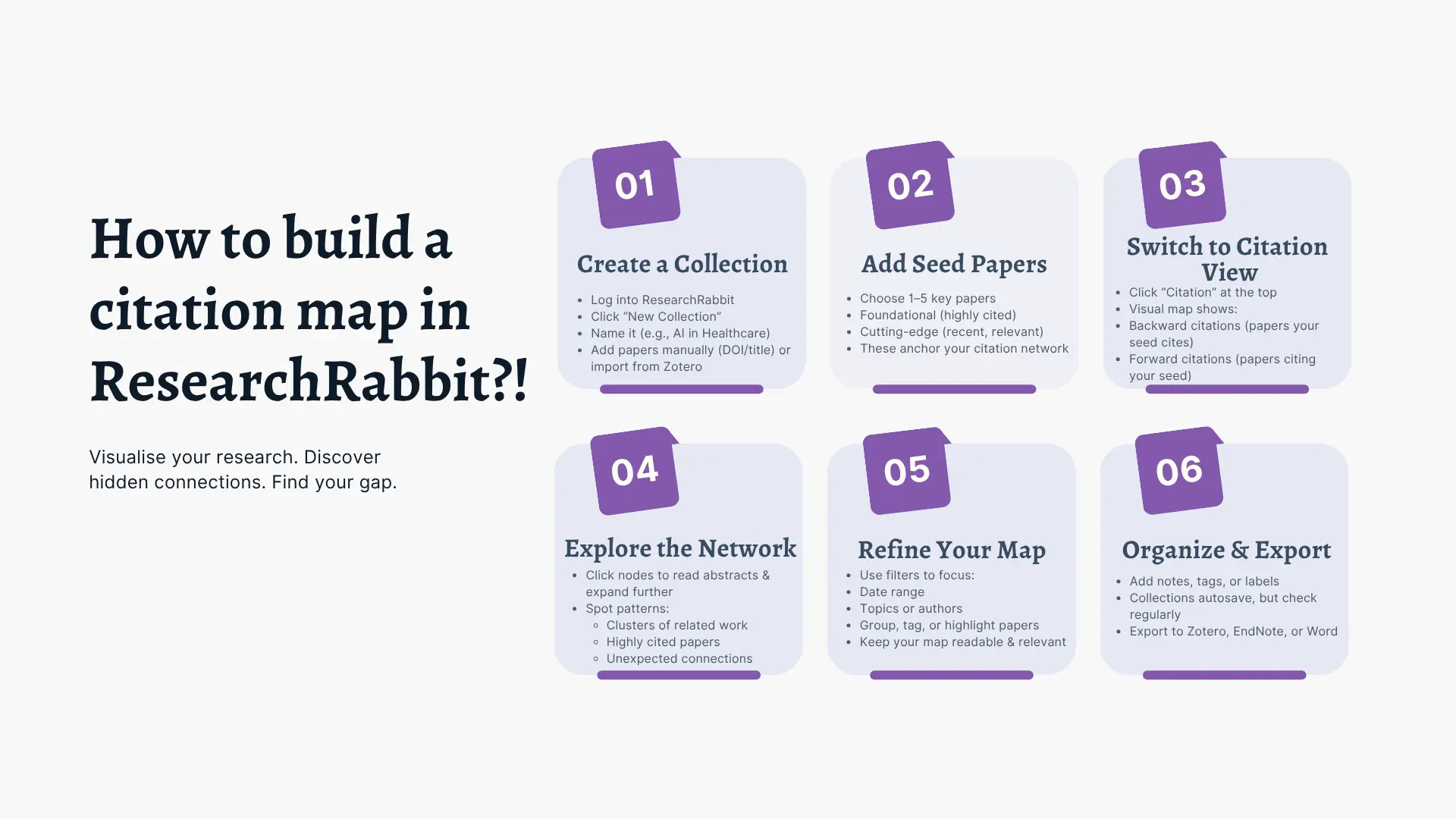
With ResearchRabbit, this process becomes highly visual and intuitive. When you switch to the Visualise tab (or Citation view), each paper appears as a node in an interactive network. The connections between them show how ideas relate through citations, making it easy to spot clusters of related research.
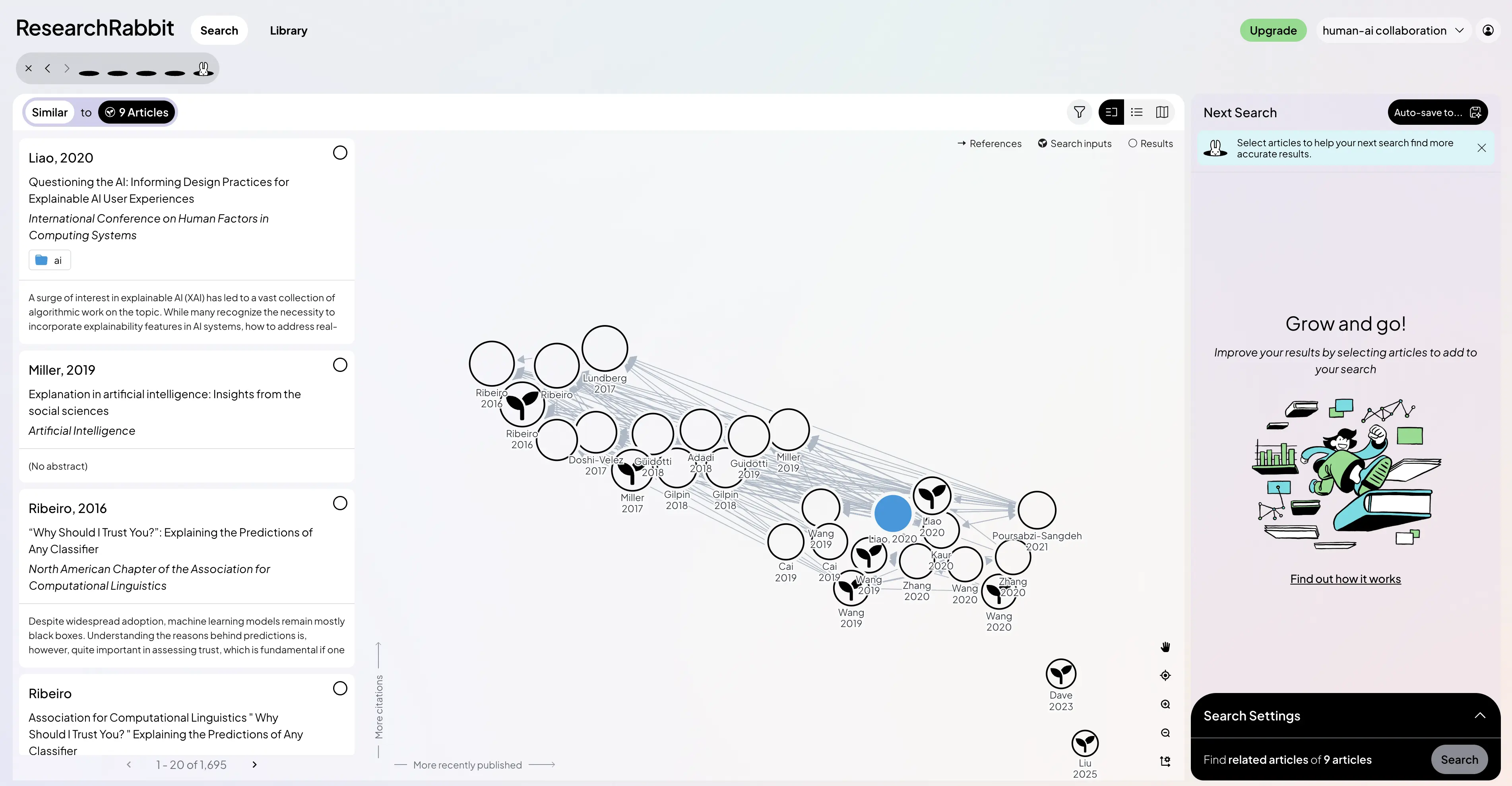
You can also use the timeline view to follow how ideas have developed over time, helping you understand both foundational work and newer directions.
From there, each interaction becomes part of your exploration. You can click on any paper to preview the abstract, save it to a collection, or continue expanding the network to explore more connections.
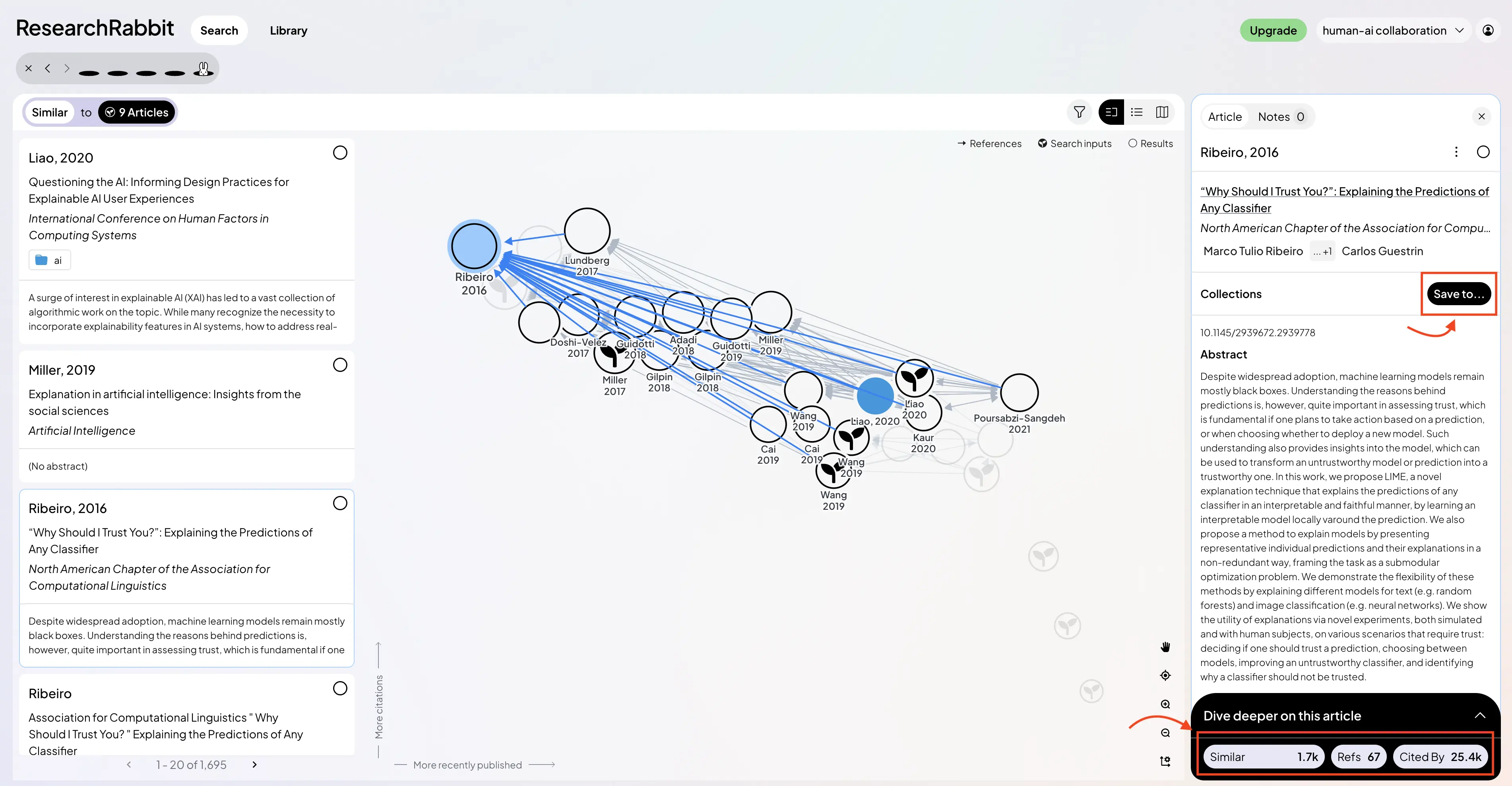
With each step, your view expands. What started as one paper becomes a small network, then a cluster, and eventually a clearer structure of the field.
You begin to recognise patterns, groups of papers working on similar problems, key authors contributing to specific areas, and connections between topics that didn’t seem related at first.
Instead of jumping between disconnected results, you’re building a connected understanding of your research area.
👉 This is exactly the kind of exploration tools like ResearchRabbit are designed to support, helping you turn a starting point into a structured view of the literature.
From search to understanding
Search is a powerful way to begin.
It helps you find an entry point into a topic and identify initial papers to work with.
Citation mapping builds on that foundation by helping you explore how those papers connect to others.
If you want a deeper look at how these two approaches work together, you can read more about search vs. discovery in literature reviews.
By combining both approaches, you can move from:
- finding papers → to understanding how they relate
- exploring individual studies → to seeing the structure of a field
- building a list → to building a coherent perspective
This makes your research process not only more efficient, but also more insightful and complete.
Final thoughts
Improving research quality isn’t just about reading more, it’s about seeing better.
Citation mapping gives you a way to do that.
By following the structure of the literature itself, you can expand your coverage, reduce blind spots, and build a more confident understanding of your topic.
If you want to explore your own research topic this way, you can try ResearchRabbit and start building a connected view of your field from a single paper.
%20(800%20x%201036%20px).webp)
This is a big test comment on your article.