


Most researchers approach a pile of papers the same way: start at the top, read front to back, and repeat. It's thorough in theory. In practice, it means spending 45 minutes on a paper that turns out to be peripheral, then skimming something foundational because you're running out of time.
Reading research papers faster isn't about speed-reading every sentence. It's about deciding which papers deserve a full read, which deserve a skim, and which you can safely ignore.
In this guide, you'll learn a practical workflow for prioritizing papers, choosing the right reading depth, using AI effectively, and taking notes that save you time throughout your literature review.
There's a better approach. It starts before you open a single paper.
The real problem: reading without prioritizing first
A literature review typically involves dozens, sometimes hundreds, of papers. Not all of them deserve the same depth of attention. Some are foundational and need a careful read. Some are useful for background context and can be skimmed. Some turn out to be irrelevant after two minutes.
The researchers who move through literature efficiently aren't faster readers. They're better at deciding which papers to read at full depth before they commit time to reading them.
That decision happens during prioritization, not during reading. And prioritization is much faster when you can see how papers relate to each other before you open them, which is exactly what a citation map shows you.
Step 1: Prioritize papers before opening PDFs
Before opening a single paper in full, spend time understanding where each paper sits in your citation network.
.webp)
In ResearchRabbit, papers are positioned by publication date on the x-axis and citation count on the y-axis. This positioning tells you something immediately useful:
- Upper left (older, highly cited): likely foundational, almost certainly worth a full read
- Upper right (recent, highly cited): currently influential, high priority
- Lower right (recent, fewer citations): emerging work, worth a quick scan to assess relevance
- Isolated nodes (few connections): peripheral, low priority unless specifically relevant to your question
Papers that appear repeatedly across different branches of your citation network, cited by multiple papers you already have, are signaling centrality. These are the ones to prioritize for full reads, regardless of publication date.
This structural view takes five minutes and tells you more about which papers to prioritize than reading abstracts for an hour would.
Step 2: Choose a reading mode
Not every paper deserves the same depth of attention. Once you've prioritized, assign each paper to one of three reading modes before you open it.
Rule of thumb
If you're unsure, start with a quick scan. It's easier to promote a paper to a focused skim than to spend an hour reading a paper you don't need.
Full read, for papers your argument depends on
These are the papers that are directly central to your research question, methodologically relevant, or cited by almost everything else in your network. Plan 30-60 minutes.
Read in this order:
- Abstract, get the research question, method, and main finding
- Conclusion, see where the authors end up
- Introduction, understand the context and framing
- Methods, assess the study design and its appropriateness
- Results and discussion, engage with the evidence
This order isn't how papers are written, but it's how they're most efficiently read. You know what the paper claims before you read the details, which makes the details easier to evaluate.
Focused skim, for papers that are relevant but not central
These papers provide useful context, background, or supporting evidence, but your argument doesn't depend on them directly. Plan 10-15 minutes.
Read:
- Abstract fully
- Introduction's last paragraph (usually states the gap the paper addresses)
- Conclusion fully
- Scan figures and tables, these often contain the most important findings in compressed form
- Note one key takeaway and move on
Quick scan, for papers you're assessing for relevance
These are papers you're not sure about yet. Plan 2-3 minutes.
Read:
- Title
- Abstract
- First and last sentences of the conclusion
If the paper isn't clearly relevant after this, set it aside. You can always come back.
How this maps to the three-pass method
The three-pass method, developed by S. Keshav at the University of Waterloo and widely used across many disciplines, maps closely to this framework. Pass 1 (5–10 minutes) covers the title, abstract, headings, and conclusion, equivalent to a quick scan. Pass 2 (up to an hour) reads the paper with greater care, focusing on figures and key points, similar to a focused skim. Pass 3 (1–5 hours) aims for a deep understanding of the paper and its methodology, equivalent to a full read.
The key idea behind both approaches is that not every paper deserves the deepest level of reading. However, this guide adds an important step before the three-pass method begins: prioritizing which papers are worth reading in the first place. For literature reviews, deciding which papers deserve a full read often saves more time than simply reading any individual paper faster. Once you've identified your highest-priority papers, the three-pass method provides an effective framework for reading them efficiently.
Step 3: Read with a clear goal
The single most effective thing you can do to read faster is decide what you're looking for before you open a paper.
Are you reading to understand the methodology? To check whether a claim is supported? To find the foundational papers the authors cite? To understand what the field argues about? Each goal sends you to different parts of the paper and lets you skip the rest.
Before opening any paper, write one sentence: "I'm reading this to find out ___." This takes ten seconds and saves you from passively reading sections that have nothing to offer your specific goal.
Step 4: Use AI carefully
AI tools can meaningfully speed up paper reading when used carefully. They're most useful for extraction tasks, pulling out specific information quickly, and least useful when asked to evaluate or judge the quality of a paper's evidence. That judgment still requires you.
What AI does well:
Extracting specific elements from a paper when you give it a precise task. The key is asking for something specific rather than a general summary.
These prompts work well:
- "What is the methodology of this paper?", pulls out study design, sample, measures
- "What claim does this paper make and what evidence supports it?", separates assertion from evidence
- "What limitations do the authors acknowledge?", surfaces the caveats
- "Does the conclusion match what the methods can support, or does it overreach?", flags scope inflation
- "What papers does this study cite as foundational?", helps you identify reference list priorities
What AI does poorly:
General summaries. "Summarize this paper" produces a plausible-sounding overview that tends to flatten nuance, miss methodological concerns, and occasionally misrepresent findings. The more complex the paper, the higher the risk.
AI tools also can't tell you whether a paper is reliable, whether its methods are appropriate for its claims, or whether the field has challenged its findings since publication. Those judgments require reading the paper yourself and checking its citation network.
The practical approach:
Use AI for focused skim papers, not for full reads. If a paper is central to your argument, read it yourself. If it's supporting context and you're using AI to extract one specific thing (the methodology, the main finding, the acknowledged limitations), verify the output against the actual paper before you rely on it.
Never cite a paper based on an AI summary alone. AI summaries are a starting point for deciding whether a paper deserves more of your time, not a substitute for reading it.
Step 5: Take notes that will still make sense later
The biggest time sink in literature reviews isn't reading, it's rereading. Papers you read three weeks ago blur together. You find yourself going back to check a detail you know you noted somewhere, but can't find.
A few habits that prevent this:
Note one thing per paper as you go. Not a summary of everything, one sentence capturing what this paper contributes to your specific research question. "This paper establishes that X, which supports/challenges my argument about Y." Write it immediately after finishing, before you open the next paper.
Use ResearchRabbit's built-in notes. Adding a note directly alongside each paper in your collection keeps your assessment attached to the paper itself. When you come back three weeks later, you see your note next to the abstract, not in a separate document you have to cross-reference.
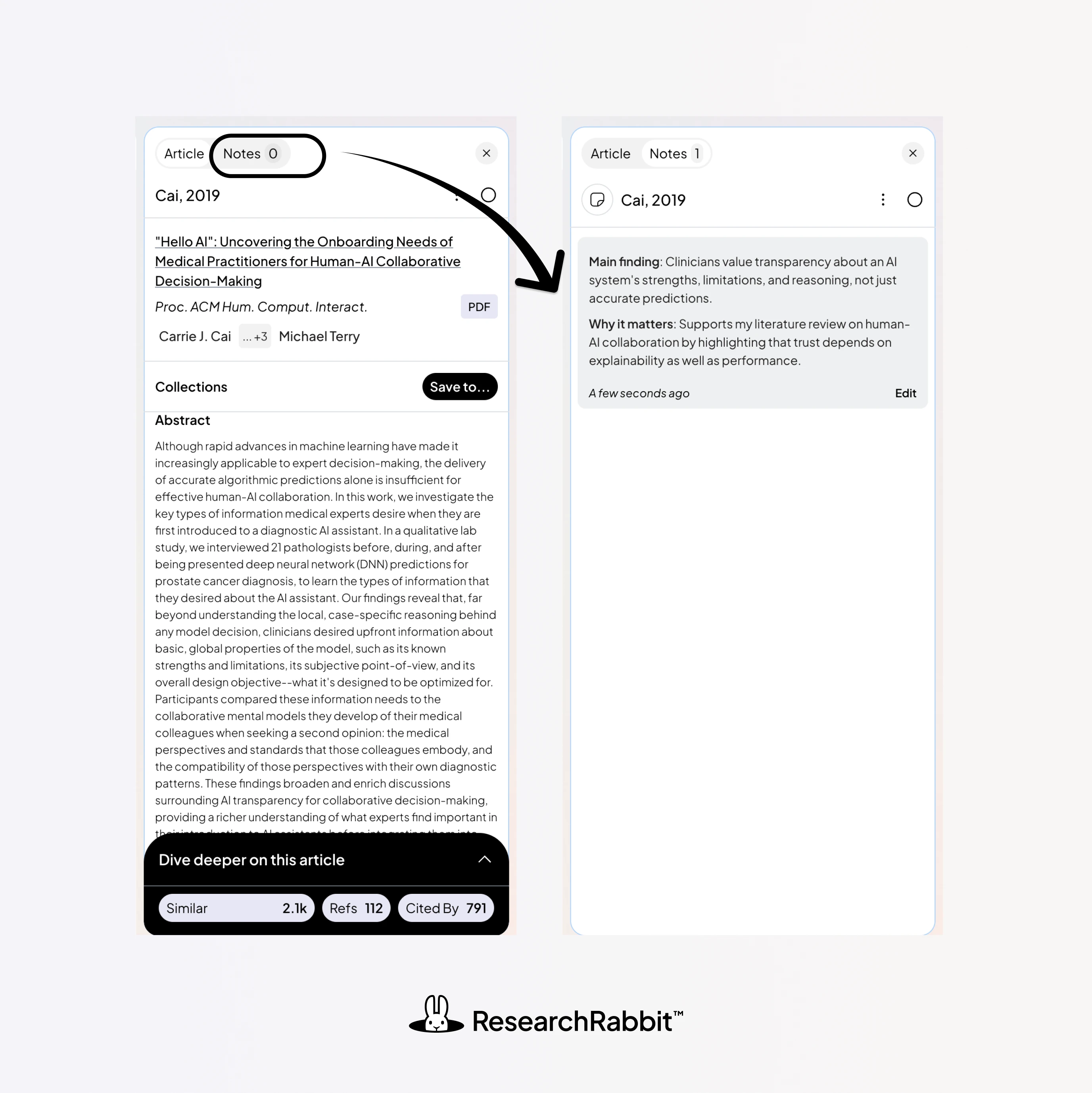
Flag papers differently as you go. Save papers to named subcollections by theme or argument strand rather than one big list. A collection called "foundational, memory consolidation" tells you something; a collection called "papers" tells you nothing.
Step 6: Use citation networks while reading
Once you've started reading, the citation map becomes a navigation tool, not just a discovery tool.
When you encounter a claim in a paper that seems important, check whether the cited source appears in your network. If it does, you may have already read it, or it may be on your priority list. If it doesn't, it might be worth adding.
When you read a paper and find it more relevant than expected, select References in ResearchRabbit to see what it was built on, some of those papers may need to move up your priority list. When you read something that challenges a paper you've already processed, select Citations to see whether the challenge has been addressed in subsequent work.
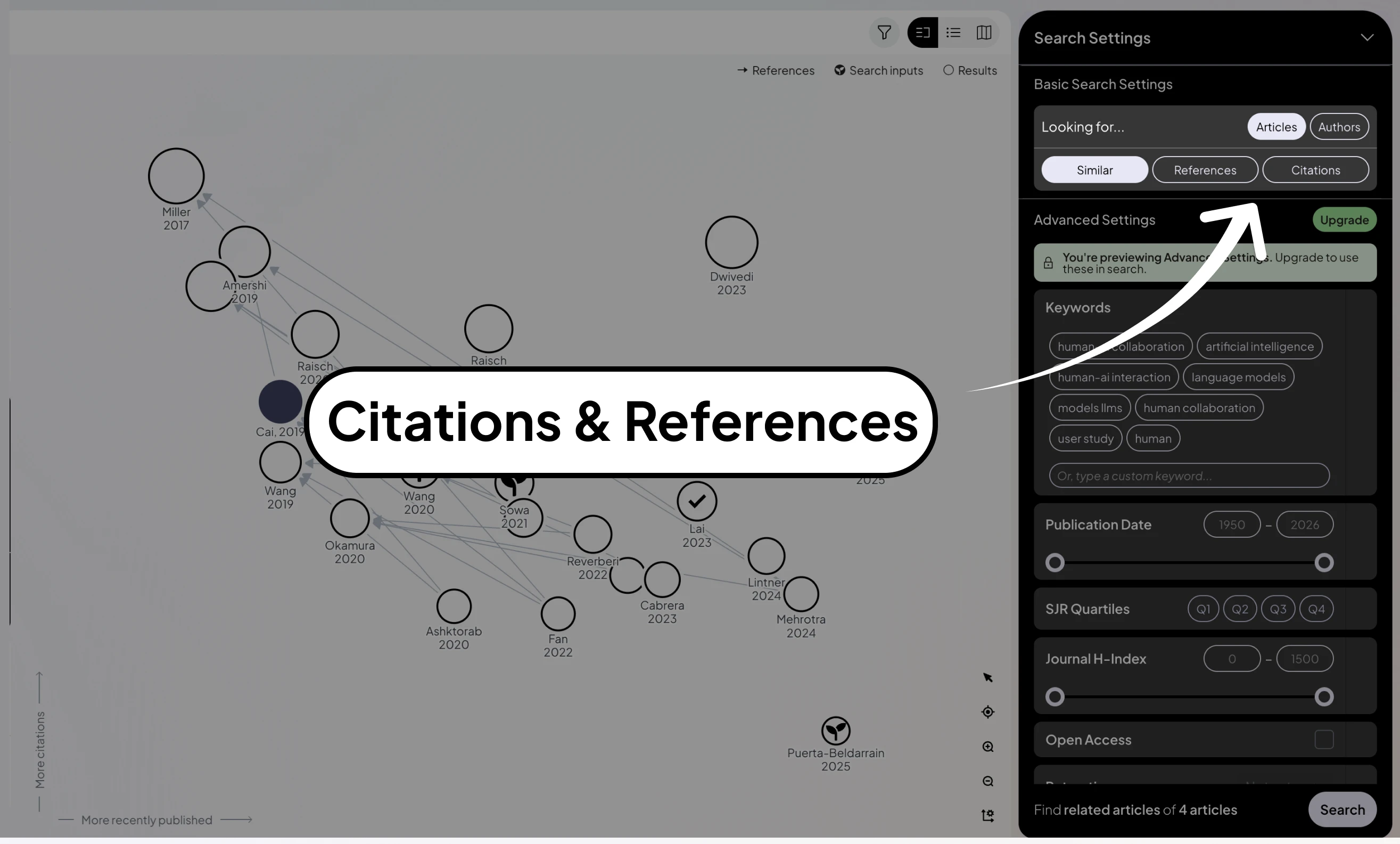
Reading and network navigation reinforce each other. As your understanding of the field grows, you'll uncover new connections that help you make sure you don't miss important papers.
Step 7: Know when to stop
One of the most useful skills in a literature review is knowing when to stop reading a paper you've already started.
If you're in a full read and realize the paper is less relevant than expected, it's fine to shift to a focused skim and move on. If you're in a focused skim and find the abstract doesn't match your research question after all, set it aside.
Signals that it's fine to stop:
- The abstract's research question is adjacent to yours but not directly relevant
- The methodology is inappropriate for the claims being made, you can note this without reading every detail
- You've already read the key finding in a paper that cites this one, and this paper doesn't add new evidence
Stopping early isn't skipping, it's prioritization in action.
30-minute workflow for a literature review session
Here's how this comes together in practice for a literature review:
Session 1 (30 minutes): map and prioritize
- Add your starting papers to ResearchRabbit.
- Explore References, Citations, and Similar for each paper.
- Use the citation map to classify papers into:
- Full read
- Focused skim
- Quick scan
Your goal is simply to decide which papers deserve your time.
Session 2 onward: Read based on priority
- Start with your highest-priority papers.
- Use a full read for foundational papers.
- Use a focused skim for supporting papers.
- Quick-scan anything you're unsure about.
- Add notes as you go and update your priorities when you discover new papers.
Ongoing: Refine your reading list
Each paper you read changes your understanding of the field.
- Promote papers that turn out to be more important than expected.
- Demote papers that are less relevant.
- Continue expanding your citation network as you learn.
Common mistakes
Reading in the order papers are listed. Citation count and recency are better guides to reading order than the sequence they appeared in a search result.
Reading everything at full depth. A peripheral paper read at full depth costs the same time as a foundational one. Match depth to importance.
Taking notes that describe rather than evaluate. "This paper found that X" is less useful than "This paper found that X, which I need to address because it contradicts my argument about Y."
Reading without a goal. Passive reading is slower than purposeful reading. Decide what you're looking for before you open the paper.
Rereading because you didn't note well enough the first time. A one-sentence note at the end of every paper takes thirty seconds and saves you twenty minutes of rereading later.
FAQ
What is the three-pass method for reading research papers? The three-pass method, developed by S. Keshav at the University of Waterloo, is a structured approach to reading papers at three levels of depth. Pass 1 (5-10 minutes) covers title, abstract, section headings, and conclusion, enough to decide if the paper is worth reading further. Pass 2 (up to an hour) reads the paper carefully with attention to figures and key points. Pass 3 (1-5 hours) involves deep understanding and mentally re-implementing the paper's methodology. Most papers in a literature review only need Pass 1 or Pass 2.
How long does it take to read a 30-page research paper? It depends on your goal and the paper's complexity. A quick scan to assess relevance takes 2-3 minutes. A focused skim to extract key findings and methodology takes 15-30 minutes. A full read for a paper your argument depends on takes 45-90 minutes. A 30-page paper rarely needs to be read front-to-back at full depth, the abstract, conclusion, and key figures often contain most of what you need.
How do researchers read papers so fast? Experienced researchers read faster because they've developed two skills: they know which parts of a paper to read and which to skip, and they know before opening a paper roughly how much depth it deserves. Both skills come from practice, field familiarity, and having a system. The structural approach, prioritize, match depth to importance, read with a specific goal, is how most efficient researchers work, whether or not they've formalized it as a method.
What's the best order to read a research paper? Abstract, conclusion, introduction, methods, results. Not the order it's written, the order that builds your understanding most efficiently. Reading the conclusion before the introduction lets you evaluate the framing with the endpoint already in mind.
How do I know which papers to read fully? Papers that are highly connected in your citation network, cited by multiple papers you already have, are almost always worth a full read. Papers at the center of your ResearchRabbit citation map (upper portion, appearing repeatedly across branches) are your priorities.
How do I stop losing track of what I've read? One sentence per paper, written immediately after finishing, about what the paper contributes to your specific research question. Add it directly in ResearchRabbit's notes so it stays attached to the paper itself.
%20(800%20x%201036%20px).webp)
This is a big test comment on your article.