


More often, research topics develop gradually. One paper leads to another. A pattern begins to form. You start noticing a question that keeps appearing but never quite gets resolved. That moment, when something feels both interesting and unfinished, is often where strong research topics begin.
If choosing a topic feels harder than the research itself, you’re not alone. Many researchers discover their strongest ideas while exploring the literature rather than trying to decide everything upfront. The challenge today isn’t a lack of ideas, but navigating an overwhelming amount of literature and recognizing where meaningful opportunities exist.
Exploring literature isn’t just something you do after choosing a topic. Done well, it’s one of the most reliable ways to discover what your research question could become.
In reality, this process is rarely linear. Researchers often move back and forth between searching, reading, and exploring citations before a clear direction emerges.
Choosing a topic vs choosing a research question
Early-stage researchers often start with a broad topic area. That’s completely natural. But topics alone rarely carry a project very far.
A topic might be “climate adaptation,” “graph neural networks,” or “student wellbeing.” A research question, by contrast, points to something specific, answerable, and grounded in the existing literature.
Why topics alone often stall early-stage research
Starting with a broad topic is a natural first step. However, before it can guide a research project, it usually needs refinement. On its own, a topic doesn’t yet tell you:
- what has already been studied
- where disagreements exist
- what remains unclear
- whether the question is feasible
This is why your research idea often evolves through several stages before becoming a clear project. The distance between a general interest and a workable research direction can sometimes be larger than it first appears.
How the literature helps sharpen your question
The literature acts like a map of a field in motion. As you explore it, you begin to see:
- which questions are already well studied
- which debates are still active
- which populations or methods are underexplored
- where findings start to conflict
Strong research questions usually develop gradually as your understanding of the literature deepens. As you explore more papers and connections, your question becomes clearer and more focused.
Why starting with the literature works
Starting with the literature helps you explore ideas with more clarity. Instead of developing a topic in isolation, you’re grounding your thinking in how the field is actually evolving.
It reveals what is already known
A quick scan of recent and highly cited papers can quickly show you which areas are well established and which are still developing. This helps you focus your energy on questions that still offer room for new insight.
It surfaces active debates and open questions
Pay close attention to where authors disagree, hedge their conclusions, or call for more work. These moments often highlight promising entry points for new research.
It helps you test the feasibility of ideas
Some ideas may seem promising at first but become clearer once you explore the literature more closely. Early exploration helps you understand what has already been studied and where meaningful opportunities still exist before investing too much time.
How to find a research topic from the literature
A structured approach can make this process much more manageable. The steps below outline a practical way for you to move from a broad interest to a focused research direction.
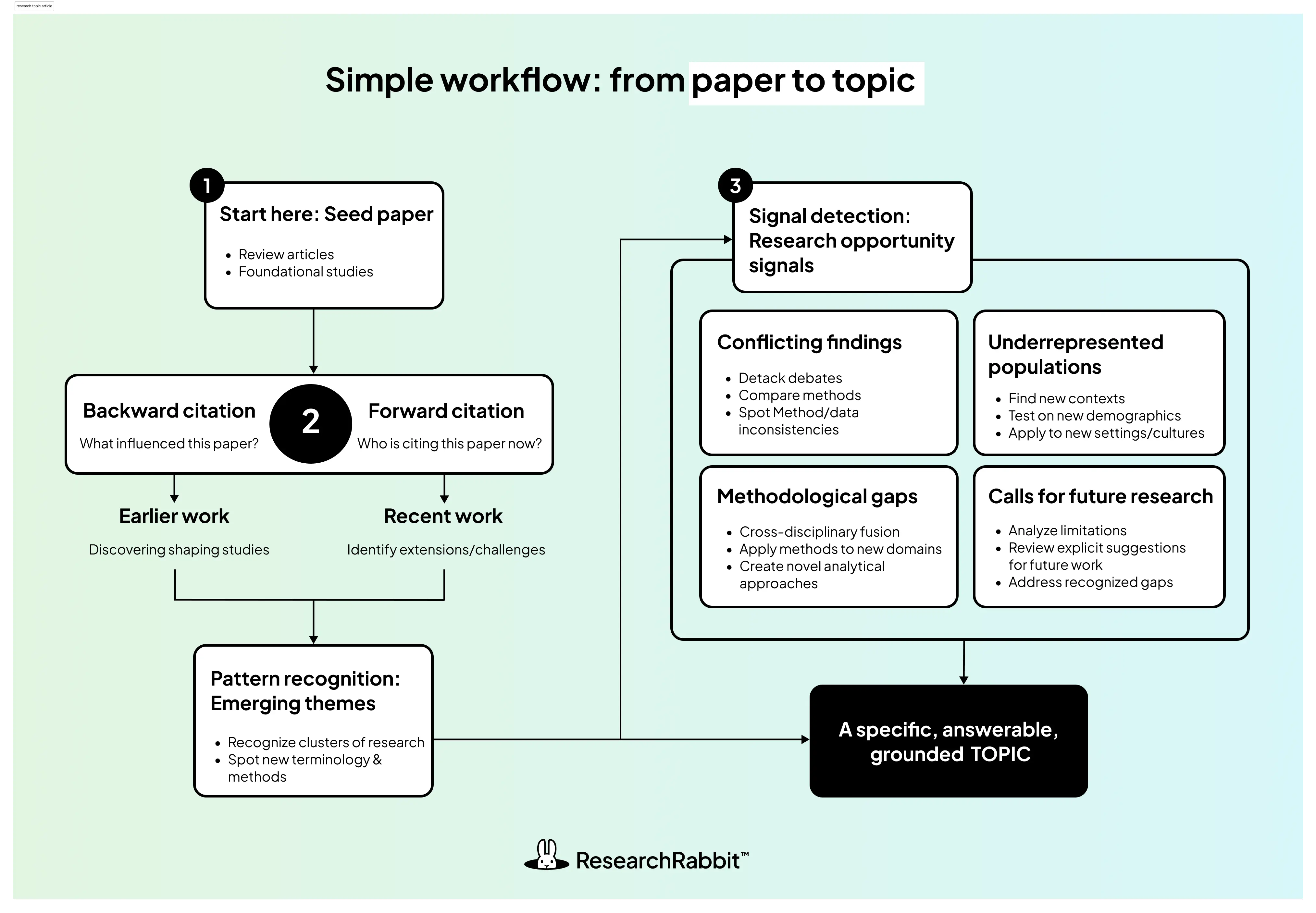
Step 1: start with a strong seed paper
Most effective literature exploration begins with a good starting point. A strong seed paper gives you language, references, and context that you can build from. Instead of starting from scratch, you’re entering a conversation where research is already developing.
What makes a good seed paper
Good seed papers tend to sit close to the center of a field. Recent review articles are often a strong place to begin because they synthesise large areas of work. Highly cited foundational studies can also provide important grounding, especially when they continue to be referenced years after publication.
In some cases, widely used methodological papers or well-scoped systematic reviews can serve the same purpose by anchoring key parts of the research landscape.
Where to find high-quality starting points
You can usually find high-quality starting points in a few reliable places. Recent review articles in your area are often the fastest route. Recommendations from supervisors or experienced colleagues can also surface influential work you might otherwise miss.
Database searches sorted by citation count frequently reveal foundational papers, and exploratory discovery tools can help highlight influential studies visually.
Importantly, you don’t need to find the perfect starting paper. Literature exploration is inherently iterative. What you need is one credible entry point that allows you to begin mapping how the field connects and where meaningful research opportunities might emerge.
Step 2: map the conversation around the paper
Once you have a seed paper, the real exploration begins. Instead of reading the paper in isolation, start expanding outward through its citation network. Look closely at the studies it references, and then examine who has cited it since publication. This shift, from linear reading to network exploration, helps you see how the field actually connects and evolves over time.
Following citation paths
Following backward and forward citation paths helps you uncover the structure of the research landscape. You’ll discover earlier foundational work that shaped the conversation, identify newer studies that extend or challenge the original findings, and begin to see how ideas have developed across time.
Tools like ResearchRabbit can make this process much easier to explore visually, helping you explore citation networks visually and trace relationships between papers far more efficiently than manual searching alone.
Recognizing emerging themes in the literature
As you move outward, patterns usually begin to emerge. You may notice clusters of papers focusing on similar questions, new terminology gaining traction, or certain methods appearing more frequently in recent work. At the same time, some subtopics may appear less explored. These signals are valuable because they often indicate where the field is consolidating and where meaningful research opportunities may still be forming.
Spotting influential authors and clusters
Pay attention to names that appear repeatedly across papers. Influential research groups often shape the direction of a field, and their work can help you understand where important conversations are happening.
Step 3: look for signals of research opportunity
Not every gap in the literature leads to a productive research direction. At this stage, your goal is to identify opportunities that are not only visible but also meaningful and realistically researchable. As your map of the field becomes clearer, start paying attention to places where the conversation feels incomplete, contested, or unevenly developed.
Unresolved debates and conflicting findings
Some of the strongest research opportunities appear where studies reach different conclusions or where findings remain ambiguous. When papers point in different directions, it often suggests that the question is still open and that further investigation could contribute something valuable. These tensions in the literature can often be more informative than areas where consensus is already well established.
Methodological and population gaps
You can also look for methodological and population patterns. For example, you might notice methods that have been applied extensively in one context but rarely in another, populations that are underrepresented in existing studies, or datasets that have not yet been revisited using newer analytical techniques. These asymmetries often point toward research directions that are both feasible and worthwhile.
Future research sections worth mining
Finally, don’t overlook the “future research” sections of papers. Authors often highlight areas where additional work could be valuable. While these suggestions shouldn’t be followed
automatically, they can provide helpful signals about where the field itself recognizes remaining opportunities. When combined with your broader exploration of the literature, they can help you identify directions that align with the field’s evolving trajectory.
From a broad topic to a focused research direction
At this point, your initial interest should begin narrowing into something more concrete.
Narrowing scope without losing relevance
One helpful step is to start pressure-testing your idea. Ask yourself whether the question is specific enough to study, whether there is enough literature to support it, and whether it still connects to an active conversation in the field. Refinement rarely happens in a single step. Instead, your idea usually becomes clearer through several small iterations as you continue exploring the literature.
Testing feasibility with targeted search
This is also a good moment to return to structured keyword searches. By using the terminology and concepts you encountered while exploring the literature, you can begin to see how crowded the research space is, how recent the work in that area is, and whether your potential angle offers something distinct. This step helps confirm that your emerging topic is both relevant and feasible.
Pressure-testing your idea before committing
Before fully committing to a direction, it can also help to briefly step back and reflect on the idea. Talking it through with a supervisor or colleague, sketching a preliminary research question, or checking whether the scope feels manageable can provide valuable perspective. Spending a little time refining the idea at this stage often saves significant effort later in the research process.
Common challenges when choosing a research topic
Even careful researchers encounter a few predictable challenges when selecting a research topic.
Starting too broad or too narrow
Very broad topics can quickly become difficult to manage, while extremely narrow ones may not have enough supporting literature to build a strong project. Finding the right balance usually takes a few rounds of refinement as you explore the field more closely.
Relying only on keyword search
Keyword search is a powerful tool, but it rarely captures the full landscape of a research area. Important work can sit just outside your initial terminology, particularly in interdisciplinary fields where different communities use different language.
Committing to a topic before exploring the literature widely
It’s natural to feel excited about an idea early on, but allowing some flexibility during the exploration phase makes it much easier to refine your direction as you learn more about the field.
Ignoring how the field is actually evolving
Methods change, terminology shifts, and new questions emerge over time. Regularly scanning the literature helps ensure that your research question remains connected to the current direction of the field.
Key takeaway: topics are discovered, not invented
The most promising research topics rarely appear out of nowhere. Instead, they emerge as you explore how a field is structured, where tensions exist, and which questions remain unresolved.
Keyword search helps you narrow your focus, while citation exploration reveals how ideas connect across the literature. Used together, they allow you to move from a vague interest to a focused and defensible research direction.
Ready to find your gap? Try starting with one seed paper in ResearchRabbit and follow the citation paths to see where the conversation leads.
FAQ
How do I know if my research topic is original?
Originality comes from your framing. By exploring citation networks, you can ensure your specific angle hasn't already been exhausted by others.
How many papers should I read before choosing a topic?
There is no "magic number." You should read until you can clearly identify the major debates and the "main players" in the field.
Can I find a research topic using only keyword search?
It’s possible, but risky. Keyword searches often miss interdisciplinary connections. Citation exploration provides a much more comprehensive view of the landscape.
%20(800%20x%201036%20px).webp)

This is a big test comment on your article.