




A type of literature review is the method you use to find, select, appraise, and synthesize existing research on a question. Common types include narrative, scoping, systematic, and integrative reviews, plus rapid reviews, which are a faster way to carry out a systematic or scoping review. The right choice depends less on which type sounds most rigorous and more on what you want your review to do.
In this guide, you'll learn what each major type is designed for, how the commonly confused types differ, and how to narrow down the best fit using a simple decision framework. You'll follow one research topic throughout (peer tutoring in undergraduate STEM courses) to see how a change in your question can point to a different review type.
For the bigger picture of planning and writing a review, see this step-by-step guide to doing a literature review.
What "type of literature review" means, and why lists disagree
If you've seen articles promising "4 types," "5 types," or "14 types" of literature review, you've already noticed that no single list exists. Grant and Booth identified 14 review types in their well-known typology. A decade later, Sutton and colleagues identified 48 review types and grouped them into seven families.
Part of the variation comes from how the word "type" is used. In the health sciences, it usually refers to an evidence synthesis method, such as a systematic or scoping review. Some social science guides, including USC Libraries and FIU Libraries, also use it for an organizing approach, such as argumentative, historical, or theoretical reviews. Business research has its own labels too, including the semi-systematic review, as described by Snyder.
This guide focuses on four purpose-based types (narrative, scoping, systematic, and integrative) plus the rapid review. You may also come across umbrella reviews (which compile evidence from existing reviews), mapping reviews, and systematized reviews, all included in Grant and Booth's review typology.
Start with your research question
The most useful starting point is what you want your review to do. Munn and colleagues suggest the key consideration is whether you want to answer a specific question that can inform practice, or to identify, map, and discuss what the literature contains.
Here's how that plays out for one topic:
Later in this guide, you'll turn this into a step-by-step decision, including what to do when time is short.
The main types of literature review and when to choose each
Narrative review
What it's for: A narrative review (sometimes called a traditional literature review) offers an interpretive overview of a topic. It draws on the author's judgment to select, connect, and critique the literature.
Choose it when: You need background and context for a thesis chapter or paper, want to trace how ideas have developed, or want to make an argument about a field.
What it involves: Searching may or may not be comprehensive, and the review may or may not include quality assessment. Because narrative reviews rely heavily on the author's existing knowledge, they can be more subjective than systematic approaches, though they remain useful for providing an overview. Greenhalgh and colleagues argue that narrative reviews shouldn't be seen as inferior: their strength is interpretation and critique that deepen understanding.
Scoping review
What it's for: A scoping review maps the available evidence on a topic. Its purposes include identifying the types of evidence in a field, clarifying key concepts, examining how research on a topic is conducted, identifying knowledge gaps, and acting as a precursor to a systematic review.
Choose it when: Your topic is broad or emerging, and you want to know what's out there before asking a narrower question.
What it involves: Scoping reviews still use rigorous, transparent methods, often guided by a protocol. The PCC framework (population, concept, context) is recommended for shaping the question. Unlike systematic reviews, they generally don't assess risk of bias in the included studies unless the review's aim requires it. Key methodological guidance includes Arksey and O'Malley (2005) and Peters et al. (2015), and reporting follows PRISMA-ScR.
Systematic review (and when to add a meta-analysis)
What it's for: A systematic review answers a specific, clearly defined question using explicit methods chosen to minimize bias.
Choose it when: You want a trustworthy answer that can inform practice, policy, or future research. Systematic reviews aren't limited to "does it work?" They can address questions about feasibility, appropriateness, and meaningfulness as well as effectiveness. Munn, Stern, and colleagues describe ten kinds of systematic review, each built around a different type of question. In the running example, "How do students experience peer tutoring?" would suit an experiential systematic review.
What it involves: A pre-planned protocol, a comprehensive search, screening against eligibility criteria, and quality appraisal that may determine which studies are included. A meta-analysis is a statistical technique for combining the results of quantitative studies, so you'd add one within your systematic review when your included studies are similar enough to pool. Reporting follows PRISMA 2020. For a closer look at the process, see this plain-English guide to systematic reviews.
Integrative review
What it's for: An integrative review summarizes empirical or theoretical literature to build a more comprehensive understanding of a phenomenon or problem, following the approach described by Whittemore and Knafl. It can bring together experimental and non-experimental research alongside theory.
Choose it when: Your question spans different kinds of evidence, and your goal is to develop concepts or a fuller picture rather than a single answer.
What it involves: Whittemore and Knafl outline five stages: problem identification, literature search, data evaluation, data analysis, and presentation. The method developed largely within nursing research. In business research, Snyder uses the term for reviews that synthesize literature to generate new frameworks and perspectives. If you only need to combine quantitative and qualitative studies, a mixed methods systematic review may also fit.
Rapid review: a faster route, not a separate purpose
A rapid review speeds up a systematic review by streamlining or omitting specific steps, as Hamel and colleagues describe. There's no single agreed definition, but that core idea is common to most. Munn and colleagues describe rapid reviews as "systematic reviews with shortcuts." They note that the main reason to choose one isn't the question itself but whether a full review is feasible given time and resource limits. A rapid review could serve any of the purposes of a systematic or scoping review.
Rapid reviews are often driven by requests for timely evidence to support decisions, and Cochrane rapid review guidance outlines methods for conducting them. If you take this route, report your methods transparently. Interim reporting guidance recommends using PRISMA 2020 as the foundation for reporting rapid reviews.
How the main types of literature review compare
Commonly confused types: key differences
Systematic review vs. scoping review
The difference starts with the question. A systematic review answers a focused question and appraises the evidence to produce findings that can guide practice. A scoping review maps the evidence and generally doesn't appraise it.
In the running example, "Does peer tutoring improve exam performance?" calls for a systematic review. "What research exists on peer tutoring?" calls for a scoping review. If you're not yet sure a narrower question can be answered, a scoping review can come first. It can also help you confirm your inclusion criteria before a systematic review.
One caution: a scoping review isn't a shortcut around critical appraisal. If your aim is to answer a specific question or inform practice, a systematic review is usually the better fit.
Systematic review vs. narrative review
A systematic review uses explicit, reproducible methods to answer a narrow question and summarize the evidence. A narrative review offers interpretation and critique across a broader area. Greenhalgh and colleagues argue the two serve different purposes and are best seen as complementary rather than ranked. The right choice depends on whether you need a reproducible answer or a deeper understanding.
Which type of literature review should you choose?
Work through these three steps.
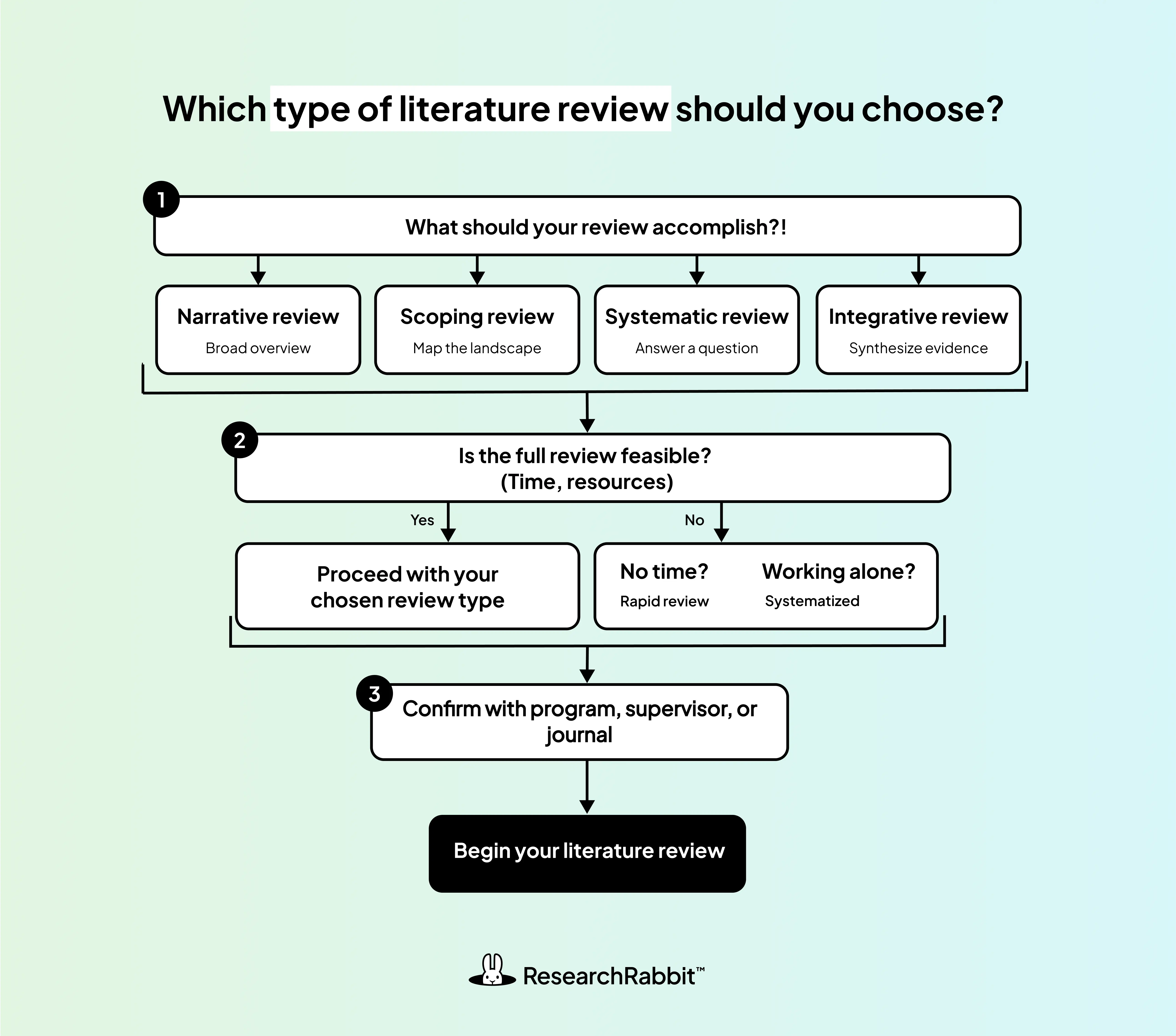
Step 1: What should your review do?
- Answer a specific, well-defined question to inform practice, policy, or research → systematic review. If your studies are comparable and quantitative, consider adding a meta-analysis.
- Map what evidence exists, clarify concepts, find gaps, or check whether a systematic review is feasible → scoping review.
- Combine empirical and theoretical literature to build fuller understanding or develop concepts → integrative review.
- Give an interpretive overview, context, or argument (for example, the background chapter of a thesis) → narrative review.
Step 2: Is a full review feasible?
- Facing a decision deadline? Consider a rapid version of your systematic or scoping review.
- Working alone? Systematic reviews usually need at least two independent reviewers, so a systematized review may describe your work more accurately (see the FAQ below).
Step 3: Check expectations. Confirm what your program, supervisor, or target journal expects, since terminology and standards vary by discipline.
What to do after you've chosen your review type
Frame your question. For scoping reviews, the PCC framework helps define your population, concept, and context. For systematic reviews, effectiveness questions are often structured with PICO (population, intervention, comparison, outcome), while experiential questions can use PICo (population, phenomena of interest, context).
Write a protocol where relevant. Systematic reviews start from a protocol, and scoping reviews often do too. Systematic reviews with a health-related outcome can be registered in PROSPERO if they meet its eligibility criteria, but PROSPERO doesn't accept scoping reviews, as discussed by Page, Shamseer, and Tricco. General registries such as OSF Registries accept any study design, according to Pieper and Rombey.
Plan your search. Database searches with carefully chosen keywords (in Scopus, Web of Science, PubMed, or your field's key databases) are central to any structured search. Supplementary methods help you catch what keywords miss. The Cochrane Handbook, chapter 4 treats checking reference lists as a required step for Cochrane intervention reviews and recommends considering citation searching as an additional source.
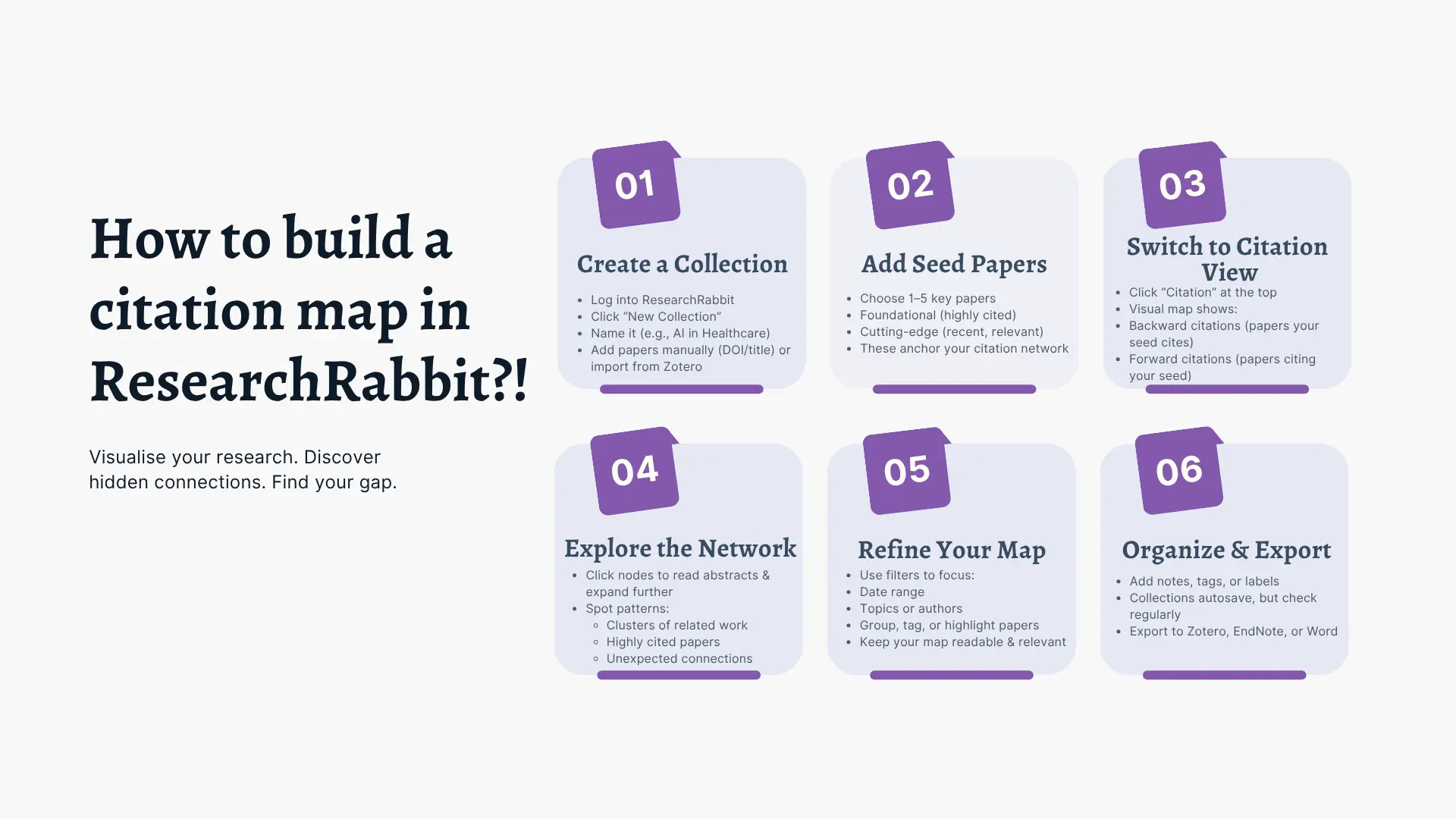
This is where citation discovery can help. In ResearchRabbit, you can start from one or two strong seed papers (usually enough to begin) and explore how the literature connects around them:
- References shows the papers your seeds cite.
- Citations shows the papers that cite your seeds.
- Similar finds related papers and ranks them largely by how often they're cited alongside your seeds.
For narrative, scoping, and integrative reviews, this can help you find adjacent work and see how a field fits together. For systematic reviews, or any review with formal inclusion criteria, use ResearchRabbit alongside your database searches rather than instead of them. For more on combining approaches, see search vs. discovery in literature reviews and how to search in ResearchRabbit.
Key takeaway
Your review type isn't locked in on day one. A project can start broad with a scoping review and narrow into a systematic review once the question is clear , as Munn and colleagues explain. What matters is that your method matches what you're asking.
👉 Once you know your approach, start with a strong seed paper in ResearchRabbit to explore how the literature around your question connects.
FAQ
What are the five types of literature reviews?
There's no fixed number. Typologies range from 14 types (Grant & Booth, 2009) to 48 (Sutton et al., 2019). This guide covers narrative, scoping, systematic, and integrative reviews, plus rapid reviews as a faster route to a systematic or scoping review.
What are the types of systematic reviews?
It depends on the source. Munn, Stern, and colleagues describe ten kinds of systematic review, each defined by the type of question asked, such as effectiveness or experience. Sutton and colleagues treat rapid reviews and reviews of reviews as separate families. Some library guides, by contrast, group scoping, rapid, and umbrella reviews under one systematic review family (OHSU Library).
Can you do a systematic review on your own?
Cochrane guidance calls for at least two people working independently to decide which studies meet the eligibility criteria, although one person may do the initial title and abstract screening. If you're working alone, check your program's expectations, or consider whether a systematized review better describes your approach.
%20(800%20x%201036%20px).webp)




This is a big test comment on your article.