



Methods are the specific techniques you use to collect and analyze data, such as interviews, surveys, sampling strategies, or statistical tests. Methodology is the overall approach that guides those choices: the reasoning that connects your research question to your techniques, shapes how you use them, and explains why they suit the question.
The two terms are often used interchangeably, including in published papers, so it's normal if the line between them feels blurry. In this guide, you'll learn what each term covers, how methodological reasoning shapes the choices in a study, where the usual confusion comes from, and how to describe both clearly in your own thesis or paper.
What's the difference between method and methodology?
The difference is one of level. Methods are the concrete things you do in a study. Methodology is the thinking that decides which of those things make sense for your question.
What counts as a research method
A method is any concrete technique you use to gather or make sense of evidence. That's broader than data collection alone. Alongside tools like interviews, questionnaires, and observation, Harvey and colleagues include sampling (how you identify and select participants or cases) and analysis techniques, such as statistical tests or thematic analysis.
A quick check: if another researcher could read your description and carry out the same steps, you're probably describing a method.
What methodology adds
Methodology is the overall approach behind those steps. It sets out what kind of answer you're looking for, what would count as convincing evidence for it, and why your methods suit the task. It also shapes decisions as you go, including how you apply your methods and interpret what you find, not just how you explain them afterward.
In many fields, methodology also connects to assumptions about how knowledge is produced, which is why methodology discussions often mention research philosophy. You don't need to settle those debates to write a clear methodology. You do need to make your reasoning visible.
For a more detailed guide to planning and writing your methodology section, see this research methodology guide.
How methodology shapes your design and method choices
Methodology is easiest to see when it changes a study's decisions. Take one research question: why do some community college students who plan to transfer to a four-year university end up not transferring?
Now imagine three researchers who each need a different kind of answer: one looking for patterns across the college, one trying to understand how students weigh the decision, and one hoping to improve the college's advising.
The question is the same, but each researcher's reasoning about what a good answer looks like leads to different choices: who to include, what evidence to gather, and how to analyze it.
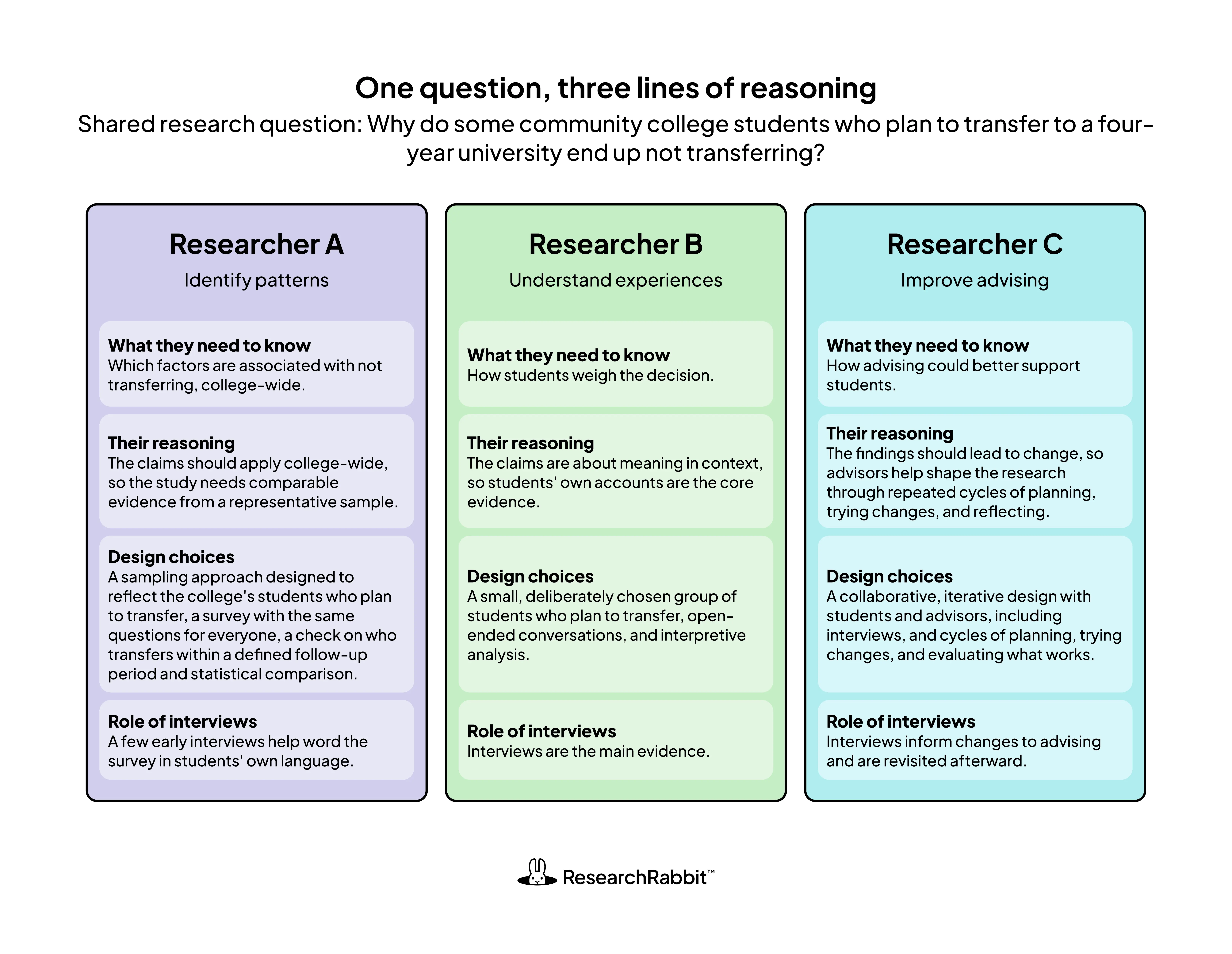
Notice what drives each column. Researcher A needs comparable evidence from students who reflect the target population, along with a follow-up to see who actually transfers. Researcher B needs students' own accounts to understand how they make sense of their decisions. Researcher C involves advisors in repeated cycles of change because the goal is to improve practice, an approach often called action research.
The methods differ because each researcher needs a different kind of answer to the same question.
Can the same method serve different methodologies?
All three researchers interview students, but the interviews do different work: preparation for A, the core evidence for B, and one input into a cycle of change for C.
That's why listing your methods doesn't explain your study. Many methods aren't tied to a single methodology, and as education professor Pat Thomson explains, the same technique can take on a different meaning depending on the reasoning behind it. Your readers need that reasoning to judge whether your methods fit your question.
Do you choose your methodology before your methods?
When you're planning, it usually helps to start from your question and the kind of answer you need, then choose methods that fit. Harvey and colleagues recommend settling your methodology first for this reason.
In practice, though, the relationship isn't always a neat sequence. Thomson describes methodology and methods as shaping each other, and notes that you may learn specific techniques before fully understanding the frameworks behind them. Expect to move back and forth as your project develops. What matters is that, by the time you write it up, you can explain why your choices fit together.
Where people get confused
Most confusion comes from the fact that researchers, textbooks, and journals don't all use these terms the same way. Knowing where the differences lie makes it easier to read sources critically and to describe your own study clearly.
Research design vs methodology
Research design is the concrete plan for a particular study: which methods you'll use, how they fit together, in what order, and with which participants or materials. Methodology is the reasoning for why that plan suits your question. In the community college example, each researcher's design choices are their design. Their reasoning is what justifies those choices.
Sources don't all draw this line in the same place. A teaching piece from the UK's National Centre for Research Methods describes design as the structure that assembles methods, with methodology providing the justification for it. Some researchers treat approaches like ethnography as a methodology, while others classify the same approaches as designs, and some textbooks use "research design" for the entire plan of a study, reasoning included, as a review in The Qualitative Report documents.
These are established conventions in different fields and textbooks, not simple errors. What causes trouble is mixing them within one piece of writing, such as calling the same thing your design in one place and your method in another.
Is "qualitative" a method or a methodology?
It depends on the source. Qualitative and quantitative are often used to describe kinds of data collection and analysis. Other authors use them for broader approaches, designs, or whole research traditions, though some methodologists argue that labeling them as designs or paradigms blurs important distinctions.
Whatever the convention, the label alone doesn't tell a reader much about your reasoning. Researcher A in the example uses both interviews and a survey, yet what defines the study is its need for claims that apply college-wide. If you use these terms, say what you mean by them, as Godswill Makombe, the author of The Qualitative Report review, recommends.
When "methodology" just means "methods"
You'll often see a section headed "Methodology" that only describes methods. In a 2023 methodological note, Harvey and colleagues found published papers that use the heading this way, and even journal author guidelines that seem to. Other papers combine both under one heading or use neither.
So published papers aren't always a reliable guide to the distinction. When you read a study, look for the reasoning behind its choices, wherever it appears, rather than relying on the section label.
How to explain methods and methodology in your own writing
There's no single correct layout. How methods and methodology are written up can depend on your discipline, the publisher's house style, what reviewers focus on, and word limits. So check your program's or journal's guidance first, then use these principles within it.
- Theses and dissertations often give you more room to explain your reasoning, sometimes in a dedicated chapter. For a PhD thesis, Harvey and colleagues suggest that if a chapter covers both, a title like "Methodology and Methods" makes that clear.
- Journal articles often have tight word limits, so the reasoning may be compressed into brief justifications within a methods section.
- Timing. Methodological thinking tends to happen early, when you're shaping the study, while methods are carried out later.
- Define your terms once. If you use labels like "design," "approach," or "qualitative," say what you mean early and use them consistently.
If you're still shaping the study itself, it can help to start with how to write a research question and how to write a research proposal.
A two-question check for every choice
For each major decision in your study (who you include, how you collect evidence, and how you analyze it), ask:
- What did I do?
- Why was this the right way to answer my question?
Your answers to the first question are your methods. Your answers to the second are the core of your methodology. If you can answer the first but not the second, that's the part of your write-up to develop next.
Learn from how others studied similar questions
Before you settle on an approach, it helps to see how other researchers have studied questions like yours. Their methods sections show which designs and techniques have been used, and their reasoning gives you something to compare against when you explain your own choices.
If you already have one or two key papers on your topic, ResearchRabbit can help you find related studies through their citation connections. Add a key paper as a seed, then use Similar to find related papers that are often cited alongside it, References to see the papers it cites, and Citations to see later studies that cite it. It works alongside keyword searches in your library databases, not instead of them. From there, reading those papers' methods sections closely is where you'll learn the most.
For guidance on structuring the rest of your paper, see how to write a research paper.
Key takeaway
Before you write up your study, list your three or four most important decisions and run the two-question check on each. Where your "why" answers are thin, that's where your methodology needs more work. Where they're clear, turn them into a short explanation of your approach, so readers can follow how your question led to each choice.
%20(800%20x%201036%20px).webp)





This is a big test comment on your article.