




Turning a broad interest into a focused research question is harder than it sounds. But moving from vague curiosity to a clear, researchable inquiry is one of the most important steps in any research project.
This guide walks you through how to write a strong research question step by step, with practical examples you can adapt to your own research.
What is a research question?
A research question is the specific inquiry that your study sets out to answer. It's different from a research topic, which describes a broad area of interest, and a hypothesis, which proposes an outcome or relationship to test.
Research questions take different forms across academic fields:
- Psychology: How does social media use relate to sleep quality in teenagers?
- Biology: What environmental factors influence antibiotic resistance in bacterial populations?
- Education: Do collaborative learning strategies improve retention in online courses compared with traditional lectures?
- Business: What organizational factors predict employee retention in remote-first companies?
Although their structure varies depending on the methodology, strong research questions are generally focused, researchable, and specific enough to guide a study.
Why your research question matters
Your research question determines what literature you'll search for, what methodology you'll use, and what data you'll need to collect.
If your question is too broad, you may end up reading hundreds of papers without knowing which ones actually matter. If it's too narrow, you may struggle to find enough evidence or collect enough data to answer it.
A strong research question gives your project boundaries. It helps you decide what belongs in your research, and what doesn't.
Six steps to writing a research question
Step 1: choose a broad topic
Start by identifying an area that genuinely interests you. At this stage, it doesn't need to be particularly specific.
Broad topics might include:
- Social media and mental health
- Climate change and agriculture
- Remote work and productivity
- Machine learning in healthcare
Your topic should fall within your field of study and align with your course requirements, research program, or broader research goals.
But a topic isn't yet a research question.
For example:
Topic: Remote work and productivity
Too broad: How does remote work affect employees?
Before narrowing the question, you need to understand what researchers already know about the topic.
Step 2: explore the existing research
A strong research question rarely comes from brainstorming alone. It usually develops from understanding the existing literature.
Start with a few relevant papers or literature reviews and look for:
- Findings that repeatedly appear across studies
- Areas where researchers disagree
- Populations or contexts that haven't been studied extensively
- Limitations mentioned by authors
- Questions suggested for future research
- Relationships that haven't been fully explained
This preliminary exploration helps you avoid asking a question that's already been thoroughly answered and can reveal more interesting directions for your research.
You don't necessarily need to search from scratch every time you find a useful paper. If you already have one or two relevant studies, you can use their citation networks to explore the literature around them.
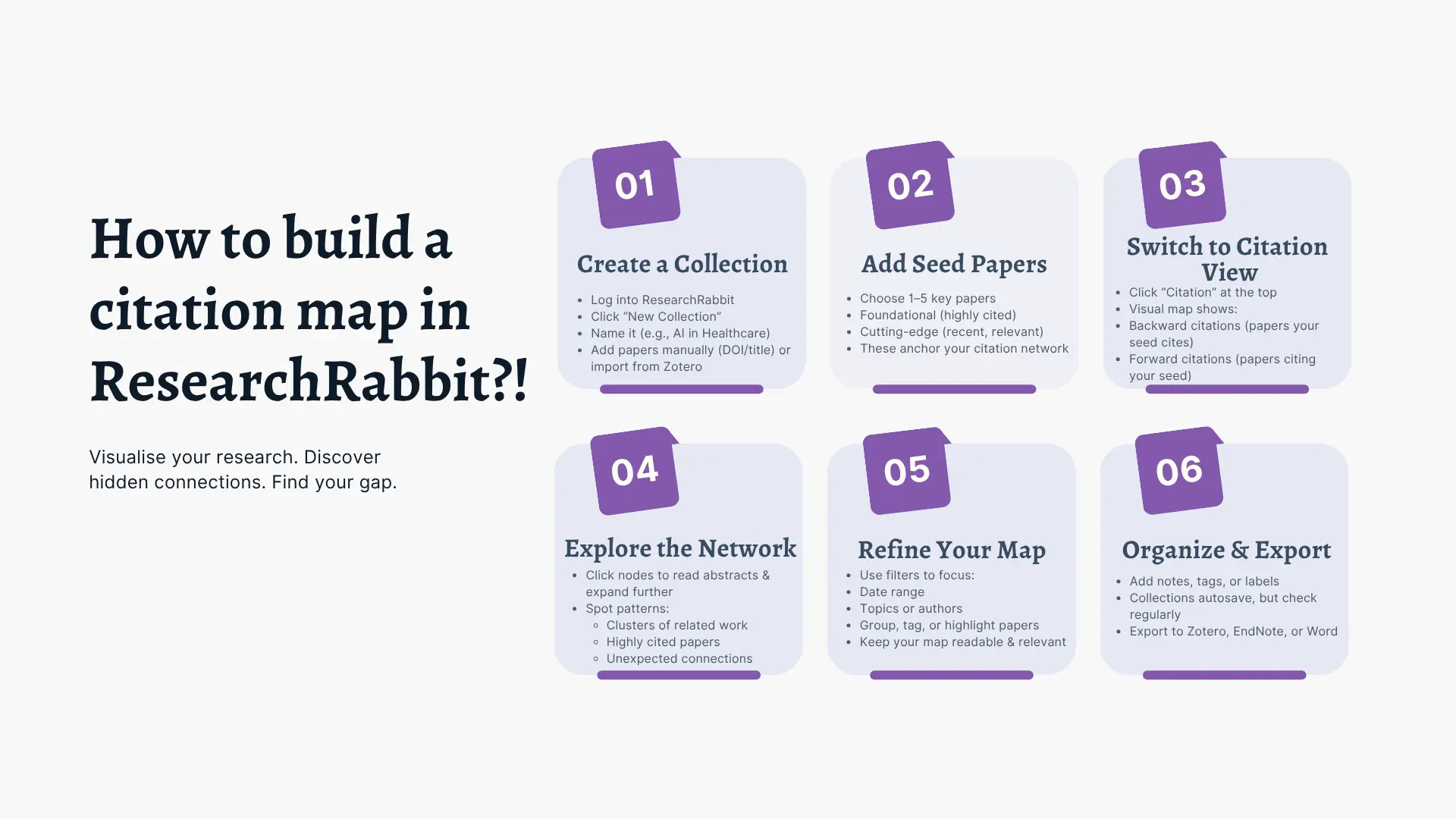
Using ResearchRabbit : If you have one or two relevant papers, add them to ResearchRabbit to visualize their citation networks. Add one relevant paper as a starting point. Explore its References to find earlier studies, Cited By to see newer work that builds on it, and Similar to find related papers you might miss with your original search terms. Compare the studies’ findings, populations, and methods to identify directions worth investigating, then read the relevant papers before claiming you've found a research gap.
Learn how to build your first citation map here.
Suppose your broad topic is social media and mental health. Exploring the literature might show that depression has been studied extensively, while certain relationships between social media use and anxiety, or particular populations, have received less attention.
That gives you a more informed starting point for your question.
Step 3: narrow your focus
Once you understand the research landscape, choose the dimensions that matter most to your study.
You might narrow your topic by:
- Population: Who are you studying?
- Variables or concepts: What specifically are you examining?
- Time period: Are you studying current behavior or change over time?
- Location: Does a particular country, region, or community matter?
- Context: Under what conditions does the phenomenon occur?
- Comparison: Are you comparing groups, interventions, or environments?
Here's how a broad idea can gradually become a more researchable question:
Too broad:
How is social media use related to body image satisfaction?
Narrower:
How is daily Instagram use associated with body image satisfaction among college students?
More specific:
Among female college students aged 18–22, how is daily Instagram use associated with body image satisfaction during one academic semester?
The goal isn't simply to make your question as narrow as possible. It's to make it specific enough to investigate while still meaningful enough to contribute something useful.
Step 4: choose the right question structure
The wording of your question should match what you're actually trying to investigate.
For exploratory questions, words such as how, why, what, and to what extent often work well:
How does remote work affect employee productivity?
What factors influence the adoption of AI tools among university researchers?
To what extent does peer support influence academic persistence among first-year students?
However, questions beginning with does, do, is, or can aren't automatically weak.
They can be appropriate for quantitative, comparative, and experimental studies when the variables, population, and relationship being tested are clearly defined.
For example:
Too vague:
Does exercise help people?
Researchable:
Does a 12-week aerobic exercise program reduce resting blood pressure among sedentary adults aged 50–65 compared with no structured exercise program?
The important question isn't whether your sentence starts with "how" or "does." It's whether the question clearly defines what you want to investigate and can be answered using an appropriate research method.
Step 5: check if It's researchable
Before committing to your question, make sure you can realistically answer it.
Ask yourself:
- Do I have access to the data or participants I need?
- Can I answer this within my available timeframe?
- Do I have access to the necessary tools or resources?
- Is the proposed research ethical and approved by my institution?
- Is there enough existing literature to establish the context for the study?
- Is the scope appropriate for my project?
For example:
Probably unrealistic for a student project:
How do different parenting styles affect child development from birth through adulthood?
Answering this directly could require decades of longitudinal data.
More feasible:
How are parenting styles during early childhood associated with emotional regulation at kindergarten entry?
Your research question should fit the resources, data, and time you actually have, not the project you wish you could conduct.
Step 6: revise for clarity
Finally, read your question as if you had never seen your project before.
Could another researcher understand what you're investigating without asking several follow-up questions?
Remove:
- Unnecessary jargon
- Multiple questions bundled into one
- Variables that aren't relevant to the main question
- Vague terms such as "significant," "important," "better," or "major" unless they're clearly defined
For example:
Before:
How do various social media platforms' different features impact the psychological wellbeing outcomes of users in different age groups?
After:
How is the use of short-form video platforms associated with anxiety levels among users aged 13–19?
The revised version gives the researcher much clearer boundaries.
What makes a good research question?
The FINERMAPS framework helps you evaluate whether your research question is well-formulated (Ratan, Anand, and Ratan's stepwise approach to formulation of research questions):
- Feasible: Realistic given your time, resources, and access to data or participants.
- Interesting: Genuinely compelling enough to sustain your engagement through the research.
- Novel: Investigates something new or explores an underexamined angle of existing knowledge.
- Ethical: Complies with institutional standards and minimizes harm to participants.
- Relevant: Addresses gaps or practical concerns meaningful to your field.
- Manageable: Appropriately scoped for your skills and available resources.
- Appropriate: Aligns with the methodological and ethical values of your discipline.
- Potential value and publishability: Has the capacity to inform practice, policy, or contribute new knowledge.
- Systematic: Structured with clear methods and logical sequence.
Example: Does the timing of aerobic exercise (morning vs. evening) affect blood pressure reduction differently in sedentary adults over 50? This question is feasible (measurable), interesting (practical health application), novel (specific timing angle), ethical (non-invasive), relevant (addresses health disparities), manageable (defined population), appropriate for clinical research, has publishable potential, and is systematic (clear methods).
Research question examples by type
The right structure depends partly on the kind of study you're conducting.
The right structure depends partly on the kind of study you're conducting. Use these examples to see how the wording changes with the research design.
Qualitative research question
Qualitative questions often ask how people experience or make sense of a phenomenon. Define the people and context, but leave room to explore answers you may not anticipate.
Template: How do [population] experience or perceive [phenomenon] in [context]?
Quantitative research question
Quantitative questions use measurable variables. Depending on the study design, they may examine an association, compare groups, or test an intervention. Be clear about what you will measure and whom you will study.
Template:
What is the relationship between [variable X] and [variable Y] among [population]?
Comparative research question
Comparative questions need clearly defined groups or approaches and a shared outcome you can assess across them.
Template: How does [outcome] differ between [group A] and [group B]?
Correlational research question
Correlational questions ask whether variables are associated. Use wording such as “associated with” or “related to” when your design cannot establish cause and effect.
Template: To what extent is [X] associated with [Y] among [population]?
Experimental research question
Experimental questions specify an intervention, a comparison condition, an outcome, and a population. This makes it clear what effect the study aims to test.
Template: Does [intervention] affect [outcome] compared with [comparison] among [population]?
A good research question doesn't need to follow one universal formula. Its wording should reflect the evidence you plan to collect and the kind of answer your study can support.
Research question examples in different fields
Psychology
Weak:
Does social media use affect mental health?
“Social media” could refer to many platforms, while “mental health” could mean anxiety, depression, sleep, or body image. The population is also undefined.
Stronger:
Among college students, is daily use of image-focused social media associated with body image dissatisfaction?
Why it’s stronger: It defines a population, a type of social media use, and one outcome.
Biology and environmental science
Weak:
How do pesticides affect biodiversity?
The question doesn't identify a pesticide type, the organisms being studied, or an ecosystem.
Stronger:
Is neonicotinoid insecticide concentration in soil associated with pollinator abundance in agricultural landscapes?
Why it’s stronger: It identifies what will be measured and where the study will take place.
Business and management
Weak:
Does remote work improve productivity?
“Productivity” is undefined, and the question doesn't specify which workers or work arrangements it compares.
Stronger:
Among software developers, is the number of remote-work days per week associated with project completion time?
Why it’s stronger: It defines the workforce, the aspect of remote work, and a measurable outcome.
Education
Weak:
Does using technology improve learning?
Both “technology” and “learning” are too broad to guide a study.
Stronger:
Among high school algebra students, does AI-adaptive tutoring improve test scores compared with teacher-led instruction alone?
Why it’s stronger: It specifies the tool, subject, population, outcome, and comparison.
Medicine and public health
Weak:
Do vaccines prevent disease?
The question doesn't specify a vaccine, population, health outcome, or timeframe.
Stronger:
Among immunocompromised adults aged 50 and older, is receiving an mRNA COVID-19 booster associated with a lower hospitalization rate over six months compared with not receiving a booster?
Why it’s stronger: It defines the population, exposure, comparison, outcome, and timeframe without assuming the result.
Pattern across disciplines: A focused question identifies what you're studying, whom or what you're studying, and the relationship or outcome you want to examine. You can investigate further factors through sub-questions if your project requires them.
How long should a research question be?
There's no universal word limit for a research question.
The goal is clarity, not a particular number of words. In many cases, one concise sentence is enough. More complex projects may require a primary research question supported by several sub-questions.
If your question contains multiple populations, outcomes, variables, contexts, and comparisons, you may be trying to fit several studies into one sentence.
For example:
Too broad:
In what ways do Instagram, TikTok, Snapchat, and Facebook affect depression, anxiety, self-esteem, and body image among teenagers, college students, and young adults, and how do demographic characteristics and usage patterns influence all of these relationships?
More focused:
How is daily short-form video use associated with anxiety among college-aged users?
You can then use secondary research questions to investigate additional variables if your study requires them.
Can you use ChatGPT or AI tools to generate a research question?
AI tools can be useful for brainstorming possible directions and refining the wording of a research question. ChatGPT and other AI tools can't replace grounding your question in existing research. See our guide on using AI in research for best practices.
For example, they can help you:
- Generate possible angles on a broad topic
- Compare alternative question structures
- Identify terms that may be too vague
- Rephrase a question more clearly
- Turn a broad idea into several possible questions
But an AI-generated research question isn't evidence that a genuine research gap exists.
A plausible-sounding question may already have an extensive body of research behind it, or it may be difficult to investigate with the data available to you.
Use AI-generated suggestions as starting points, then check them against the literature.
Take the concepts or questions that look promising and explore the relevant research. Citation networks can be particularly useful here because they let you move beyond individual search results and see how papers relate to one another.
The combination is more useful than either approach alone: AI can help you generate possibilities, while literature exploration helps you determine which possibilities are actually grounded in the research landscape.
Common mistakes when writing research questions
1. Asking multiple questions at once
Too broad:
How does social media affect sleep, academic performance, and mental health?
That's potentially several studies.
Choose the primary outcome or divide the project into a main question and clearly defined sub-questions.
2. Building your expected answer into the question
Leading:
How does remote work negatively affect productivity?
"Negatively" already assumes the direction of the relationship.
Neutral:
How does remote work affect employee productivity?
Let the evidence determine the answer.
3. Being too vague
Too vague:
What is the impact of technology on society?
Which technology? Which population? What kind of impact? In what context?
Narrowing these dimensions makes the question researchable.
4. Asking something already established
Research usually aims to investigate uncertainty rather than reproduce a basic factual answer.
Preliminary literature exploration helps you see what's already well established and where meaningful questions remain.
5. Making the question too narrow
Specificity is useful, but you can narrow a question so far that it becomes difficult to collect meaningful data or connect your findings to a broader body of research.
Your scope should match your research design and purpose.
Research question checklist
Before finalizing your question, ask:
- Can I explain the question clearly in one or two sentences?
- Is the population, phenomenon, or context sufficiently defined?
- Does the wording fit my research design?
- Could I realistically collect or access the evidence needed to answer it?
- Have I explored enough existing research to understand what's already known?
- Does the question avoid assuming its own answer?
- Is the scope appropriate for my available time and resources?
- Would another researcher understand what I'm investigating?
- Am I genuinely interested in finding out the answer?
That last question matters. You may spend months, or years, working with your research question, so it should be something you genuinely want to understand.
From your research question to your literature review
Your research question isn't the end of the research process. It gives your literature search direction.
Once you've developed a working question, use its main concepts to explore the literature more systematically. The next step is finding the sources that will build your literature review.
Start with papers that closely match your question. Then explore their references, citations, authors, and related research to understand the wider research landscape.
With ResearchRabbit, you can add your strongest starting papers to a collection and explore the citation network around them. As you discover relevant research, your understanding of the field will grow, and your research question may change with it.
That's normal.
Research questions often develop iteratively:
Broad topic → preliminary literature → working question → deeper literature exploration → refined question
Rather than trying to create the "perfect" question before reading the literature, treat your research question as something that becomes sharper as your understanding of the research landscape improves.
Key takeaways
- A research question turns a broad topic into a focused inquiry.
- Explore the existing literature before committing to your question.
- Narrow your topic by population, variables, context, time period, location, or comparison where relevant.
- Match the structure of your question to your research design rather than automatically avoiding words like "does" or "is."
- Make sure the question is clear, focused, researchable, and meaningful.
- AI can help generate and refine ideas, but potential questions should be checked against the existing literature.
- Use citation networks and related research to understand what's already known and where meaningful questions remain.
- Your research question often evolves as you explore the literature, expect to refine it, not perfect it on the first draft.
A strong research question doesn't usually appear fully formed. It develops as you move between your interests and the existing research, gradually narrowing the space between what we already know and what you still want to find out.
%20(800%20x%201036%20px).webp)





This is a big test comment on your article.