
Give every one of them the full ResearchRabbit+ toolkit. It builds real research skills, every recommendation can be traced back to its source, and you can try it with your own researchers before you commit.
Get in touch
Most search tools give researchers a list. ResearchRabbit treats papers as a network, with the tools to filter, analyze, and keep up to date as a literature review grows.
Start from papers you know, by keyword, title, or DOI, or bring in a Zotero collection.
See what came before, what came next, and the papers you’ve missed, on a live map.
Narrow a big batch of results to a set worth reading, and check Article Risk Indicators before you cite.
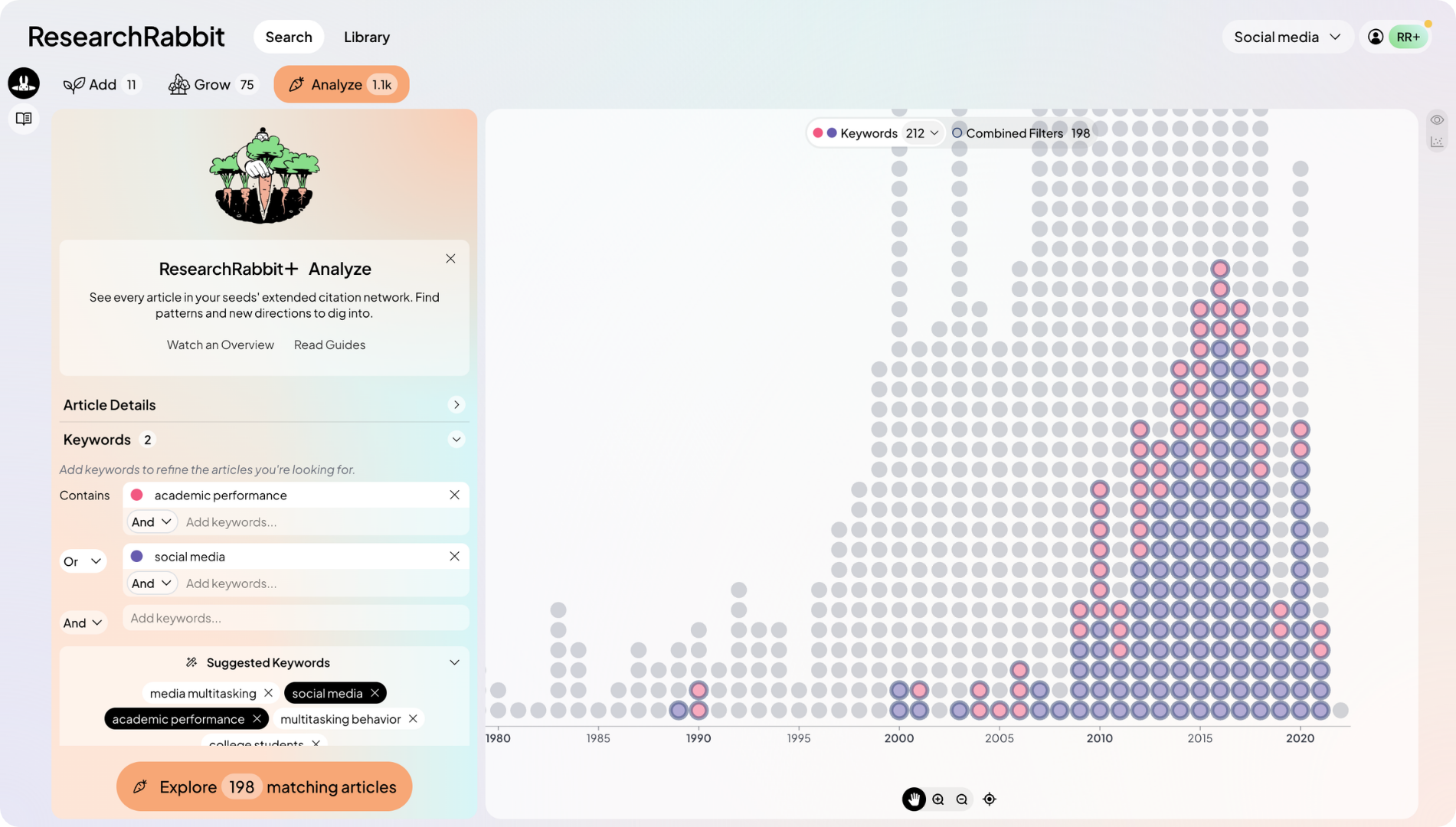
See the whole network on one chart, then hunt for gaps and probe unexpected cross-overs.
Collections and notes sync both ways with Zotero, and Alerts show new research as it comes in.
Recommendations come from the citation network itself, not from AI writing answers. Researchers still do the thinking, and every step is easy to explain.
No hallucinations. Every recommendation is a real article, found through citation and authorship links you can trace.
Easy to explain and repeat. Researchers can show how they found each paper, which supports a clear search method.
Article Risk Indicators flag retractions, unusual citation patterns, and AI-generated content before anyone cites.
“Iterative chaining without the clutter: ResearchRabbit shipped its biggest update in years, a cleaner iterative “rabbit hole” flow and a more configurable citation graph.”

More than a license: we help you get ResearchRabbit working for your researchers.

Anyone with your institution email gets the full ResearchRabbit+ toolkit, with nothing to install.

See how researchers at your institution are using ResearchRabbit, so you can show its value.

A live onboarding webinar, recorded for anyone who can’t make it, plus short guides and videos to share.

24/7 help in the app, backed by a real person, and a named contact on our team.
Build a starter collection once and share it with a class, a lab, or a cohort, so everyone begins from the same foundation.
Using ResearchRabbit in your teaching
You see it working with your own researchers before you decide.
A 30-minute call to see ResearchRabbit in your field, including how many of your researchers already use it.
We switch on a ResearchRabbit+ trial for your institution so researchers can try it in their own work.
We run an onboarding webinar for your researchers and share short guides and videos.
Near the end of the trial we share how it was used and talk through what access would look like.
Once you decide, we switch on full access for everyone with your institution email.
Librarians want AI they can trust and explain, and tools that keep the good friction in research.
Teach skills, not just tools, and make it work for every student, not just some.
Twice a year: how to teach ResearchRabbit, a ready-made toolkit, and stories from other libraries.
Save your spot →We switch it on for your email domains. Researchers sign in with their institution email.
No, it works alongside them. Papers link to open access PDFs or to the publisher through your library login.
Using ResearchRabbit alongside library databases →Yes. Every recommendation comes from a citation or author link they can see.
How ResearchRabbit uses the citation network →Yes. Collections sync both ways with Zotero, and you can import from and export to EndNote, Mendeley, or any other reference manager.
Import from your reference manager →320+ million articles from Semantic Scholar and OpenAlex, updated twice a week.
The ResearchRabbit database →No. We don’t sell user data or use it to train our AI models.
How we use AI, and where we don’t →On Amazon Web Services in the US, encrypted in transit and at rest, with regular backups.
Data responsibility at a glance →Nothing to install and no access to your networks. We’ll send our security overview for review.
Tell us a little about your institution and we’ll be in touch to arrange a call.